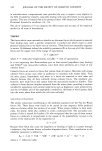
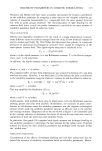
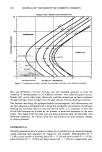
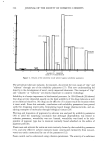
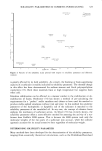
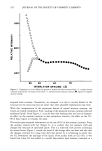
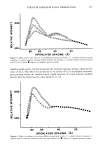
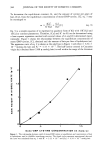
STRATUM CORNEUM X-RAY DIFFRACTION 353 z LU I- Z LU LU 600- 400, a'o ' Jo ' 4'o 3'0 INTERLAYER SPACING (.•,) Figure 3. Effect of G2 with time on x-ray diffraction spectrum of skin. ¸, untreated normal stratum corneum [•, normal stratum corneum treated with G2 for one hour /•, normal stratum corneum treated with G2 for 13 hours O, regions of complete spectral overlap. lameliar liqu!d crystal, the G2 dominated the interlayer spacing, giving a characteristic value of 45 A. This effect was attributed to the ability of G2 to accomplish extremely good packing within the lameliar liquid crystal structure of a lipid mixture modeled exactly after the blend found in skin lipids (6,11, 12). 600 400 0ø% o o o o AA 0 øøOo A 0 A A 0 ! I 80 •'o 4:0 3'o INTERLAYER SPACING (•,) Figure 4. Effect of soybean oil on x-ray diffraction spectrum of skin. ¸, normal stratum corneum /•, normal stratum corneum treated for one hour with soybean oil O, region of complete spectral overlap.

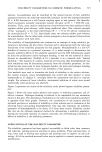
354 JOURNAL OF THE SOCIETY OF COSMETIC CHEMISTS It is essential to realize the difference between the influence on skin lipids by a fatty oil (a liquid triglyceride such as soybean oil) and by G2. Stratum corneum treated with soybean oil (Figure 4) showed little difference in lipid interlayer spacing, while treat- ment with G2 caused a new band to appear at 30-45 fk. Hence, the comparison of soybean oil-treated stratum corneum with G2-treated stratum corneum demonstrates that the 30-45 /ix band is neither the result of G2's triglyceride structure nor trace impurities remaining in the purified G2. From the studies of G2 treatment on washed stratum corneum, we find that G2 can interact with the stratum corneum even after the bulk of the lipid has been removed by washing. This is concluded after comparison of the 30-45 A band for G2-treated stratum corneum with the 30-45 fk band of G2-treated stratum corneum after washing (Figure 1). It is also shown that most of the lipid structural change caused by G2 is removed with the lipids during washing, since the spectrum for stratum corneum washed after treatment was identical to washed untreated stratum corneum. SUMMARY From the small-angle x-ray diffraction study of human thin skin stratum corneum, it is proposed that the broad diffraction band from 50-80/ix is due to epidermal lipids. Whereas washing removes epidermal lipids, treatment with G2 changes the packing structure of epidermal lipids. It is proposed that this interaction is the primary source of the skin-softening properties of G2. This interaction can occur even after removal of epidermal lipids by washing however, when the stratum corneum is washed after treatment with G2, the characteristic x-ray reflection caused by addition of G2 was removed. REFERENCES (1) (2) (3) (4) (5) (6) (7) (8) (9) (lO) (11) (12) G. Swanbeck, Macromolecular organization of epidermal keratin, Acta Dermato-Venerelogica, 39, 1- 37 (1959). G. Swanbeck and Nils Thyresson, A study of the state of aggregation of the lipids in normal and psoriatic horny layer, Acta Dermato-Venerelogica, 42, 445-457 (1962). L. A. Goldsmith and H. P. Baden, Uniquely oriented epidermal lipid, Nature, 225, 1052-1053 (1970). G. L. Wilkes, An-Lac Nguyen, and R. Wildnaver, Structure-property relations of human and neo- natal rat stratum corneum. I. Thermal stability of the crystalline lipid structure as studied by x-ray diffraction and differential thermal analysis, Biochimica et Bio-Physica Acta, 304, 267-275 (1973). A.M. Kligman, "The Biology of the Stratum Corneum," in The Epidermis, W. Montagna and W. C. Lobitz, Jr., Eds. (Academic Press, New York, 1964), pp 387-433. D. T. Downing, J. S. Strauss, and P. E. Pochi, Variability in the chemical composition of human skin surface lipids,J. Invest. Dermatol., 53, 322 (1969). B. A. Gilchrest, Skin and Aging Processes (CRC Press, Inc., Boca Raton, Florida, 1984), p 39. M. A. Lampe, M. L. Williams, and P.M. Elias, Human epidermal lipids: Characterization and modulations during differentiation, J. Lipids Res., 24, 131-140 (1983). S. E. Friberg and D. W. Osborne, A lameliar liquid crystal as an in situ surface balance. II. The conformation of a glyceridacid, Colloids and Surfaces (in press). D. W. Osborne, Ph.D. dissertation (under preparation). E. Haahti, Major lipid constituents of human skin surface with special reference to gas-chromato- graphic methods., Stand. J. C/in. Lab. Invest., 13 (Suppl. 59), 1-108 (1961). H. J. O'Neil, L. L. Gershbein, and R. G. Scholz, Identification of pristance in human sebum and related lipid sources, Biochem. Biophysical Res. Comm., 35, 946-952 (1969).
Purchased for the exclusive use of nofirst nolast (unknown)
From: SCC Media Library & Resource Center (library.scconline.org)