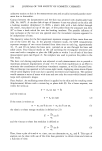
SUNSCREEN SUBSTANTIVITY 357 into a comparison sunscreen solution. The amount of each sunscreen deposited on each subject's skin was obtained by weighting the solutions before and after the introduction of the hands. Hands were allowed to air dry for 35 min and then submerged in distilled water at 25øC for 30 min. Hands were again air dried and, finally, dipped into IPA at 50øC for 2 min. Aliquots of the IPA solution were read by spectrophotometer, thus obtaining the amount of screen remaining on the skin after the water treatment. The substantivity of the screen was estimated using the following equation: S%= amount of screen (mg) recovered x 100 amount of screen (mg) deposited initially on the skin In the spectrophotometric analysis PABA was read at 289 nm and both Escalol 507 © and Amerscreen "P"© at 310 nm using a Carl Zeiss M4 Q III spectrophotometer. DETERMINATION OF SUBSTANTIVITY IN VITRO Experiments were performed utilizing human keratin and ethanol as solvent because preliminary experiments proved that there were no differences in the results when using either IPA or ethanol. The concentration ranges for each sunscreen were established between those at which the affinity of the material for the skin remains constant, determining in each case the sorption isotherm. The values obtained for the three substances were: PABA, 80-115 mg% Escalol 507 ©, 80-120 mg% and Amerscreen "P"©, 80-120 mg%. Once the concentration range was selected, the substantivity was determined using the procedure described by Bottari et al. (1), modified by us as follows: A 100-mesh stainless steel basket containing 0.1 g of human keratin powder was placed in a flask with 20 ml of water and held 40 hr in a thermostatically controlled shaker bath, to allow hydration of the keratin. Hydration of the keratin previous to the treatment with the sunscreen was necessary. Experiments performed without previous hydration failed. The material was then allowed to dry at 20øC for 30 min. The following sunscreen solutions in ethanol were prepared: PABA, 85-90-105 mg% Escalol 507 ©, 100-110-120 mg% and Amerscreen "P"©, 80-110-120 mg%. Twenty ml of sunscreen solution were placed in a glass flask and the stainless steel basket containing the previously hydrated keratin was then added. The flask was stop- pered, sealed, and held for 72 hr in a thermostatically controlled shaker bath at 37øC. The solution was then filtered using a millipore H.A.-type filter and and assayed by spectrophotometer. The basket containing the keratin was then allowed to dry at 30øC for 30 min. After drying, the basket with the keratin was placed in a glass flask containing twenty ml of distilled water. The stoppered and sealed flask was held for 48 hr in a thermo- statically controlled (25 -+ iøC) bath. At the end of this time the basket was taken from the solution and allowed to dry for 60 min at 30øC. Finally, the basket containing the keratin was placed into a glass flask with twenty ml of ethanol. The flask was stoppered, sealed, and shaken in a constant temperature bath at 50 -+ iøC for 24 hr. The resultant solution was filtered and assayed by spectropho- tometer.

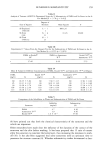
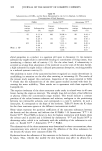
358 JOURNAL OF THE SOCIETY OF COSMETIC CHEMISTS The K values for the sorption isotherms at 37øC were calculated according to Bottari (!) using the following equation: Ck K- Cs where Cs is the equilibrium concentration of the sunscreen in the solvent and Ck is the concentration of the sunscreen in the keratin substrate. The percentage of substantivity was calculated as indicated for the in vivo method. STATISTICAL ANALYSIS The differences in substantivity obtained in the in vivo method were examined using an analysis of variance (ANOVA) (7) and the test of Dunnett (8). RESULTS Table I shows the percentages of substantivity obtained for the three sunscreens in the in vivo studies. Tables II and Ill contain the ANOVA of the data and application of the Dunnett's significant differences test, respectively. Table IV shows the mean K values for different concentrations of PABA, Escalol 507 ©, and Amerscreen "P"©. In Table V a comparison of the solubilities in water and percentages of substantivity of PABA and its esters determined by the in vivo method can be seen. Table VI shows the percentages of substantivity obtained for the three sunscreens by the in vitro method. It can be seen that there are very significant differences between the substantivity found for Escalol 507 © and those obtained for the other two substances but that there are no significant differences between PABA and Amerscreen "P"©. DISCUSSION The mechanism of the interaction of the sunscreen substances and the skin have not been established clearly. It is known that there are several factors involved. Sayre eta/. Table I Substantivities of PABA and Its Esters Determined by the In Vivo Method Substantivity (%) Subject # PABA Escalol 507 © Amerscreen "P"© 1 0.29 57.5 0.58 2 0.28 58.2 0.39 3 0.32 58.5 0.46 4 0.30 57.4 0.41 5 0.27 57.5 0.56 6 0.32 57.2 0.46 7 0.36 58.6 0.46 8 0.29 58.8 0.37 Mean -+ SD 0.30 --+ 0.03 57.96 -+ 0.63 0.46 - 0.08
Purchased for the exclusive use of nofirst nolast (unknown)
From: SCC Media Library & Resource Center (library.scconline.org)