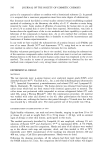
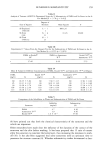
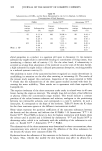
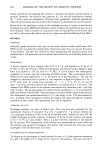
HAIR BIS-DINITROPHENYL CYSTINE INTERCHANGE 365 the solution for 30 minutes. Then it was transferred to a centrifuge tube and centrifuged for 10 minutes at 1000 G. The tube had a wire mesh platform in the middle section to prevent the centrifuged hair from mixing with the liquid. Immediately following the centrifugation, the weight of the hair sample was determined. Then the hair sample was dried in a 105øC oven for 2 hours. When the sample was cooled, it was weighed again. The percentage of liquid retained was calculated from the difference of wet and dry weights divided by the dry weight. RESULTS AND DISCUSSION DETERMINATION OF THE EQUILIBRIUM CONSTANT The disulfide interchange reaction is very slow in hydrochloric acid having a concen- tration below 9N (2). In determining the concentration of Mono-DNP-cystine in the reacting solution, the acid concentration was diluted to about 2.4N during extraction. Therefore, because the reaction was stopped in the separation process, the concentration of mono-DNP-cystine should not be affected by removal of bis-DNP-cystine during the procedure. The reaction reached equilibrium in about 20 days. At equilibrium, the concentration of each species in the reacting solution may be expressed by [C] 2 k• - - K (eq. 2) [A][B] k2 where kx and k 2 are the forward and reverse reaction rate constants and K is the equilibrium constant. The other parameters, A, B, and C, are species shown in eq. 1. Under the chosen conditions, the solution was saturated with bis-DNP-cystine (B) throughout the experiment the concentration of B was constant at 1.3 m mole/1 (4). From the law of mass conservation, the concentration of cystine ([A]) is [A] = [A]0 - 0.5[C] (eq. 3) where [A]0 is the concentration of A at t = 0, i.e., the amount of cystine in hair keratin. It may be rewritten as [A]0 = m[Cy] (eq. 4) where [Cy] is the amount of cystine in ! g of hair and m is the weight of hair per liter of hydrolysate. Eq. 2 can then be reduced to [C] 2 = K'(m[Cy] - 0.5[C]) (eq. 5) where K' = K[B] (eq. 6) The solution for eq. 5, i.e., the concentration of mono-DNP-cystine at equilibrium, would be [C] = 0.5(-0.5K' + Q) (eq. 7) where Q = (0.25K '2 4- 4K' m[Cy]) •/2 (eq. 8)

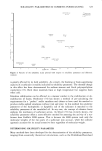
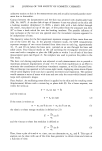
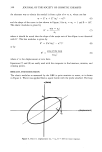
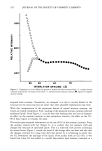
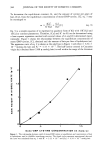
366 JOURNAL OF THE SOCIETY OF COSMETIC CHEMISTS To determine the equilibrium constant, K, and the amount of cystine per gram of hair, ICy], from the equilibrium concentration of mono-DNP-cystine, [C], eq. 5 may be rearranged to [C] 2 0.5 m - K'[Cy] + [•yy] [C] (eq. 9) Eq. 9 is a simple equation of m expressed in quadratic form of [C] with 1/K'[Cy] and 1/ICy] as constant parameters. Therefore, ICy] and K' (or K) can be determined using a least squares regression method with several values of m and [C] determined exper- imentally. Figure 1 shows the relationship between the equilibrium concentration of mono-DNP-cystine, [C], obtained and the amount of hair per liter of hydrolysate (m). The regression curve of eq. 9 is shown as the solid line in Figure 1 with [Cy] = 6.54 X 10 -4 mole/g dry hair and K' = 3.33 X 10 -3. The half-cystine content in Caucasian virgin hair obtained here (1308 }x mole/g hair) is well within the range of the literature 1.5 .5 0 .5 i 1.5 mono-DNP CYSTINE CONCENTRATION (m mole/L) Figure 1. The relationship between yield of mono-DNP-cystine at equilibrium and concentration of hair in hydrolysate used in disulfide interchange reaction. The closed circles represent experimental data and the curve was calculated from eq. 5 with K' = 3.33 X 10 -3 and ICy] = 6.54 X 10 -4 mole/g hair.
Purchased for the exclusive use of nofirst nolast (unknown)
From: SCC Media Library & Resource Center (library.scconline.org)