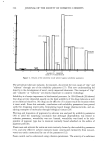
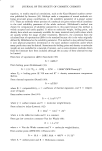
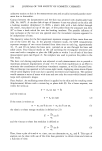
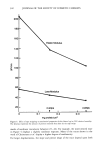
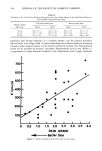
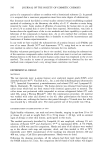
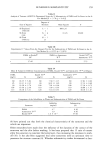
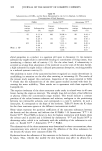
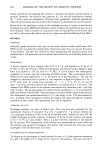
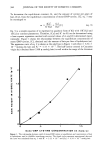
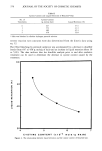
HAIR BIS-DINITROPHENYL CYSTINE INTERCHANGE 369 CYSTINE CONTENT IN OXIDIZED HAIR Figure 3 depicts rates of mono-DNP-cystine production for hair at different levels of peroxide treatment. The amount of mono-DNP-cystine formed is related proportionally to the level of the treatment. This indicates an increase in the disulfide bonds broken as the hair was subjected to more oxidation. The cystine concentration in the oxidized keratin fibers could be calculated from the concentration of mono-DNP-cystine at equilibrium using eq. 5 and the equilibrium constant obtained above. The amounts of hair used, the concentration of mono-DNP-cystine at equilibrium, and the calculated cystine contents are listed in Table I. The rates of mono-DNP-cystine formation as a function of time for the bleached hair are shown in Figure 3. The curves in the figure are calculated from eq. 12 using the same reaction rate constants (k• and k2) as for the virgin fibers. It can be seen that good agreement (r = 0.988, t = 23.14) exists between the experimental data for the oxidized hair and the rates predicted using the constants derived from untreated hair. In the peroxide bleaching process, the perhydroxy anion (HO2-) is the reactive species, and its attack on hair keratin appears to be focused on the disulfide bond (6). As the cystine content decreases, there is a corresponding increase in cysteic acid which is the only established major end product of the oxidative cleavage (7,8). Any other reaction intermediates formed would be unstable under alkaline conditions and would revert to cystine and cysteic acid during hydrolysis. The conversion of the disulfide group to two more hydrophilic cysteic acid groups will increase the liquid retention of the oxidized hair fiber (9). The disulfide concentrations and the corresponding liquid retentions for the peroxide bleached hair fibers are listed in Table II and shown in Figure 4. As expected, the disulfide concentration decreases and the liquid retention increases when the number of treatment increases. CONCLUSION Sanger's (1,2) experience in producing a mixed disulfide from the reaction of two symmetric disulfides was successfully applied to hair keratin disulfide analysis. Using eq. 5 with different amounts of hair in the hydrolysate and the corresponding equilib- rium concentrations of the mixed disulfide formed, the cystine content in hair and the equilibrium constant for the exchange reaction were determined. The forward and the Table I Experimental Results and Calculated Cystine Content* for Bleached Hair Number Amount of Hair Con. of Mono-DNP Cystine of in Hydrolysate at Equilibrium Treatments m (g/l) [C] (m mole/l) Calculated Cystine Content in Hair [Cy] (• mole/g hair) 0 0.20184 0.245 1 0.21216 0.211 3 0. 2086 0. 187 5 0.2204 0. 181 647 553 489 450 * Using eq. 5 with K' = 3.33 X 10 -3.

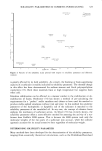
370 JOURNAL OF THE SOCIETY OF COSMETIC CHEMISTS Table II Cystine Content and Liquid Retention of Bleached* Hair No. of Cystine Content Treatments (ix mole/g hair) Liquid Retention (%) 0 647 37.5 1 553 41.3 3 489 45.3 5 450 52.8 * Hair was bleached in alkaline hydrogen peroxide solution. reverse reaction rate constants were also determined from the kinetic data using eq. 12. Hair fiber bleaching by peroxide oxidation was accompanied by a decrease in disulfide bonds (from 647 to 450 p• mole/g of hair) and an increase in liquid retention (from 38 to 53%). The data indicate that the disulfide analysis prior to and after oxidative treatment can be used to determine the decrease in cystine content caused by the treatment. 60 50 40 30 i 4 $ CYSTINE CONTENT (x 10 -4 mol©/g HAIR) Figure 4. The relationship between liquid retention and the cystine content of bleached hair.
Purchased for the exclusive use of nofirst nolast (unknown)
From: SCC Media Library & Resource Center (library.scconline.org)