HAIR BIS-DINITROPHENYL CYSTINE INTERCHANGE 371 ACKNOWLEDGEMENTS The authors thank Ms. I. Cushman for preparing hair samples and determining liquid retention values and Mr. S. Pozzi for statistical evaluation of data. REFERENCES (1) F. Sanger, A disulfide interchange reaction, Nature, 171, 1025-1026 (1953). (2) A. P. Ryle and F. Sanger, Disulfide interchange reactions, Blochem. J., 60, 535-540 (1955). (3) R. E. Benesch and R. Benesch, The mechanism of disulfide interchange in acid solution: Role of sulfonium ions, J. Am. Chem. Soc., 80, 1666-1669 (1958). (4) A. N. Glazer and E. L. Smith, Estimation of cystine and cysteine in proteins by disulfide interchange reaction, J. Bio/. Chem., 236, 416-421 (1961). (5) L. J. Wolfram "The Reactivity of Human Hair. A Review," in Hair Research, C. E. Orfanos, W. Montagna, and G. Stuttgen, Eds. (Springer-Verlag, New York, 1981) p 479. (6) C. R. Robbins and M. K. Bahl, Analysis of hair by electron spectroscopy for chemical analysis, J. Soc. Cos. Chem., 35, 379-390 (1984). (7) H. Alter and M. Bit-Alkhas, Infrared analysis of oxidized keratin, Text. Res. J., 39, 479-481 (1969). (8) J. Nachtigal and C. R. Robbins, Intermediate oxidation products of cystine in oxidized hair, Text. Res. J., 40, 454-457 (1970). (9) L. J. Wolfram, K. Hall, and I. Hui, The mechanism of hair bleaching, J. Soc. Cosmet. Chem., 21, 875-900 (1970).

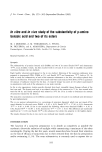
j. Soc. Cosmet. Chem., 36, 373-374 (September/October 1985) Letter to the Editor TO THE EDITOR: Various chemical assay methods have been described for pyrithion salts since the in- troduction of zinc pyrithion (ZPT) as an antidandruff agent in 1963 (1, 2 and the references therein). However, there does not appear in the literature to be any simple, convenient method of determining ZPT in situ on the hair. The demonstration of ZPT binding to hair and the development of a method for assessing subsequent release during rinsing are the subjects of this letter. 250 ml Sabouraud-dextrose agar (Oxoid) inoculated to give approximately I X 106 cells/ml Candida albicans NCPF 3179 (ATCC 10231) were poured into a 25-cm square antibiotic assay plate giving a depth of approximately 4 min. Eight ZPT aqueous suspensions (Pyrion-Chemie, W. Germany) were prepared in doubling dilutions be- tween 200 and 1.56 •g ml-•, and 0.1 ml of each suspension was placed in each of 8 cavities on the assay plate in a Latin square design. Following overnight incubation at 35 ø the mean zone diameters were calculated for the eight suspensions and the square of these values plotted (on the ordinate) against logarithm of the concentration: a linear relationship between 1.56 and 25 •g ml-• resulted. Slight day-to-day variation in the calibration plot occurred, but a typical line was that represented by the equation y = 283x + 172 (correlation coefficient 0.998, which exceeds the tabulated value of 0.991 for p = 0.001). Using a similar procedure, inhibition of Pityrosporum ovale was ob- served, but the zones, although larger, were less clearly defined and growth was slower. .100 mg finely cut unwashed human hair was immersed in 5 ml supernatant liquid from a 20 mg ml -• ZPT aqueous suspension for 15 rain at room temperature and centrifuged at 2000 X g for 10 min. The hair was washed once in 5.0 ml water, recentrifuged, suspended in 1.0 ml water, and 0.1 ml of this suspension placed in 8 wells on the assay plate. The mean inhibition zone created was equivalent to that resulting from a 5.5 •g ml-• suspension. No antimicrobial activity was observed either in suspensions of untreated hair or in the water used for rinsing hair treated and centrifuged as described above. This indicates that the activity in treated suspensions was due to ZPT adsorbed onto the hair rather than to "carry-over" in the suspending medium. When 8 such 100-rag hair samples were individually determined, the coef- ficient of variation for the calculated equivalent ZPT suspensions was 11.9% (mean 2.0 •g ml- •). Four 100-mg hair samples were similarly treated but subjected to one, two, three, and four X 3-ml water washes respectively. This resulted in the second, third, and fourth samples exhibiting zones equivalent to ZPT concentrations which were 88, 55, and 50% of that due to the single-washed sample. The results indicate that ZPT is adsorbed onto hair and is subject to limited removal on repeated washing. The observed zones of inhibition must, therefore, have been created following the desorption of ZPT from 373
Purchased for the exclusive use of nofirst nolast (unknown)
From: SCC Media Library & Resource Center (library.scconline.org)