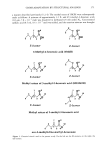
372 JOURNAL OF COSMETIC SCIENCE to reflux for 1.5 h. Reaction progress was monitored by aliquot workup and gas chro- matography (Perkin-Elmer 990 GC 30-m x 0.52-mm (i.d.) column with 1.0-1a coating of Stabilwax [Restek, Bellefonte, PAl held at 100øC for 17 minutes and programmed at 6øC per minute to 200øC). The reaction mixture was poured into chilled water. Dichloromethane was added, and the aqueous phase was basified to pH 8 with sodium bicarbonate. The organic compo- nents were extracted into dichloromethane (2 x 25 ml) and distilled. Separation of the acids from the esters was accomplished by column chromatography through silica gel with dichloromethane doped with 1% NH4OH as eluent. Analysis of the acid-free ester mixture was performed by combined gas chromatography/ mass spectrometry (GC/MS Finnigan/MAT 4510) utilizing the same chromatographic conditions described above. This analysis indicated that in addition to the desired methyl esters, a small amount of three other products derived from double-bond mi- gration to the 3- and exo-position were present. These data indicated that the following percentages of methyl esters were present: E (56.7%)-and Z (17.6%)-3-methyl-2- hexenoates and the remaining 25.7% consisting of the E, Z-3-methyl-3-hexenoates (16.3%) and exo-3-methylidine-methyl-hexenoate (9.4%). We did not attempt to fur- ther separate the isomer mixture and used it as the cross-adapting stimulus. STIMULI PRESENTATION Odorants were diluted in odorless, light, white, mineral oil and presented in 270-ml polypropylene squeeze-bottles with plastic, flip-top caps. Each bottle contained 10 ml of the odorant/mineral oil solution. A twelve-step binary dilution series was prepared for each odorant. Initially, 20 mg of each odorant was diluted in 20 ml of odorless, light, white, mineral oil to yield a 1 mg/ml (0.1% w/v) solution with molar concentrations of 7.81 mM for 3M2H and 7.04 mM for ME3M2H. The dilution scheme for each odorant was the same, ranging from 1.0 x 10 -• w/v (step 12) to 4.88 x 10⁻⁵% w/v (step 1). Subjects were tested in two 30-minute sessions using a procedure described previously (3,9,10). Briefly, a forced-choice, staircase procedure was used at the beginning of each session to equate intensities of the test stimuli for each subject. A two-minute rest was imposed following perceptual matching. Subjects then rated, using magnitude estima- tion, the intensities of step 10 of the adapting stimulus and the intensity-matched concentration of the other test odorant. Subjects assigned numerical ratings to each of these two stimuli twice. If the means of the magnitude estimates for each odor were dissimilar (greater than 20% discrepancy), the matching procedure was repeated. In this manner, initial magnitude estimates ensured that the two stimuli were perceptually equivalent for that subject. Thus, in a given session, the test odorants were step 10 of the odorant for adaptation and the concentration of the other odorant judged to be most similar in intensity by the individual subject the stimulus used for adaptation was a fourfold higher concentration (i.e., step 12) than the test stimulus. After making the initial magnitude estimates, subjects began to sniff repeatedly the adapting stimulus. Every 15 seconds during this adaptation period, subjects sniffed and rated a test stimulus between sniffs of the adapting stimulus. The test stimulus, either 3M2H or ME3M2H, alternated on sequential trials so that subjects made a total of 20

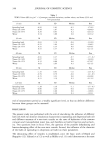
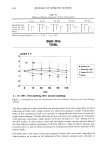
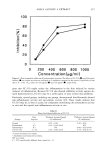
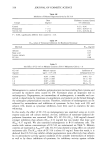
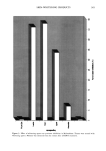
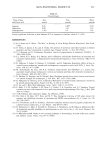
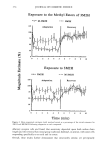
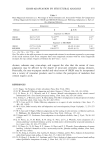
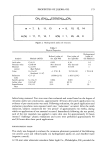
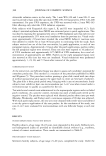
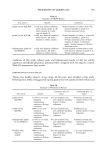
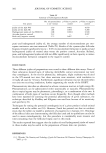
CROSS-ADAPTATION BY STRUCTURAL ANALOGS 373 ratings (ten 3M2H, ten ME3M2H) during the five-minute adaptation period. Following these ratings, the adapting stimulus was removed and subjects continued to rate test stimuli every 15 seconds during a five-minute post-adaptation period. Subjects thus made a total of 20 ratings during this recovery period. In the second session, the adapting odorant, either 3M2H or ME3M2H, was reversed and the procedure repeated. The adapting odorant used in a particular session was counterbalanced across sessions for all subjects. Each magnitude estimate was converted to a percentage of the initial magnitude esti- mate for that odorant the resulting percentages are presented in Figure 2. These data were analyzed by a series of repeated, single-factor ANOVAs a separate analysis was performed for each comparison. The ANOVAs were calculated after each estimate was first subtracted from 100, allowing an assessment of whether estimates were signifi- cantly different from the initial estimates (100%). RESULTS Both 3M2H and ME3M2H showed significant self-adaptation (Table I). The pattern of self-adaptation observed was consistent with a pattern we have observed previously (3,10) strong self-adaptation occurred quickly and continued for the duration of the adaptation period. Following removal of the adapting odorant, each self-adapted odorant displayed a pattern of recovery to baseline levels (Table I). Significant cross-adaptation between 3M2H and ME3M2H was observed asymmetri- cally. Exposure to ME3M2H significantly reduced the perception of 3M2H via cross- adaptation, but there was no effect of 3M2H exposure on the perception of ME3M2H (Table I Figure 2). DISCUSSION These results suggest that the cross-adaptation relationship previously observed between 3M2H and its ethyl esters (10) may be a general one, as the methyl esters displayed a strikingly similar pattern of effectiveness in reducing the perception of 3M2H intensity. Thus, the initial reduction in perception following 15 seconds of exposure (35.0% following exposure to EE3M2H vs 36.5% following ME3M2H exposure), the shape of the adaptation curve, and the overall reduction in perceived odor intensity (mean re- duction of 35.1% following EE3M2H exposure 34.3% following ME3M2H) are con- sistent between the ethyl and methyl ester exposures. In addition, this similarity was seen even though the methyl ester mixture contained three minor components whose homologues were not present in the ethyl ester mixture previously employed (10). Also of note is that a significant reduction in the perception of 3M2H was achieved by the methyl ester mixture this level of reduction was not seen either with the EE3M2P or EE3M20, which are stronger smelling, fruity homologues of EE3M2H (10). Subsequent studies will include a purified mixture of only the E-Z-methyl ester isomers and/or the E- and Z-isomers alone, as per our previous studies (9). These results, suggesting a possible receptor interaction for an acid and its esters, have a neurophysiological parallel. Sato et al. (15) examined tuning specificities in mouse
Purchased for the exclusive use of nofirst nolast (unknown)
From: SCC Media Library & Resource Center (library.scconline.org)