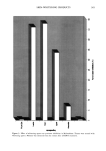
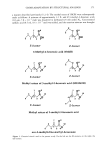
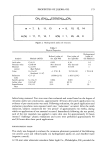
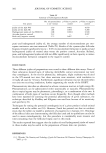
370 JOURNAL OF COSMETIC SCIENCE degree of similarity, either perceptual or structural, between the tested odorants. There is a good deal of evidence demonstrating that perceptual similarity affects cross- adaptation since perceptually similar odorants, irrespective of structural similarity, cross- adapt (1-5). Conversely, structurally similar odorants, irrespective of perceptual simi- larity, can cross-adapt as well (6-10). One system we have used to study structural similarity and cross-adaptation (10) is an isomeric mixture of (E)- and (Z)-3-methyl-2-hexenoic acid (3M2H). Both isomers are present in axillary sweat of males and females, albeit in different ratios (11,12). The E-isomer of 3M2H is a major component (analytically) in male underarm sweat (11,13). A synthetic mixture of the two isomers was formulated in the 10:1 E:Z ratio found in the male secretions (11,13) and tested for cross-adaptation with three homologous ethyl esters: the ethyl esters of 3-methyl-2-hexenoic acid (EE3M2H), 3-methyl-2-octenoic acid (EE3M20), and 3-methyl-2-pentenoic acid (EE3M2P). The esters, in contrast to the volatile sweaty-smelling organic acids, are pleasant and fruity-smelling. Significant cross-adaptation was observed between 3M2H and its ethyl esters (10) since exposure to EE3M2H resulted in significantly reduced magnitude estimates for the intensity of 3M2H. Cross-adaptation was asymmetric adaptation to 3M2H did not significantly affect the perceived intensity of EE3M2H. Further, there was no significant cross-adaptation between 3M2H and the ethyl esters of the lower (EE3M2P) and higher (EE3M20) molecular weight homologues (10). Similarity ratings between the ethyl esters and 3M2H revealed no significant differences among the ethyl esters in their mean similarity rating to 3M2H i.e., each was rated equally dissimilar to 3M2H (10). Thus, it is unlikely that the differences among the ethyl esters in their efficacy in cross- adapting 3M2H were attributable to perceptual differences. A more likely explanation for the pattern of cross-adaptation observed is the greater structural similarity between EE3M2H and 3M2H as revealed by molecular modeling studies (10). We have recently also established that the E-isomer is singularly more effective in cross-adapting 3M2H than is the Z-isomer (9). The methyl esters of 3M2H (ME3M2H) have a pleasant, fruity odor however, the odor is much weaker than that possessed by the ethyl esters (9,10). In the present work, we sought to determine whether the ME3M2H would be as effective in cross-adapting 3M2H as the ethyl esters. We assessed cross-adaptation between a mixture of methyl esters of 3M2H and a 10:1 E:Z mixture of 3M2H. EXPERIMENTAL SUBJECTS Twelve paid subjects (five males and seven females mean age of 25.3 years) were recruited from among colleagues and the surrounding university community. All sub- jects were first screened for sensitivity to the odorants used in the experiment and paid to participate. STIMULI SYNTHESIS AND PURIFICATION The stimuli used are presented in Figure 1. The 3M2H was synthesized and purified in

CROSS-ADAPTATION BY STRUCTURAL ANALOGS 371 a manner described previously (11,14). The methyl esters of 3M2H were subsequently made as follows: A mixture of approximately 3:1 E- and Z-3-methyl-2-hexenoic acids (1.0 gm, 7.8 x 10 -3 mol) was dissolved in methanol (25 ml) under N 2. Concentrated sulfuric acid (0.5 ml, 9.4 x 10 -3 mol) was added, and the reaction mixture was brought 5 ? 0 8 6•• 0 8 6 4 2 9 H H 7 2 9 E-Isomer Z-Isomer 3-Methyl-2-hexenoic acid (3M2H) 5 7 8 •4 0 8 5• 6 • 10 o o / 7 2 9 E-Isomer Z-Isomer Methyl esters of 3-methyl-2-hexenoic acid (ME3M2H) E-Isomer 7 0 8 6• Z-Isomer Methyl esters of 3-methyl-3-hexenoic acid exo-3-methylidine-methyl-hexenoate Figure 1. Chemical stimuli used in the present study. On the left are the (E)-isomers, on the right, the (Z)-isomers.
Purchased for the exclusive use of nofirst nolast (unknown)
From: SCC Media Library & Resource Center (library.scconline.org)