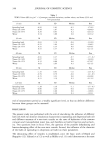
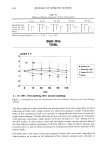
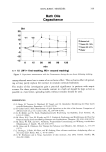
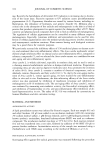
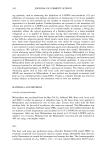
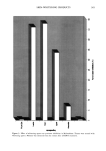
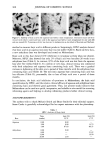
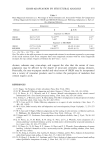
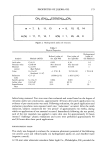
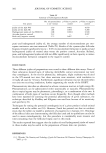
348 JOURNAL OF COSMETIC SCIENCE Table IV Differences Between Capacitance Values (Corneometer) 15 min 30 min 60 rain 90 min 120 min Tween 20: 18% *]* '1'] * *] *]*] ]+ Tween 20: 47% Water Wilcoxon signed-rank test (, = p 0 .01, + = p 0.05). Bath Oils TEWL 1 o -1 -2 -3 g/sqm x h 0 15 30 60 90 120 ß Almond oil -• Tween 20: 18% • Tween 20: 47% -•- Water rnin n = 15 (WI= first washing, W2= second washing) Figure 1. Transepidermal water loss measurement with the Tewameter during the two hours following washing. The data compiled in this work allow the interpretation of an exsiccating effect of water baths and oil baths with a high content of a mild non-ionogenic tenside. Furthermore, baths of this composition lead to an increase in transepidermal water loss in terms of a slight barrier damage. Tenside solutions are not occlusive as oil solutions are. Treatment with solutions containing a high amount of Tween 20 leads to a "dry" sensory feel on the skin surface. In this context, water and the higher tenside content solution showed the least lubricity and the spreading oil the best lubricity. Thus the barrier damage may be partly due to a lack of lubricity during the washing procedure and an abrasion of the barrier lipids. Oil baths with a low share of the non-ionogenic tenside and, even more, spreading oil baths produce an increase in the hydration of the stratum corneum and a decrease in

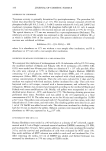
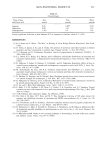
NON-IONIC TENSIDES 349 Bath Oils Capacitance 20 15 10 5 0 -5 -10 -15 Skt 0 15 30 60 90 120 '-Almond oil -• Tween 20: 18% • Tween 20: 47% -•- Water min n = 15 (WI= first washing, W2= second washing) Figure 2. Capacitance measurement with the Corneometer during the two hours following washing. transepidermal water loss in terms of an occlusive effect. This occlusive effect of spread- ing oil may partly explain the increase in stratum corneum hydration. The results of this investigation gain a practical significance in patients with atopic eczema. For these patients, the tenside content in a bath oil should be kept as low as possible or, even better, spreading baths without tensides should be used. REFERENCES (1) S. Braig, H. Tronnier, G. Meinhard, M. Teupel, and Ch. Gloxhuber. Rfickfettung der Haut durch spezielle Badezusiitze, Kosmetologie, 4, 85-89 (1974). (2) B. Gabard and E. Bieli, Measurement of lipid deposition on the skin of the forearm: Comparison of different bath oils,./. Soc. Cosmet. Chem., 42, 299-308 (1991). (3) K.H. Mfiller and Th. Nook, Biopharmazeutische Beurteilung von Bade/31en, •rztl. Kosmetol., 16, 122-129 (1986). (4) M. Gloor, H.-J. Voss, M. Kionke, and H. C. Friederich, Entfettung und Rtickfettung der Haut bei K/3rperreinigung durch tensidhaltige L/3sungen mir Lipidzusiitzen, Therapiew., 22, 42364240 (1972). (5) M. Gloor, W. Falk, and H. C. Friederich, Vergleichende Untersuchung zur Wirkung verschiedener •51badezusiitze, Z. Hautkr., 50, 429436 (1975). (6) M. Gloor and R. Ohrmann, Zur Therapie der Sebostase mit •)lbiidern, Akt. Dermatol., 1, 273-279 (1975). (7) J. Betringer, J. Fluhr, M. Gloor, and W. Gehring, Have oil/water emulsions a dehydrating effect on the horny layer? Kosmet. Med., 1, 46-49 (1996). (8) C.W. Blichmann and J. Serup, Assessment of skin moisture, Acta Derre. Venereol. (Stockh.), 68, 284-290 (1988).
Purchased for the exclusive use of nofirst nolast (unknown)
From: SCC Media Library & Resource Center (library.scconline.org)