220 JOURNAL OF COSMETIC SCIENCE phological components, with the intermediate _filament associated l•roteins (IFAP) as the major component, but also including minor morphological components such as cuticle, cell membrane complex, nuclear remnants, etc. (4). The two dominant components, IFs and IFAPs, largely determine the mechanical prop- erties of human hair (2) and, according to their molecular structure, play specific roles for the performance and effects of hair cosmetic treatments (5). The thermal analysis of keratins in water by applying differential thermal analysis (DTA) (6-8) or differential scanning calorimetry (DSC) (9-11) was found to be especially suited to investigate the denaturation performance of the o•-helical IF structures, the role of the cystine cross-linked IFAPs, and the effects of physical and chemical treatments. Spei and Holzem (12) and others (13) have shown that the denaturation peak can usually be detected adequately and evaluated also for dry fibers (approx. 240øC). It is obvious from their DSC curves, however, that the effect is always secondary in size compared to a large background peak, due to general keratin pyrolysis (14). By measuring in water, the helix denaturation peak shifts for human hair down to around 150øC and exhibits no background effects (9). This paper deals specifically with the effects that bleaching and permanent waving leave in the DSC curves of hair fibers measured in water. These effects, as reflected in changes in denaturation temperatures and enthalpies, are discussed in terms of the thermal properties of filaments and matrix and lead to a kinetic approach for the description of the influences of the cosmetic treatments. EXPERIMENTAL All investigations were conducted on a power-compensated DSC instrument (DSC-7, Perkin Elmer) using pressure-resistant (25-bar), stainless steel, large-volume capsules in the temperature range of 50ø-190øC (heating rate: 10øC/rain sample weight: 4-7 rag). The samples consisted of short fiber snippets (approx. 2 mm in length) cut from the middle sections of hair swatches. Prior to measurement the samples were stored under standard room conditions (20øC, 65% RH) to ensure invariant water content. Under these conditions a given material was weighed into the sample container, 50 lal of water was added, and the container was sealed and stored over night to achieve equilibrium water content and distribution. Caucasian mixed hair, untreated, medium brown, from a commercial source (Kerling, Backnang) was used in the form of swatches (16 cm long, 100 hairs). Bleaching was done with a commercial preparation (Wella) based on an alkaline solution (pH 8.3) of hydrogen peroxide (9%) and ammonium persulfate applied for 30 rain and at room temperature. Eight hair swatches were prepared, namely the unbleached start material and swatches bleached repeatedly and at intervals of 24 hr up to seven times. DSC tests on these samples were conducted five times. Perre-waving was done on hair swatches at room temperature with a commercial prepa- ration (Wella) based on thioglycolate (8%) as reducing agent at pH 8, adjusted with ammonia, for various times between 10 and 30 min. Hydrogen peroxide solution (2.5%) (pH 3) was used as neutralizer. This process was repeated up to five times at 24-hr

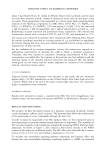
DSC ANALYSIS OF HAIR IN WATER 221 intervals, yielding eleven hair swatches with different chemical histories. DSC tests on the samples were conducted three times. DATA ANALYSIS Figure 1 shows a DSC curve typical for untreated human hair in water. In accordance with conventional practice in calorimetry, endothermic effects, i.e., heat absorption by the sample, are represented by an increase in the ordinate value from the baseline. The DSC peak is characterized by its position (peak temperature), which is taken as the denaturation temperature T O of the helical material in the IFs. The area of the peak with respect to its baseline yields the denaturation enthalpy AHr), which is the energy required for the helix denaturation. The enthalpy depends on the amount and the structural integrity of the o•-helical material in the intermediate filaments of human hair. There is good evidence to suggest (9,10), that T O is kinetically controlled by the cross-link density of the matrix (IFAPs) in which the IFs are embedded. The higher the cross-link density in the IFAPs, the higher their viscosity and the more hindered is the helix/coil transition in the IFs and vice versa. T D = 156,7øC 140.3øE /xHD = 17.9 Jig 168.2ø6 0 i [ I • 130 140 150 160 170 180 Temperctfure in øC Figure l. Typical DSC curve for untreated human hair in water. The location of the peak gives the denaturation temperature To, and its area, with respect to the baseline, gives the denaturation enthalpy AH D. The start and end temperature of the baseline, defining the peak, are marked.
Purchased for the exclusive use of nofirst nolast (unknown)
From: SCC Media Library & Resource Center (library.scconline.org)