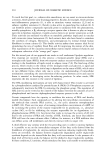
222 JOURNAL OF COSMETIC SCIENCE On the assumption that AH o is a measure of the amount of native, (x-helical material, the relative helix content HXre / is given by: HXre/ = AHo/AHo ø (1) AHo ø is the arithmetic mean denaturation enthalpy for the start material for each specific part of the study. As a first approach and against the background of a previous investigation (11), first- order kinetics are assumed for the treatment-induced decrease of the helix content in terms of time: -dHX•//dt = ktHXre / (2) as well as of the number of treatments -dHX•/dn = k,HX•a (3) where k t is the reaction rate constant related to treatment time and k, the apparent reaction rate constant with respect to the number of treatments, respectively. In view of the properties of equations 2 and 3 after integration, plotting ln(HX•/) vs t or vs n should yield a straight line with the slopes -k t and -k,,, respectively. RESULTS AND DISCUSSION Bleaching and perm-waving lead to unique changes in the DSC curves of the treated hair. In this paper, results for the changes in the principal parameters, namely dena- turation temperature and enthalpy are presented and discussed. Tables I and II sum- marize the results for T o and AH o for the bleached and perre-waved samples, respec- tively, in the form of the arithmetic means and standard deviations. With values for the standard deviation for T o of generally around or less than IøC and of around 1 J/g or less for the denaturation enthalpy, the method shows good precision. The values for T o for the untreated samples (bleach: 158øC perm-wave: 155øC) as well as for AH o (bleach: 19.3 J/g perm-wave: 15.3 J/g) in both sets of experiments are in the usual range for (x-keratins (9). Table I Denaturation Temperatures T O and Enthalpies AH o for Hair Samples Bleached Multiple Times Number of bleachings T O + s (o) AH o _+ s (J/g) 0 158.3 + 0.34 19.3 + 0.41 1 157.8 + 0.18 18.0 + 0.21 2 152.6 + 0.47 15.6 + 1.13 3 145.3 + 0.39 13.7 +- 0.81 4 140.9 + 0.36 12.4 +_ 0.41 5 141.4 +_ 0.32 12.9 + 0.44 6 139.6 + 0.23 13.0 + 0.44 7 138.4 + 0.44 11.7 + 0.25 s: standard deviation for fivefold measurements. 0: untreated hair material.

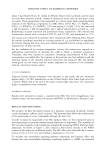
DSC ANALYSIS OF HAIR IN WATER 223 Table II Denaturation Temperatures T o and Enthalpies AH o for Hair Samples Perm-Waved Multiple Times Number of treatments Time of treatment (min) T o ñ s (ø) AH o ñ s (,J/g) Start -- 155.2 + 1.03 15.3 + 0.32 Bleach 152.5 + 0.57 14.9 ñ 0.40 1 10 152.9 ñ 0.58 11.3 ñ 0.36 20 150.3 ñ 0.36 11.5 + 1.05 30 148.7 ñ 1.08 10.2 ñ 0.56 3 10 146.4 ñ 1.07 8.5 ñ 0.97 20 144.0 ñ 0.86 7.4 + 0.68 30 143.5 + 0.57 7.5 ñ 1.04 5 10 136.7 ñ 0.71 3.2 ñ 0.97 20 134.6 ñ 0.74 1.9 + 0.36 30 121.3 ñ 2.01 1.0 ñ 0.33 s: standard deviation for threefold measurements. Start: untreated reference hair material. Bleach: once-bleached reference material, on which the perm-wave treatments were performed for different time periods. The variability of the locations and shapes of the peaks for individual samples can be attributed to general, inherent, natural inhomogeneities of the samples as well as to variations induced by the chemical and physical history of the samples beyond the applied treatments. BLEACHING EFFECTS Figure 2 summarizes the results for peak temperatures and denaturation enthalpies, respectively, for the bleached samples, in the form of a multiple "box & whisker" plot. The results show that the first four bleaches lead to a roughly linear decrease for both parameters. Beyond, T D levels off at a temperature that is 20øC lower than for the untreated material. In parallel, AH o decreases by 40% from 19 to 12 J/g. The plot of denaturation enthalpy vs temperature (Figure 3) reveals a strong linear relationship, showing the similarity in the course with which both parameters decrease. Taking their relationship to specific morphological components into account, as dis- cussed above, it can be concluded that bleaching leads to largely homogeneous damage in IFs and IFAPs. Assuming first-order kinetics and consequently plotting ln(HX•a) vs the number of bleachings, as realized in Figure 4, yields a well-defined straight line from which the apparent reaction rate constant (kn = 0.069 ñ 0.0103 95% confidence limits) is de- duced. Leroy et al. (13) investigated virgin, bleached, and permwaved hair by DSC in the dry state. For the virgin hair they observed a strong bimodality of the curves, which is related to fractions of cortical cells differing in cystine content (10), rather than to a filament/matrix structure (12,15).
Purchased for the exclusive use of nofirst nolast (unknown)
From: SCC Media Library & Resource Center (library.scconline.org)