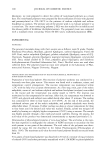
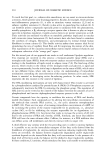
226 JOURNAL OF COSMETIC SCIENCE 160 (.,1 155 o ß - 150 ß ,-, 145 ,-, 140 E !- 135 0 130 :3 125 e 120 115 0 1 i i f i i i i start bleach lx10 lx20 lx30 3x10 3x20 3x30 5x10 5x20 5x30 16 14 12 I= 10 8 "' 6 ._o 4 ::3 2 Code for Hair Treatment Figure 5. Denaturation temperatures and enthalpies of the perm-waved samples as multiple "box & whisker" plot (see Figure 2). For the definition of codes see text. Vertical lines separate data groups that have undergone the same number of treatments. 18 = 14 a. 12 -= 10 4,-I LU 8 • 6 ß 2 0 1 10 115 120 125 130 135 140 145 150 155 160 Denaturation Temperature in øC Figure 6, Plot of AH o vs T o for the perm-waved samples, As a guide for the eye, an exponential fit (solid line) is drawn through the data,

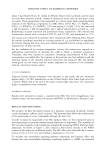
DSC ANALYSIS OF HAIR IN WATER 227 Plotting all individual values of AH D vs T o for the perm-waved samples, as realized in Figure 6, shows a heuristic, exponential relationship. The decrease in enthalpy occurs much faster than that of the peak temperature. In view of the morphological interpretation of the parameters, it can be concluded that perm-waving damage is much more pronounced in the helical segments of the inter- mediate filaments than in the surrounding, highly sulfur cross-linked matrix. Perm- waving greatly reduces the amount of native, u-helical material in hair. Leroy et al. (13) in their DSC studies on dry hair also found the progressive decrease of the peak area through perming. This is in agreement with 13C CP/MAS NMR studies by Nishikawa et al. (17), showing a decrease in the amount of u-helical material in Asian hair through perm-waving. Similar effects have been observed by Ogawa et al. (18), upon submitting hair to strong heat/reduction conditions. In contrast to our results, however, Leroy et al. (13), when testing dry hair, found no change in the peak temperature. This shows the overriding importance of hydrogen bonds in the dry state. Once these are broken through the presence of water, the effects of perming on the disulfide bonds can be detected by thermal analysis. Calculating HXre I on the basis of AH o = 14.9 J/g for the bleached material (bleach) and plotting the results as ln(HXre l) vs time as well as against the number of treatments, yields in the 3D-plot of Figure 7 a well-defined plane (r -- 0.89), which supports the assumption of additive first-order kinetics in both parameters. 1,0 0,fi 0,0 .0,fi .1,0 .1 ,fi .2, 0 .2, fi .3, 0 z = 0,37 -0.408x-0.01 ly r= 0.89 Figure 7. Plot ofln(HXre ) vs time (y) and number (x) ofperm-waving treatments. Based on the assumption of first-order kinetics for both parameters, a plane, for which the equation is given, is fitted through the data.
Purchased for the exclusive use of nofirst nolast (unknown)
From: SCC Media Library & Resource Center (library.scconline.org)