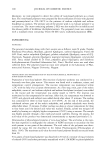
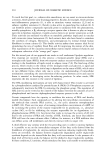
204 JOURNAL OF COSMETIC SCIENCE plug, was used to measure the pF value (capacitance). About 30 ml of polymeric solution was taken into a suitably sized cylinder, and the head of the probe cell was dipped into the solution. Care was exercised to take all the readings at the same temperature and at the same height. All measurements were done at a fixed frequency of 3 mc/S. The conductivity measuring cell lends itself to relative measurement of pF value for com- parison. The recorded pF values were used as such without further reduction and were thus designated relative dielectric constants (relative DEC). The relative DEC for water was found to be 54, whereas the value of DEC is 80. The creams were allowed to equilibrate to room temperature before the readings were taken. Viscosity measurement. The viscosity study was done by a Brookfield synchro-lectic vis- cometer, using the method as specified by the manufacturer. RESULTS AND DISCUSSION It was observed that the creams show good spreadability and homogeneity. EVALUATION OF DRUG RELEASE Figure 1 shows the percent release of diclofenac diethylammonium from various creams in the receptor medium across the rat skin. Cream containing polymer 2 showed better release of the drug for the first two hours than did the marketed cream. The overall release was greater for the marketed preparation after two hours. The cream containing Tween 60, however, showed a poor release pattern as compared to the marketed prepa- ration and creams containing polymer 2. The cream containing polymer 2 showed the 16 14 = • 10 0 I [ I I I 4 õ 6 7 8 Time (Hours} -•- RM + RT -•-- R2 Figure 1. Comparison of in vitro release profile of diclofenac diethylammonium from various cream bases with marketed preparation using Keshary Chien diffusion cell. RM: marketed cream. RT: cream with Tween 60. R2: cream with polymer 2.

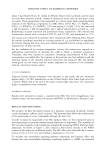
ROSIN-BASED POLYMER AS CREAM BASE 205 release of drugs from 2.8 to 13.3 percent over the period of eight hours. The marketed preparation showed release of the drug from 2.2 to 13.6 percent. Thus the amount of drug released at the end of eight hours was similar for the marketed preparation and the cream containing polymer 2. This is also evident from a Student's t-test, which revealed that there is no statistically significant difference (p 0.01) in the overall release of the creams containing polymer 2 and that of the marketed cream. STABILITY STUDIES Dr•g content. The creams containing polymer 2 showed an initial drug content of 97.5 percent. After storage at 40øC and 50øC for 50 days, the drug content decreased to 97.2 percent and 97.0 percent, respectively. The creams containing Tween 60 showed an initial drug content of 97.7 percent. After storage at 40øC and 50øC for 50 days, the drug content decreased to 97.5 percent and 97.0 percent, respectively. The marketed preparation showed an initial drug content of 97.8 percent. After storage at 40øC and 50øC for 50 days, the drug content decreased to 97.5 percent and 97.3 percent, respec- tively. This indicates that the stability of the active ingredient in creams is reasonably satisfactory. pH. The pH of the creams ranged from 6.0 to 7.0, which is the normal pH range of skin. Particle size. The changes in particle size of the creams during storage are presented in Figure 2. The particle size data is in good agreement with all the other parameters tested for the stability of the creams. As shown in the figure, the particle size increased more in the case of creams containing Tween 60 and stored at 40øC and 55øC. The slight 25 20 15 10 i i i i I 14 28 42 -4• Room temperature • Room temperature --A-- 4OøC. i•T ß 55ø0 RT • 55øC • Time (Days) Figure 2. The changes in particle size of the prepared creams during aging. RT: cream with Tween 60. R2: cream with polymer 2.
Purchased for the exclusive use of nofirst nolast (unknown)
From: SCC Media Library & Resource Center (library.scconline.org)