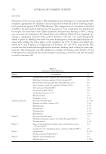
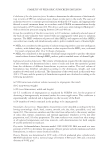
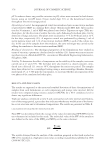
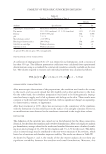
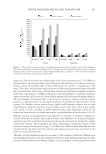
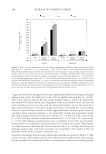
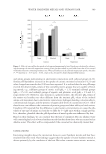
J. Cosmet. Sci., 62, 393–404 ( July/August 2011) 393 A study of four antioxidant activities and major chemical component analyses of twenty-fi ve commonly used essential oils CHIU-CHING HUANG, HSIAO-FEN WANG, CHIA-HUI CHEN, YA-JU CHEN, and KUANG-HWAY YIH, Department of Applied Cosmetology, Hungkuang University, Shalu, No. 34, Chung-Chie Rd., Taichung, Taiwan, 433 R. O. C. Accepted for publication April 19, 2011. Synopsis Twenty-fi ve essential oils and their major chemical components were screened for their possible antioxidant activities by assaying their DPPH free-radical scavenging activity (DFRS), total phenolic contents (TPC), trolox equivalent antioxidant capacity (TEAC), and ferric thiocyanate (FTC). Based on the TPC and TEAC assays, the essential oil ajowan is among the best essential oils studied. Furthermore, the DFRS and FTC as- says reveal that the essential oils cinnamon bark extra and oregano are also among the best oils studied. More specifi cally, at a concentration of 1 mg ml−1, the essential oils cinnamon bark extra and benzoin showed 93.75 ± 0.01% and 90.64 ± 0.01% DFRS, while the essential oils ajowan and oregano showed TEAC values of 4374.72 ± 0.01 and 4023.49 ± 0.01 μM of trolox per mg, respectively. In addition, the essential oils oregano and ajowan showed 29.17 ± 0.02% and 25.26 ± 0.03% FTC based on the assay results. At a concentration of 10 mg ml−1, the essential oils ajowan and oregano showed 1845.20 ± 0.04 and 1665.36 ± 0.04 μg of TPC relative to GAE, respectively. Two major chemical components of the essential oils cinnamon bark extra, ajowan, and oregano were trans- cinnamaldehyde (90.61%), eugenol (2.58%), carvacrol (61.20%), p-cymene (37.44%), thymol (77.09%), and p-cymene (10.01%). It is clear that phenolic compounds in the aforementioned essential oils yield a positive correlation with the DFRS, TPC, TEAC, and FTC assays. INTRODUCTION Essential oils are commonly used in the food and aromatherapies industries and have in- creased the value of products and also enlightened the cosmetics industry. Other applica- tions include, but are not limited to: antioxidant, antimicrobial (1), anti-infl ammatory, anti-cholinesterase (2), anti-thrombotic (3), anxiolytic (4), EEG (5) and blood-pressure infl uential (6) properties. Essential oils are commonly considered to be volatile oils, which give rise to the rich fragrance found in aromatics. Many chemical components in natural Address all correspondence to Kuang-Hway Yih at khyih@sunrise.hk.edu.tw.
Purchased for the exclusive use of nofirst nolast (unknown)
From: SCC Media Library & Resource Center (library.scconline.org)