THE GERANIUM FAMILY IN PERFUMERY 11 The odour-framework, which with the terpenes constitutes the remaining 30 per cent in the make-up of the Java oil, according to the literature, is seen to comprise some thirty items, but just how some of these contribute towards the composite aroma it is difficult to assess, and although the presence of citronellyl and geranyl acetates is noted, yet some inter-esterification is probable from the occurrence of butyl and amyl alcohols which donate certain fruity notes. These are complemented by green nuances, following the incidence of hexanol, hexenol and methyl heptenone, while traces are found of cadinol, methyl eugenol and citral. All of these, be it noted, are very powerful osmophores, and must there- fore blend to effect a profound modifying action upon the basic odours of the two main constituents. Citronella Ceylon. A brief glance at the build-up of Ceylon citronella (ex Andropogon nardus) reveals another storehouse of ancillary aromatics. This oil is important commerciall 5 as an economical source of a second- grade geraniol and d-citronellal, the approximate balance of these con- stituents being as 30:10, but the incidental components only amount, however, to about a dozen items. These comprise, in addition to the acetic esters, methyl eugenol and methyl heptenone, common to both oils, but the incidence of small amounts of such dominant osmophores as borneol, cam- phene and thujyl alcohol is sufficient to repress the more delicate fragrance, due to traces of a nerol-linalol complex and farnesol hence in comparison with the odour of the Java oil, that from Ceylon is crude and heavy, being somewhat unbalanced by the background of herbaceous elements. The Formosan oil inclines closely towards the Java type, and is interesting for the formulation of economical, yet powerfnl bases for industrial perfumes, as well as being an important commercial source of the aromatic isolates and their derivatives: geraniol, citronellal, citronellol, the corresponding esters, hydroxycitronellal and synthetic menthol. INTERESTING FRAGRANCE-PATTERNS One of the most interesting natural associations of geraniol, and incident- ally a pattern which with variations is typical of quite a number of fragrant Australasian flora, is to be found in the foliage of Boronia Muelleri (N.O. Rutaceae), in which the rosy geraniol note is complemented by an aromatic- balsamic nuance of the fennel-myrrh type, backed by pinene and refreshed with geranyl acetate. From this ensemble a very pleasing and intriguing bouquet emerges. In the antipodes there are qui•e a number of these fragrant Boronias with distinctive and well-defined odours, B. citriodora, for example, yields an oil containing upwards of 80 per cent of/-citronellol, another source of which is Eucalyptus citriodora while Verbena (Aloysis or Lippia) citriodora,

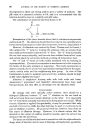
12 JOURNAL OF THE SOCIETY OF COSMETIC CHEMISTS with its high citral content, is a further example of the lemon-citronella scent found associated with gerarfiol and/or its esters. Among •the myrtles (N.O. Myrtaceae) are found the eugenol-containing clove and pimenta trees, the oils of which have a high content of this phenol alcohol. It is, however, from the small white flowers and the foliage of Myrtus communis, the well-known evergreen shrub in its natural habitat, that, in my opinion, the component balance of eugenol and geraniol is so adjusted by Nature as to engender an initial spicy-rose scent, which is supported and sustained by the presence of myrtenol, nerol, cineol and cinnamic aldehyde--a grouping which may thus be selected as a prototype bouquet which may be conveniently described as the Myrtle Bloom Fragrance. With some modifications, this nuance is found extensively in other genera of this N.O., for instance, among the widely spread Australian melaleucas, the well-known "bottle-brushes" of which Callistemon salignus, the white or willow bottle-brush, is a typical example. The same spicy-rose motif is also characteristic of several members of the N.O. Calycanthaceae, for example, Calycanthus Floridus, the Carolina allspice-tree and Chimonanthus fragrans, the Japanese variety, while similar sweet odours which perfume the air for a considerable distance around are the proclivity of Elaeagnus hortensis and other varieties of this "wild olive" family, which, like the myrtles, are prolific in their tiny white flowers from which such a continuous volume of powerful fragrance is disseminated. THE U•igUITOUS GERANIOL The above examples are representative of the presence of geraniol in sufficient proportion in the several fragrance-patterns to exercise a modifying effect upon the other osmophores present and thus engender a natural bouquet, and it is therefore instructive to learn, upon referring to the conveniently arranged lists now available in the several "Aromatic Codices" that, progressing through the alphabet from acacia to zdravets, the incidence of geraniol in flower absolutes and essential oils extends to some fifty itemsq a magnitude which is shared only with linalol. Moreover, it is remarked in the literature, albeit somewhat laconically, that gerani01 is extensively used as a base for many types of floral compounds, but it may not perhaps be realised until an audit is made from a comprehensive range of contemporary type-formulae (such as is to be found in Jellinek's Practice of Modern Per- . fumery) that the incidence of geraniol and/or geranium is seen in more than half of the examples. Because of the normal association of scent with the beauty, colour and shape of flowers, regarding which the premier position is usually accorded to the rose, we have ample evidence of the usage made by the earlier Eastern civilisations of rose-water and rose-perfumed oils and unguents, while the
Purchased for the exclusive use of nofirst nolast (unknown)
From: SCC Media Library & Resource Center (library.scconline.org)