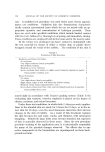
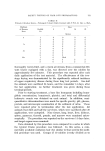
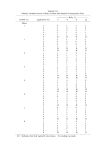
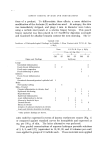
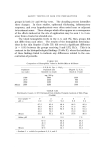
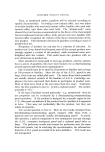
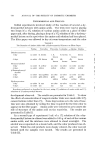
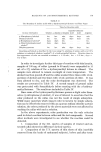
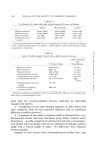
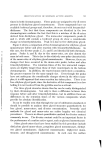
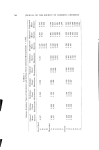
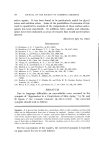
778 JOURNAL OF THE SOCIETY OF COSMETIC CHEMISTS EXPERIMENTAL AND RESULTS Initial experiments involved study of the reaction of several a-hy- droxymethy] ketones with amino acids. The tests were run by placing two drops of a 1% solution of various amino acids on a piece of filter paper and, after drying, placing a drop of a 1% solution of the a-hydroxy- methyl ketone on the spot where the amino acid solution had been placed. The filter paper was allowed to dry at room temperature and the color TABLE I The Reaction of Amino Acids with a-Hydroxymethyl Ketones on Filter Paper Proline Norvaline Threonine Isoleucine a-Alanine Glycine Dihydroxyacetone 1 day 4 days no color lt. brown v. lt. lt. brown lt. brown brown brown no color dk. brown dk. dk. dk. brown brown brown brown Phenacyl alcohol 1 day no color lt. yellow 4 days no color yellow p-Bromophenacyl alcohol I day no color trace golden 4 days no color gold-ydlow no color yellow no color no color no color yellow yellow yellow no color no color no color no color gold- gold- gold- gold- yellow yellow yellow yellow Itydroxyacetone 1 day no color lt. tan no color no color no color no color 4 days no color tan tan tan tan tan Reactions performed as described in the text, using IS solutions of amino acids and 1% solutions of a-hydroxymethyl ketones. development observed. The results are presented in Table I. To show the effects of concentration of reagents similar trials were made with 10% concentrations rather than 1%. Some impressions as to the rate of reac- tion were also obtained by noting the time required for the first color to appear on the filter paper. Amino acids were selected so as to assess the role of structure of the amino acid on the reactivity. The results are presented in Table II. In a second type of experiment 5 ml. of a 1% solution of the a-hy- droxymethyl ketone in ethanol was added to 0.05 g. of each of the various amino acids, and the mixtures were allowed to stand overnight. The alcohol was evaporated on a steam bath, and the color produced was ob- served. While the end products were deeply colored, the color was not formed until the samples were heated. The results are presented in Table III.

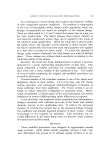
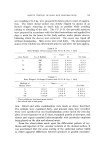
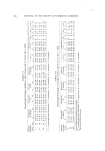
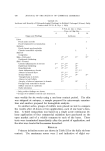
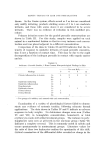
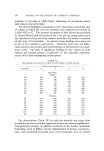
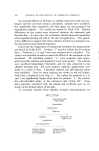
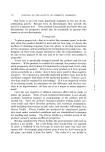
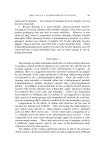
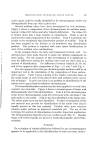
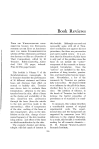
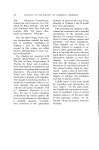
REACTION OF a-HYDROXYMETHYL KETONES TABLE II The Reaction of Amino Acids with a-Hydroxymethyl Ketones on Filter Paper 779 Time for Reaction with Aspartic Glutamic Ketone Derivative Glycine a-Alanine •-Alanine Acid Acid Arginine p-Nitrophenacyl alcohol hrs. hrs. min. days days min. Phenacyl alcohol hrs. hrs. min. days days min. p-Bromphenacyl alcohol* days days hrs ....... hrs. p-Dimethylaminophenacyl days days days ...... days alcohol* Dihydroxyacetone hrs. hrs. min. days days hrs. Reactions performed as described in the text, using 1% solutions of amino acids and 10% solutions or saturated solutions (marked*) of a-hydroxymethyl ketones. Reaction times to first appearance of color are recorded as minutes = 1-15 min. hrs. = 2-5 hrs. days = 11•-2 days. In order to investigate further this type of reaction with skin keratin, samples of 100 mg. of callus (ground to 60 mesh) were suspended in 15 mi. of a 5% solution of the a-hydroxymethyl ketone in ethanol. The samples were allowed to remain overnight at room temperature. The alcohol was then poured off and the callus washed three times with 15 mi. portions of alcohol and two times with 15 ml. portions of ether. It was then allowed to dry, and the color development was observed. The results are presented in Table IV. A second sample of ground callus was pretreated with formaldehyde before reacting with the a-hydroxy- methyl ketones. The results are included in Table IV. Since some of the hydroxymethyl ketones possess a slight color them- selves (p-nitrophenaeyl alcohol), it was of interest to ascertain that the color produced on the callus was not the result of simple adsorption. While many materials which impart color to keratin by simple adsorp- tion can be effectively removed with an aqueous sodium chloride-acetone solution, the colors produced by the above materials were not affected by washing the callus with such a solution. In the above experiments, color production was the only criterion used to detect reaction between callus and the test compounds. Several other methods were investigated to see whether the reaction could be detected. 1. Comparison of the I.R. spectra of samples of treated and un- treated callus showed no differences in their spectra. 2. Comparison of the U.V. spectra of thin sheets of skin (carefully removed from the backs of sunburned subjects), before and after treat-
Purchased for the exclusive use of nofirst nolast (unknown)
From: SCC Media Library & Resource Center (library.scconline.org)