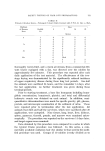
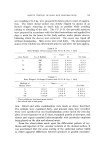
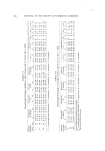
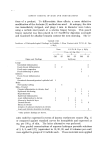
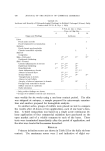
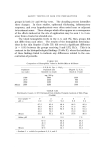
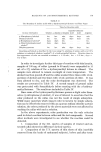
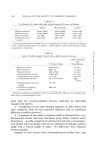
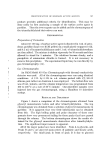
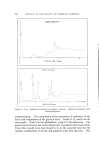
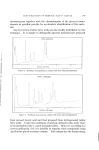
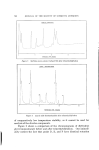
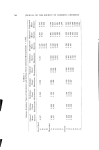
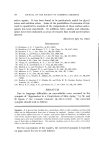
780 JOURNAL OF THE SOCIETY OF COSMETIC CHEMISTS TABLE III The Reaction of Amino Acids with a-Hydroxymethyl Ketones in Solution Alaninc Phenyl Alaninc Cystinc Dihydroxyacetone brown liquid brown liquid yellow solid Hydroxyacetone brown liquid brown liquid yellow solid Phenacyl alcohol tan solid yellow solid white solid p-Bromophenacyl pink solid gold solid white solid alcohol Reactions performed as described in the text, using 0.05 g. of amino acid and 1% solutions of the a-hydroxymethyl ketone in ethanol. Table indicates colors observed after ethanol evaporated on steam bath. TABLE IV Colors of Callus Samples Treated with a-Hydroxymethyl Ketones Untreated Callus Callus Pretreated with Formaldehyde Dihydroxyacetone Hydroxyacetone Phenacyl alcohol p-Bromophenacyl alcohol p-Hydroxyphenacyl alcohol p-Nitrophenacyl alcohol p-Dimethylamino phenacyl no color alcohol 3,5-Dichloro-4-hydroxy- light tan phenaeyl alcohol dark brown no color light tan no color light yellow no color ydlow-gold no color v. lt. tan no color dk. yellow-brown light yellow ß . . Reactions performed as described in the text, using 100 mg. callus and 5% ethanolic solu- tions of the a-hydroxymethyl ketone. merit with the a-hydroxymethyl ketones, indicated no detectable change in the spectra. 3. Comparison of the water-binding capacity of callus before and after treatment with the test materials indicated that no significant differences could be observed. 4. A measure of the extent of reaction could be obtained if the a-hy- droxymethyl ketone had some functional group which could be easily determined. A callus sample that had been treated with p-bromophen- acyl alcohol (and was deeply colored) was submitted to halogen analysis along with a control sample of callus. No differences were obtained between samples. Samples of hair treated with p-bromophenacyl alcohol were also

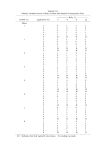
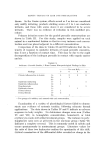
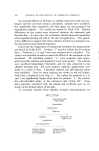
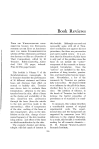
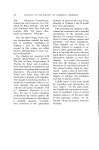
REACTION OF a-HYDROXYMETHYL KETONES 781 analyzed for bromine. The amount of bromine in these samples was too low to be detected. 5. Bovine albumin is a water-soluble, ethanol-insoluble protein. Treatment of bovine albumin with absolute ethanol, if the times are not unduly prolonged, does not alter its water solubility. However, it was observed that, when a suspension of bovine albumin, absolute ethanol and either DHA, phenacyl alcohol, p-bromophenacyl alcohol, or p-nitro- phenacyl alcohol was shaken overnight, the bovine albumin became slightly colored and was converted into a water-insoluble form. When p-dimethylaminophenacyl alcohol was used, the bovine albumin was not converted into a water-insoluble form, and no color change in the al- bumin was noted. DISCUSSION The reaction of callus and amino acids with a-hydroxymethyl ketones to produce colored products appears to be a general one, and the rate of reaction appears to be related to the concentration of reagents. In addition, there is a suggestion that the reaction is enhanced (as judged by the intensity of the colors produced) if electron withdrawing groups are attached to the a-hydroxymethyl ketone. Thus, the order of de- creasing color intensity of treated callus was p-nitrophenacyl alcohol, p-bromophenacyl alcohol, phenacyl alcohol and p-hydroxyphenacyl alcohol. In addition, it was noted that of the a-hydroxymethyl ketones reacted with bovine albumin only p-dimethyl amino phenacyl alcohol was without effect on its color and solubility. If the color formations were related to a Maillard type of reaction (8) (as suggested by the fact that removal of amino groups with formaldehyde blocked the reaction), such an activating effect would be predicted for electronegative groups. Comparisons of the effects of amino acid structure on the rate of reaction are indicated in Table II. Thus, increasing the chain length by one carbon atom (glycine vs. alpha-alanine, aspartic acid vs. glutamic acid) has little effect on the rate. On the other hand, comparison of a- vs. •-alanine shows the latter to be substantially more reactive. Thus, compounds with more basic nitrogen groups appear to produce a color reaction much sooner. This is also seen in the case of arginine, which is a relatively rapid reactor, and in the cases of the dicarboxylic acids, which are relatively slow reactors. The failure of the various analytical schemes to detect the presence of the reacted a-hydroxymethyl ketones on callus suggests that, although
Purchased for the exclusive use of nofirst nolast (unknown)
From: SCC Media Library & Resource Center (library.scconline.org)