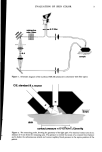
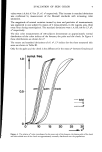
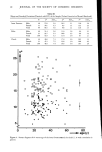
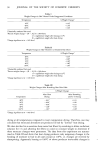
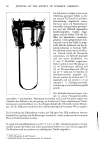
4 JOURNAL OF THE SOCIETY OF COSMETIC CHEMISTS bloodpressure level (9). This was obtained by a constant force balance. Thermal effects were avoided because the measuring head was fabricated of thermally isolating plastic. Heating from the light was not commented on by the subjects. The Lovibond is a subtractive colorimeter which uses the Lovibond-Schofield system, wherein a comparison field is visually matched to light reflected by the sample by means of colored filters. Only two out of three filter colors plus a neutral density filter were used to make a match. A bipartite field of vision of 2 ø is used. The Lovibond-type color matches are only moderately metameric (10). A spectrophotometric analysis of the Lovibond system was described by Haupt and Douglas (11) Computations by Haupt, et al. (12) related Lovibond readings to CIE 1931 x, y (chromaticity coordinates) and Y (luminance factor). From these values the L*, u*, v*, coordinates in the CIE (1976) Uniform color space were computed (13). In this color space equal distances between color points represent approximately equal perceptual differences, as long as distances are relatively small. For the present range of colors L* is related to brightness, the u* index is related to redness (+) versus greenness (-) and the v* index is related to yellowness (+) versus blueness (-). The sample was composed of a hundred dental patients which were referred to the department of oral surgery for treatment with minor oral problems. The patients originated in the northern districts of the Netherlands and contained no people evidently other than the white race. Patients with inflammatory lesions were excluded. They were measured in the 3rd and 4th week of January 1978. The median and mean age of the sample were 26 and 29 respectively. The youngest subject was 8 years, the oldest one was 76 years. The subject sat upright in a dental chair with the right arm in a horizontal position resting in the elbow support. The observations were respectively taken at the thenar palm of the hand, the inner forearm and the infra-orbital region of the cheek. For each region the measurement took no longer than 1 min. The subject was allowed to acclimatize from the outdoor temperature (8-10øC) to the micro-climate (20 +_ 0,5øC) for at least 15 min. There was no direct sunlight in the room. The inner forearm of one male subject was too hairy to measure the skin color. The cheeks of the males and females were all free from cosmetics. For the spectrophotometric verification measurement we used a Zeiss RFC-3. VERIFICATION The brightness reading on the instrument was calibrated by us using MgO surfaces and Munsell chips as described by the manufacturer. A chromaticity calibration was elaborated by the measurement of Munsell individual color standards (matte finish) of 3 x 5 in. in the gamut of the skin. The Lovibond data were compared with the tristimulus data provided by Munsell and obtained from General Electric spectropho- tometer curves. Five Lovibond measurements of each standards were averaged. The Munsell standards chosen were: 5 YR 6/4 5 YR 7/4 7.5 YR 7/4 10 YR 6/3 10 YR 7/4 10 R 6/4. (Table I). Later these standards were also measured with a Zeiss RFC-3 spectrophotometer. These data confirmed the G.E. Spectrophotometer data within _+ 2% of L*, u* and v*.

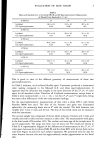
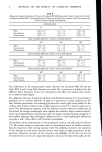
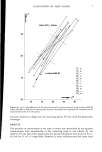
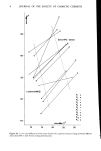
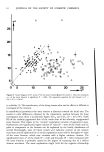
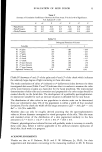
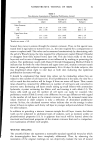
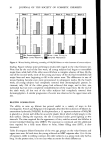
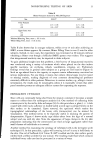
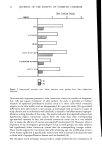
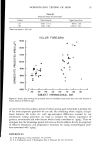
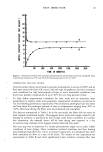
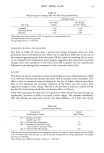
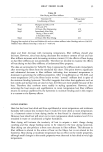
EVALUATION OF SKIN COLOR 5 Table I Means and Standard Error of Lovibond MK III and GE Spectrophotometric Measurements of Munsell Color Standards (3 x 5 in.) 10 YR 6/3 L* u* v* Lovibond 60.4 + 0.3 13.5 + 0.1 20.7 + 0.1 G.E. Spectrophotometer 61.44 16.98 25.9 10 YR 7/4 Lovibond 70.2 + 0.6 20.2 + 0.2 31.5 + 0.5 G.E. Spectrophotometer 71.41 23.78 36.42 10 YR 6/4 Lovibond 60.9 + 0.18 27.1 +_ 0.1 13.7 + 0.2 G.E. Spectrophotometer 61.69 30.27 17.50 5 YR 6/4 Lovibond 59.6 _+ 0.6 24.6 +_ 0.4 20.0 * 0.7 G.E. Spectrophotometer 61.65 28.52 25.55 5 YR 7/4 Lovibond 69.0 + 2.2 24.3 +_ 0.8 21.8 + 0.8 G.E. Spectrophotometer 71.43 28.82 26.38 7.5 YR 7/4 Lovibond 70.7 + 0.7 22.8 + 1.1 26.0 + 0.5 G.E. Spectrophotometer 71.65 26.91 30.26 This is good in view of the different geometry of measurement of these two spectrophotometers. As Table I indicates, our Lovibond flexible optic Tintometer produced a desaturated color reading compared to the Munsell G.E. and Zeiss spectrophotometers. It appeared that the deviation was roughly in the same direction of the L*, u*, v* color space for all standard colors. Therefore all Lovibond measurements, except those in Table I, were corrected with q- 1.5 q- 3.6 q- 4.6 for L*, u*, and v* respectively, being the mean color differences of the two instrumental readings. For the spectrophotometric measurements of skin color a Zeiss RFC-3 with Serial Number 96870 was used. The skin of the forearm and palm was illuminated spherically, the measuring beam was at 8 ø with the normal. The field diameter was variable over 5 mm, 15 mm and 30 mm. The skin of the cheek could not be measured with this instrument. The second sample was composed of eleven white subjects, 6 female and 5 male, and visually selected to rather extreme variance in skin color. The measurements took place in the third week of November 1979. The median and mean age of the sample were 28 and 29 respectively. The range was from 24 to 45 years old. The results are shown in Table II. A representative diagram of the differences of measurement in the L*, u*, v* color space between the Lovibond MK III and the Zeiss RFC with 30-mm field can be read from Figure 3a and b for each subject separately. We presented only the data for outer forearm because this area has approximately similar pigmentation as the facial skin.
Purchased for the exclusive use of nofirst nolast (unknown)
From: SCC Media Library & Resource Center (library.scconline.org)