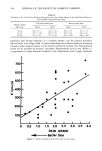
j. Soc. Cosmet. Chem., 36, 335-348 (September/October 1985) Mechanical properties of dry, normal, and glycerol-treated skin as measured by the gas-bearing electrodynamometer EUGENE R. COOPER,* PAUL J. MISSEL, DANIEL P. HANNON, and GREGORY B. ALBRIGHT, The Procter & Gamble Company, Miami Valley Laboratories, P.O. Box 39175, Cincinnati, OH 45247. Received March 6, 1985. Synopsis The viscoelastic properties of dry, normal, and glycerol-treated skin of the lower leg have been measured with a gas-bearing electrodynamometer (GBE). Elastic modulus measurements are shown to correlate well with visual assessment of the skin condition by a trained dermatological grader. Dry skin is generally stiffer than normal skin and glycerol treatment can indeed soften the skin. Removal of the outer layers of the stratum corneum by tape stripping resulted in an almost 50% reduction in the moduli--indicating a significant contribution to the mechanical properties of the skin from these layers as measured by the GBE. INTRODUCTION A variety of methods for characterizing tissue mechanical properties have been applied to skin. However, when the objective is to measure the elastic properties of stratum corneum, care must be exercised in the choice of proper instrumentation and the design of appropriate test methodology. Classical stress-strain measurements can be used to characterize strips of isolated stratum corneum under tension (1,2). Most in vivo tensile measurements involve rather large displacements and are certainly influenced heavily by the skin layers to which the stratum corneum is attached (3-5). This is especially true when the stress is applied perpendicular to the skin. Indeed, one major application of such techniques as indentometry and levarometry (6), ballistometry (7), and suction methods (8,9) is the study of age-dependent changes of the dermis (10, 11). More sophisticated experiments measuring the mechanical response of skin as a function of frequency have the advantage that small amplitudes may be used, either perpendicular (12) or parallel (13-15) to the skin surface. These techniques show promise in being easy to use and possibly able to separate dermal and epidermal response components at different frequencies (14), with a little interpretation. The two techniques which probably provide the most direct information regarding stratum corneum mechanical properties are the low-torque torsional method of Rigal and Leveque (16) and the gas-bearing electrodynamometer (GBE) of Christensen eta/. (17,18). We have used a dynamometer identical to that of Christensen eta/. in our studies. The GBE measures the displacement of skin in response to a sinusoidal driving force. The force coil and displacement measurement core are mounted on the same * Present Address: Alcon Laboratories, 6201 South Freeway, Fort Worth, TX 76134. 335

336 JOURNAL OF THE SOCIETY OF COSMETIC CHEMISTS armature, which is suspended upon a highly compliant, virtually frictionless bearing of pressurized gas. These properties enable the measurement of viscoelastic response of very soft tissues under conditions of very low driving forces and displacements. Although the technique does not measure a fundamental elastic property of stratum corneum, it does provide a convenient and rapid way to determine the effect of various agents on its mechanical properties (19,20). For example, a factor of two decrease in the elastic modulus can be observed immediately after the application of water to the skin. Thus, one has evidence that the stratum corneum contributes significantly to the elastic modulus, since a rapid response would not result from the action of water on the dermis. We have applied the GBE technique to measure the mechanical properties of skin having varying degrees of dryness, and to determine the effect of humectants such as glycerol (1,2,3-propanetriol) on the mechanical properties of skin. The results of these studies are reported in the following sections. MATERIALS AND METHODS CLINICAL GRADING AND GLYCEROL TREATMENT We report data from two separate clinical experiments. In the first experiment, the outer portion of the lower part of the left leg (28 female panelists) was graded by two trained judges according to the scale in Table I prior to measurement with the GBE. Grading was an average over the entire area rather than the small site measured in- strumentally. The purpose of this first experiment was to determine how well the GBE elastic modulus correlates with visual skin grade. In a second investigation, five female panelists applied 0.6 ml of 40% glycerol solution to a 100 cm 2 area on one calf (outer aspect) and the same amount of water to the other calf. Treatments were applied once in the morning and once four hours later in the afternoon for three days, omitting the last treatment. Visual grade assessments and GBE measurements were made immediately prior to each treatment. The treatment sites were graded by a single trained judge prior to measurement with the GBE. Panelists followed their usual bathing/showering habits throughout the study. The panelists were assumed to have achieved equilibrium with the room temperature and humidity, which were 72øF and 54 --- 3%, respectively, thrbughout the study. EQUIPMENT AND MEASUREMENT PROCEDURE The electrodynamometer is basically that described by Christensen et al. (17) and Hargens (18). For in vivo measurements, the GBE head is supported in a three-dimen- Table I Leg Grading Scale ½ 0 Skin smooth and lustrous, no detectable dryness or follicle irritation 1 Skin lustrous, slight ashing visible in cracks 2 Skin dry, smooth, but without lustre, moderate ashing covering general surface area 3 Skin slightly rough overall with slight scaling high amount of ashing covering total leg area 4 Skin has moderate to high roughness, moderate scales formed with some small, fine cracks high ashing overall 5 Skin is rough with much scaling large cracks with high ashing overall l/2 grade units are allowable.
Purchased for the exclusive use of nofirst nolast (unknown)
From: SCC Media Library & Resource Center (library.scconline.org)