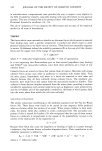
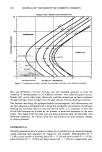
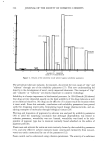
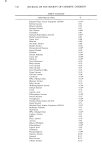
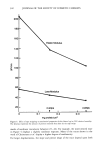
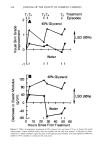
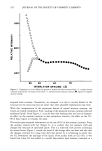
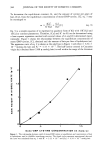
324 JOURNAL OF THE SOCIETY OF COSMETIC CHEMISTS ETHYL ALCOHOL OCTANE 6 7 8 9 10 11' 12 15 SOLUBILITY PARAMBTBR SOLUBILITY OF BENZALPHTHALIDE Figure 2. Results of the solubility study plotted against solubility parameter. PROPYLENE CARBONATE 14 15 The petroleum lubricant industry, for example, discovered the root causes of "slip" and "oilyness" through use of the solubility parameter (27). This new understanding led directly to the development of novel, vastly improved lubricants. The concepts of "slip" and "oilyness" or "lubricity" are clearly important to cosmetic technology. Solubility is of major importance in biochemical processes. In 1964 Hansch (28)showed that drug activity depended equally on the lipid solubility of the drug molecule as well as its chemical reactivity. No drug can be effective if it cannot reach the location where it must work. From this rationale, correlations with solubility parameters have proved useful for designing insecticides, formulating liquid dosage pharmaceuticals, and an- alyzing transport of molecules through biological tissues (29). Wetting and dispersion of pigments by solvents was analyzed by solubility parameter (30) to yield the surprising conclusion that although dispersability was related to cohesion parameter, wettability was not. Instead, wettability was found to be inde- pendent of pigment type due to moisture normally found adsorbed on the surface of pigment particles. Plasticizers and solvents for resins are now routinely chosen by their solubility parameter (31), and new effective solvent mixtures (some constructed exclusively from non-sol- vents) are easily constrt•cted by use of the parameter (32). Foam control can be understood using cohesion parameters. The activity of a surfactant

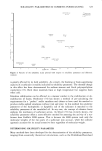
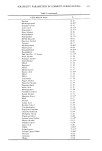
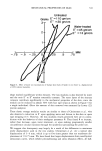
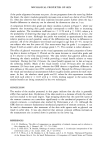
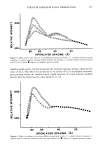
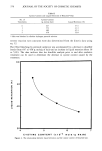
SOLUBILITY PARAMETERS IN COSMETIC FORMULATING 325 D I E 20 L E C T R I 15 C C O N 10 S T A N T S DIHETItICONE o.1% OCTANE 0.4% ACFTONoe PLG-4 23.2% 7.4% BLNZALDEI!YDE 35.5% B•IBK BENZYL A[ COilO L 17.5% 14.9% ACETIC ACID 3.8% 1• CETOi• ITRI LE , ?,PROPYLENE 14.6 % L•9JCARBO,•,iATE 12.4% ETHYL ACETATE 21.5% 6 • 7 8 9 10 11 12 13 14 SOLUBILITY PARAMETER Figure 3. Results of the solubility study plotted with respect to solubility parameter and dielectric constant. is greatly affected by its bulk solubility. As a result, the foaming or foam-suppressing capacity of a surfactant is readily indicated by solubility parameter. The thermal change in this effect has been demonstrated for sodium stearate and block polyoxyethylene copolymers (33). Both these materials foam at high temperature but suppress foam when cold. Emulsion stabilization can be effected in a manner similar to the stabilization or de- stabilization of foams. Beerbower (34) has shown a method of pre-calculating the requirements for a "perfect" stable emulsion and claims to have used his method to produce stable asphalt emulsions without trial and error. In this method the solubility parameter of the hydrophobic or lipophilic tail of the sufactant is matched to the solubility parameter of the emulsified oil. In any case, the concept of cohesive forces explains the mechanics of surfactant action. As Schott (35) has recently shown, the solubility parameter offers a more effective method for assessing the activity of a sur- factant than Griffin's HLB system. This is because the HLB system took only the molecular weights of the two parts of a surfactant into account, while the cohesive approach accounts for its actual attractive force regardless of molecular weight. DETERMINING SOLUBILITY PARAMETER Many methods have been developed for the determination of the solubility parameter, ranging from essentially theoretical calculations, such as the Hildebrand/Scatchard
Purchased for the exclusive use of nofirst nolast (unknown)
From: SCC Media Library & Resource Center (library.scconline.org)