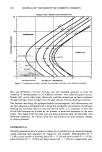
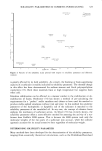
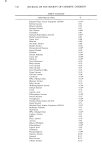
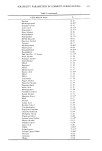
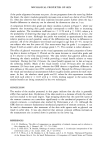
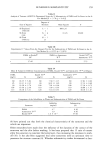
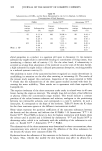
SUNSCREEN SUBSTANTIVITY 361 compound. It has been found that an increased hydration of the keratin molecules parallels an increased affinity for various substances (12). Apparently hydration causes unfolding of the keratin molecules, thus exposing more binding sites (1,12). In ad- dition, according to Scheuplein (13), it seems likely that the swelling and softening of the keratin filaments in water is accompanied by a partial dissolution of the cell mem- branes which open larger holes, which thus facilitates diffusion. Table VI contains the percentage of substantivity obtained in the in vitro studies. The results are almost identical to those determined using the in vivo method, as can be seen in Figure 1, where a comparison is made of the substativities of the three sunscreen substances obtained by the two methods. It seems desirable to establish a laboratory method for evaluating the relative resistance of sunscreen products to wash off, as a preliminary "screen" prior to testing on humans under actual use conditions. The static water bath immersion procedure carried out by Cumpelik (4) is one such method which, however, has all the limitations and problems o 5O 10 %S 1 2 3 10 50 %s "IN Vi TR O" Nlethod Figure 1. Comparison of substantivities of sunscreens obtained by in vitro and in vivo methods. O = PABA, ß = Amerscreen "P"©, ß = Escalol 507 ©.

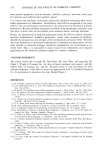
362 JOURNAL OF THE SOCIETY OF COSMETIC CHEMISTS involving experimentation with humans. Our finding that the in vitro method shows good correlation with the water bath immersion procedure indicates that probably a method like the one using keratin could, after further experimentation, be developed as a preliminary laboratory screen for evaluating the water resistance of sunscreen prod- ucts. REFERENCES (1) F. Bottari, E. Nannipieri, M. F. Saettone, M. F. Serafini, and D. Vitale, Substantivity of sunscreen a study on the interaction of four alkyl-4-aminobenzoates with keratin, J. Soc. Cosmet. Chem,, 29, 353-363 (1978). (2) O. J. Lorenzetti, J. Boltralik, E. Bushy, and B. Fortenberry, The influence of protein vehicles on the penetrability of sunscreens,_]. Soc. Cosmet. Chem., 26, 593 (1975). (3) I. Willis and A.M. Kligman, Aminobenzoic acid and its esters, Arch. Dermatol., 102, 405 (1970). (4) B. Cumpelik, Substantivity of sunscreen, Cosmet. Toiletries, 91, 61 (1976). (5) U. Hoppe, Neue hautaffine lichtschutzsubstanzen, J. Soc. Cosmet. Chem., 24, 317 (1973). (6) L. P•rez, G. Taucher, and O. Cori, Phitochemistry, 19, 183-187 (1980). (7) F. Kohout and J. Norwwod, Interpretation of research data analysis of variance, Am. J. Hosp. Pharm., 38, 96-104 (1981). (8) D. Schwartz, Mgthodes Statistiques, Deuxieme edition (Editions M•dicales Flaremarion, Paris, 1963). (9) R. Sayre, P. Poh Agin, D. Desrochers, and E. Marlowe, Sunscreen testing methods: In vitro predic- tions of effectiveness, J. Soc. Cosmet. Chem., 31, 133-143 (1980). (10) S. J. Katz, Relative effectiveness of selected sunscreens, Arch. Derm., 102, 466-468 (1970). (11) N.J. Van Abb•, The substantivity of cosmetic ingredients to the skin, hair and teeth, J. Soc. Cosmet. Chem., 25, 23 (1974). (12) D. E. Wurster and R. E. Dempski, Adsorption of lipid-soluble substances by human keratin, J. Am. Pharm. Ass. Sci. Ed., 49, 305 (1960). (13) R. J. Scheuplein, Mechanism of percutaneous adsorption, J. Invest. Dermatol., 45, 334 (1969). (14) N. J. Van Abb• and B. Cumpelik, J. Soc. Cosmet. Chem., 25, 23 (1974).
Purchased for the exclusive use of nofirst nolast (unknown)
From: SCC Media Library & Resource Center (library.scconline.org)