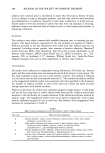
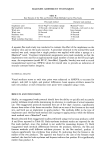
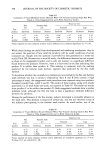
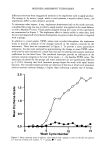
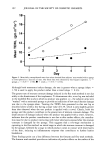
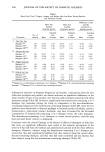
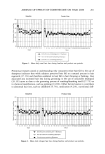
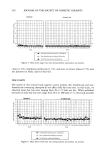
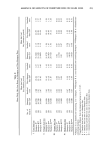
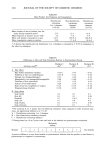
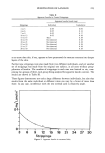
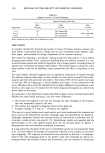
ABSENCE OF EFFECTS OF DIMETHICONE ON HAIR LOSS 199 accepted to participate and 404 subjects completed the study. Of the 36 subjects who did not complete the study, 29 subjects (6.6%) discontinued participation in the study prior to termination on their own initiative. The hair loss data from another six subjects (1.4%) were eliminated because of missing hair collections at the baseline and/or the treatment phases of the study. In this study, three subjects reported that they experienced adverse reactions during the product use phase of the study. These subjects were examined by the investigators, and their reactions were deemed to be unassociated with treatment. One subject claimed that she had hair loss. She was examined and no evidence of abnormal shedding was found. This subject continued to participate in the study uneventfully until termination. However, the hair loss information was not included in the data analyses because the subject switched from using the treatment shampoo to her own shampoo temporarily after she thought she experienced hair loss. A second subject discontinued participation after reporting that she developed a rash while using the product. Examination showed her scalp to be normal, and no rash was present. A third subject discontinued partic- ipation after reporting that she had an itchy and sore scalp. She was found to have dandruff. Each of the three subjects was on a different shampoo treatment. Statistical analyses conducted on the mean total, telogen, anagen, and broken daily hair loss rates at baseline and treatment, and differences in the total, telogen, anagen, and broken daily hair loss rates from baseline to treatment periods indicate no significant differences in the mean daily hair loss rates between the three shampoos tested in this study (Table I). The mean total hairs lost ranged from 28 to 35 hairs per day. These daily hair loss rates are consistent with reported findings in the normal population (2-3,8). No significant differences were noted in the mean daily hair loss rates during the baseline and treatment periods between the three treatment groups (Figures 1, 2, 3, 4). Statistical analyses conducted on the mean total, telogen, anagen, and broken daily hair loss rates on shampoo versus non-shampoo days indicate no significant differences in the hair loss rates between the three shampoos (Table II). However, as expected, signifi- cantly more total, telogen, and broken hairs were lost during the shampoo days as a result of the hair grooming process (Table II). Assessment of abnormal hair loss pre- to posttreatment using the pull test (3) indicate that there was no abnormal hair loss at pretreatment. Overall, less than one hair was obtained per subject in each trial of the pull test (3). There were no differences between the number of hairs lost from the pull test during the baseline or posttreatment exam- ination periods. Evaluations of the short hairs at the hair parts confirmed that subjects had tapered rather than blunt distal hair tips pre- and posttreatment, indicating normal hair regrowth rather than broken hairs. No abnormal hair loss was evident in these subjects at baseline and posttreatment. The subjects' medical and dermatologic history profiles were unre- markable. Scalp examinations performed during the baseline and posttreatment periods showed no significant differences in scalp flaking. No scalp erythema was observed in the pre- or posttreatment examinations.

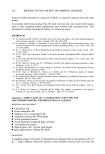
200 JOURNAL OF THE SOCIETY OF COSMETIC CHEMISTS Table I Mean Daily Total, Telogen, Anagen, and Broken Hair Loss Rates During Baseline and Treatment Periods Difference in hair Mean hair Mean hair loss/day loss/day loss/day (treatment to (baseline period) (treatment period) baseline period) Standard Standard Standard No. of error error error Treatment subjects Mean of means Mean of means Mean of means Total hair loss Shampoo I* 129 35.43 1.97 29.35 1.57 - 6.09 1.12 Shampoo II** 138 29.93 1.86 27.60 1.77 - 2.33 0.98 Shampoo TIT*** 137 31.62 1.96 27.77 1.65 - 3.85 1.21 IT. Telogen hair loss Shampoo I* 129 30.27 1.74 25.55 1.39 -4.72 0.99 Shampoo II** 138 24.90 1.64 23.35 1.54 - 1.56 0.81 Shampoo TIT*** 137 27.07 1.76 24.14 1.44 - 2.93 1.18 III. Anagen hair loss IV. Shampoo I* 129 0.06 0.02 0.02 0.01 -0.04 0.02 Shampoo II** 138 0.06 0.02 0.09 0.07 + 0.03 0.07 Shampoo III*** 137 0.05 0.02 0.01 0.002 -0.05 0.02 Broken hair loss Shampoo I* 129 5.10 0.60 3.77 0.44 - 1.32 0.35 Shampoo II** 138 4.96 0.53 4.16 0.58 - 0.80 0.49 Shampoo III*** 137 4.60 0.50 3.62 0.42 -0.88 0.34 * Shampoo I is a dimethicone-containing 2-in-1 shampoo. **Shampoo II is a non-dimethicone-containing shampoo. ***Shampoo III is a dimethicone-containing shampoo. Information obtained on shampoo frequencies and product consumption from the hair collection envelopes and product use diaries indicated no significant differences in the mean number of uses of test product over the four-week treatment period for the three treatment groups (Table III). However, significantly less dimethicone-containing 2-in-1 shampoo was consumed during the study in comparison to the non-dimethicone- containing shampoo and the dimethicone-containing shampoo (Table lll). Since the test products were distributed in identical packages to maintain product blindness, product characteristics, particularly product thickness, may have accounted for the decreased consumption of dimethicone-containing 2-in-1 shampoo versus the other shampoos. The dimethicone-containing 2-in-1 shampoo is a more viscous product, and this may have provided better control in dispensing. Consistent with the clinical findings of the absence of effects of shampoos on daily hair loss rates, no significant differences were noted in the subjects' perceptions of the severity of hair fall from the baseline and posttreatment periods with the three different shampoos. However, subjects using the dimethicone-containing 2-in-1 shampoo per- ceived that they had significantly healthier hair than subjects using the second dime- thicone-containing shampoo, and that they had more controlled and less flyaway hair than subjects using the non-dimethicone-containing shampoo (Table IV).
Purchased for the exclusive use of nofirst nolast (unknown)
From: SCC Media Library & Resource Center (library.scconline.org)