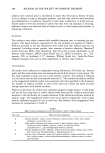
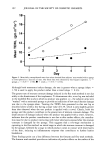
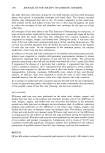
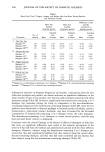
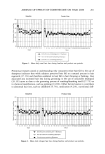
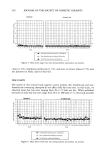
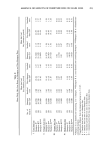
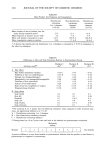
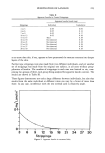
192 JOURNAL OF THE SOCIETY OF COSMETIC CHEMISTS 18- 'E I.l.I 16- 14- 12- 10- l i I I I I I I 2 3 4 5 Day Figure 2. Mean daily transepidermal water loss values obtained from subjects' arms washed with a sponge or towel plotted as a function of time. The fitted lines were obtained by least-squares regression. O = sponge, y = 8.29 + 1.70X ß = towel, y = 8.33 + 0.33X. Although both treatments induce damage, the rate is greater when a sponge (slope = 1.70) is used to apply the product rather than a towel (slope = 0.33). The greater rate of stratum corneum damage induced in the flex wash method is not due solely to the abrasiveness of the implement. To demonstrate this, a test leg was included in the modified flex study in which no product was applied, i.e., the subjects' arms were "washed" with a moistened sponge to provide an indication of how much barrier damage was due to the sponge alone. Treating the TEWL data generated in this test leg as described above yields a line having a slope value of 0.39, which is only slightly greater than that observed when the test product is applied with a towel. Clearly, both the sponge and the product contribute to the greater rate of stratum corneum damage. The small amount of damage induced when the product was applied with a towel, however, indicates that the product contribution is not due to skin surface effects the contribu- tion must be due to product interacting with lower skin layers exposed after the stratum corneum is damaged by the sponge. This suggests that a two-stage mechanism is operating in the flex method: an initial stage in which the stratum corneum is damaged by the sponge, followed by a stage in which product comes in contact with lower layers of the skin, inducing an inflammatory response that contributes to further barrier breakdown. These findings point out a key difference between the forearm and flex wash methods. The forearm wash method provides an indication of product effects on the surface of the

MILDNESS ASSESSMENT TECHNIQUES 193 skin, mimicking most normal-use conditions. Results from the flex wash method, however, are dependent on product interaction with the surface and lower layers of the skin. While there are instances where this type of exposure could occur during home use (for example, wound cleansing or product use on sun-damaged skin), this certainly cannot be considered the norm. Thus, while the forearm wash and flex wash methods both provide measures of product mildness, these measures are based on different exposure models. Given the consistency of the forearm wash and home-use data gener- ated with both soap and syndet bars, the forearm wash exposure model appears to be more relevant to actual consumer use conditions than is the flex wash exposure model. SUMMARY The mildness of several personal cleansing products was measured using two exaggerated wash protocols--a forearm wash method and a flex wash method. The forearm wash method more accurately predicted home-use results when soap bars were tested. Both exaggerated methods yielded similar mildness pictures when syndet bars were tested however, the forearm wash method was more discriminating. Experiments designed to measure implement effects show that the towel used in the forearm wash method induces minimal damage to the stratum corneum, while damage induced in the flex wash method is due to both implement and product effects. The results indicate that while both exaggerated methods provide a measure of product mildness, the methods are based on different models of consumer use and exposure. REFERENCES (1) P. J. Frosch and A.M. Kligman, The soap chamber method for assessing the irritancy of soaps, J. Am. Acad. Dermatol., 1, 35-41 (1979). (2) P. J. Frosch, "Irritancy of Soaps and Detergent Bars," in Principles of Cosmetics for the Dermatologist, P. H. Frost and S. T. Horwith, Eds. (C. V. Mosby, St. Louis, 1982), pp. 5-12. (3) G. Sauermann, A. Doerschner, U. Hoppe, and P. Wittern, Comparative study of skin care efficacy and in-use properties of soap and surfactant bars, J. Soc. Cosmet. Chem., 37, 309-327 (1986). (4) B. Komp, Skin compatibility tests--Importance in skin cleansing product development, Cosmet. Toiletr., 102, 89-94 (1987). (5) B. Komp and A. K. Reng, Developing ether sulfate-free surfactant formulations, Cosmet. Toiletr., 104, 41-45 (1989). (6) M. F. Lukacovic, F. E. Dunlap, S. E. Michaels, M. O. Visscher, and D. D. Watson, Forearm wash test to evaluate the clinical mildness of cleansing products,J. Soc. Cosmet. Chem., 39, 355-366 (1988). (7) D. D. Strube, S. W. Koontz, R. I. Murhata, and R. F. Theiler, The flex wash test: A method for evaluating the mildness of personal washing products, J. Soc. Cosmet. Chem., 40, 297-306 (1989).
Purchased for the exclusive use of nofirst nolast (unknown)
From: SCC Media Library & Resource Center (library.scconline.org)