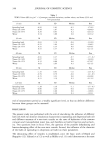
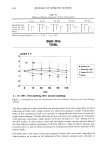
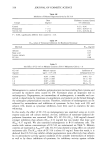
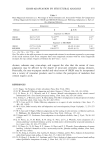
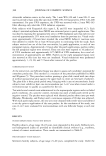
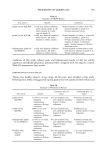
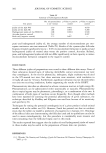
358 JOURNAL OF COSMETIC SCIENCE Table III Inhibition of Delayed Hypersensitivity by CC-516 Dose Groups (mg/ear) Thickness increased [mm] (% inhibition) Control -- Prednisolone 7 x 0.1 5% CC-516 7 x 50 0.22 ñ 0.04 0.05 ñ 0.04 (77.3) 0.15 _+ 0.03 (31.8) P 0.001, significantly different from control (n = 10). Table IV IC5o values of Tyrosinase Inhibitors for Mushroom Tyrosinase Materials IC5o (mg/ml) Arbutin 6.52 Kojic acid 0.37 Licorice extracts 2.87 CC-516 0.48 Table V The Effect of CC-516 on Melanin Contents of B-16 Melanoma Cells (n = 3) CC-516 Melanin content Inhibition of (mg/ml) (pg/1 x 10 6 cell) melanogenesis (%) Control 0.051 ñ 0.002 0.00 ñ 4.0 0.5 0.026 ñ 0.005 49.1 ñ 9.8 1.0 0.015 ñ 0.003 70.6 ñ 6.1 2.0 0.007 ñ 0.003 86.3 ñ 7.1 Melanogenesis is a series of oxidative polymerization reactions starting from tyrosine and activated by oxidative stress caused by UV. Tyrosinase plays an important role in melanogenesis. Dopaquinone, an intermediate of melanogenesis, is unstable and con- verted to dopachrome by tyrosinase or autoxidation, and melanin can be formed through the subsequent polymerization reaction. Therefore, inhibition of melanogenesis can be achieved by antioxidation and inhibition of tyrosinase. In fact, kojic acid (29) and arbutin (18), known as tyrosinase inhibitors, have been used in cosmetics for skin whitening. In this study, the effect of CC-516 on melanogenesis was examined using an in vitro enzyme assay and cell culture method. At first, inhibition of tyrosinase-catalyzed do- pachrome formation was examined (Table IV). CC-516 (IC5o: 0.48 mg/ml) showed stronger inhibition than arbutin (IC5o: 6.52 mg/ml) but was weaker than kojic acid (IC5o: 0.37 mg/ml). We also examined melanogenesis in B-16 melanoma cells. The results with various concentrations of CC-516 are summarized on Table V. Melanin contents are expressed as A4oo/106 cells. CC-516 also showed a strong effect on cultured melanoma cells. The IC5o value of CC-516 is about 0.5 mg/ml. From this result, it is deduced that CC-516 may inhibit cellular pigmentation more effectively than arbutin by its antioxidative activity against oxidation of the unstable intermediates of melanin as well as by direct inhibition of tyrosinase. Its inhibitory activity against cellular

ARECA CATECHU L. EXTRACT 359 pigmentation is thought to be largely due to its antioxidative property that can reduce oxidative stress and inhibit intermediate autoxidation rather than tyrosinase. The safety of CC-516 was evaluated by cytotoxicity on human fibroblasts and skin irritation testing. In cytotoxicity testing on human fibroblasts, the LD5o of CC-516 was about 50 mg/ml, with no change in cell proliferation at a concentration of 50 mg/ml. CC-516 inhibited cellular pigmentation by reducing oxidative stress and inhibiting tyrosinase and autoxidation, and it is expected to have a whitening effect on human skin. Also, CC-516 showed antioxidative activity in vitro as well as topical anti-inflammatory activity in vivo. REFERENCES (1) L. W. D. Wattenberg and L. K. T. Lart, Inhibition of Chemical Carcinogenesis by Phenols, Coumarins, Aromatic Isothiocyanates, Flavons, and Indoles (Plenum Press, New York, 1981). (2) D. E. Pratt, "Natural Antioxidants From Plant Material," in Phenolic Compounds and Their Efj•cts on Health II (ACS Symposium Series 547, American Chemical Society, Washington D.C., 1994). (3) M. Mizuno and T. Tanaka, Chemistry of Photo-Ingredients--Recent Advances of Crude Drugs Re- search," in The Science of Plants in Cosmetics (Fragrance Press, Tokyo, 1986), p. 2. (4) J. M. Pawelek, A.M. Chakraborty, and J. L. Bolognia, Cosmet. Toiletr., 107, 61-68 (1992). (5) G. Imokawa, FragranceJ., 14, 38•48 (1995). (6) M. Masuda, T. Tejima, and G. Imokawa, Cosmet. Toiletr., 111, 65-77 (1996). (7) K. K. Lee, J. H. Kim, J.J. Cho, and J. D. Choi, Int. J. Cosmet. Sci., 20, 1-12 (1998). (8) Y. Y. Shiau and M. Shear, Oral Surg., 47, 453 (1979). (9) I. Dockrat and M. Shear, Fourth Proceedings of the International Academy of Oral Pathology (Gordon and Breach Science Publishers, New York, 1970), p. 57. (10) V. Raghavan and H. K. Baruah, History, chemistry and utilization, Econ. Bat., 12, 315-325 (1958). (11) K. K. Wary and R. N. Sharan, 22nd Annual Meeting of ESRB, Brussels, September 11-17, 1989. (12) H. Ohkawa, N. Ohishi, and K. Yagi, Anal. Biochem., 95, 351 (1979). (13) Y. Fugita, I. Uehara, Y. Morimoto, and T. Okuda, Yakugak Zasshi, 108, 129-135 (1988). (14) G. L. Reissig and L. F. Leloir, J. Biol. Chem., 217, 959-963 (1955). (15) G. Tonnel, L. Thiabalt, and I. Ringlet, Endocrinol., 77, 625 (1965). (16) J.P. Tarayre, M. Barbara, M. Aliaga, and J. Tisne-Versailler, Arzneim Forsch/Drug Res., 40,(II) 10, 1125 (1990). (17) A. Vanni, D. Gastaldi, and G. Giunata, Amnal. di Chimica, 80, 35-60 (1990). (18) T. Maeda and M. Fukuda, J. Soc. Cosmet. Chem., 42, 361-368 (1991). (19) T.J. Mosmann, Immunol Methods, 63, 55 (1983). (20) B. N. Ames, Science, 221, 1256 (1983). (21) M. G. Simic and S. V. Jovanovic, "Inactivation of Oxygen Radicals by Dietary Phenolic Compounds in Anticarcinogenesis," in Food Phytochemicals for Cancer Prevention II (ACS Symposium Series 547, American Chemical Society, Washington D.C., 1994). (22) K. T. A. Davies, Oxidative Damage and Repair (Perganon Press, New York, 1991). (23) M. G. Simic and D. S. Bergtold, Mutation Res., 250, 17 (1991). (24) P. E. Hartman and D. M. Shankel, Environ. A--Mol Mutagen, 15, 145 (1990). (25) L. W. Wattenberg, Cancer Res., 52, 2015 (1992). (26) H. Masaki, FragranceJ., 8, 64 (1995). (27) C. K. Wang and W. H. Lee, J. Agri. Food Chem., 44(8), 2014 (1996). (28) M. Bouclier, D. Cavey, N. Kail, and C. Hensby, Pharmacol. Rev., 42, 127 (1990). (29) S.J. Lee, H.J. Baek, and H. P. Kim, Arch. Pharm. Res., 17, 31 (1994). (30) Y. Mishima, S. Hatta, and M. Inazu, Pigment Cell Res., 1, 367-374 (1988). (31) O. H. Lowry, N.J. Rosebrough, A. K. Fart, and R. T. Randall, J. Biol. Chem., 193, 256 (1951). (32) M. Dobois, K. A. Glles, and F. Smith, Analyt. Chem., 28, 350 (1956). (33) D. G. Roux, J. Soc. Leather Trades Chemists., 35, 322 (1951).
Purchased for the exclusive use of nofirst nolast (unknown)
From: SCC Media Library & Resource Center (library.scconline.org)