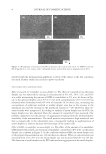
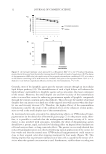
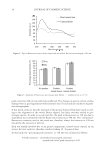
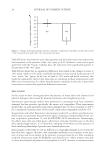
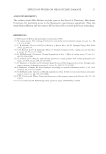
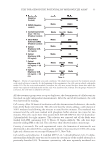
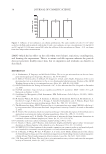
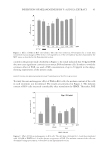
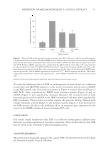
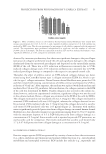
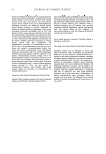
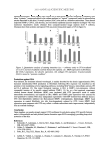
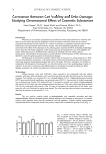
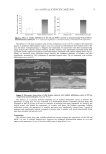
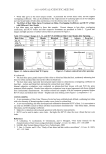
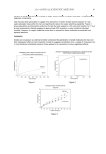
JOURNAL OF COSMETIC SCIENCE 38 DMSO (which had no effect on the cells when tested alone), sonication, centrifugation, and drawing the supernatant. This is to mimic real-life exposure wherein the particle does not penetrate healthy intact skin, but its impurities and residuals can dissolve in skin fl uids. REFERENCES (1) A. Vanhauwaert, P. Vanparys, and M. Kirsch-Volders, The in vivo gut micronucleus test detects clasto- gens and aneugens given by gavage, Mutagenesis, 16, 39–50 (2001). (2) B. Miller, F. Potter-Locher, A. Seelbach, H. Stopper, D. Utesch, and S. Madle, Evaluation of the in vitro micronucelus test as an alternative to the in vitro chromosomal aberration assay: Position of the GUM Working Group on the in vitro micronucleus test, Mutat. Res., 410, 81–116 (1998). (3) OECD Guideline for the Testing of Chemicals # 487: In Vitro Micronucleus Test. Proposed on December 21, 2006. (4) ECVAM statement: http://ecvam.jrc.it/publication/ESAC25_statement_MNT_20061128_C.pdf. Retrieved on October 4, 2010. (5) Guidelines for Mutagenicity Risk Assessment. EPA Publications. Federal Register, 51(185), 34006– 34012 (1986). (6) M. Kirsche-Vilders, M. Sofuni, T. Aardema, S. Albertini, D. Eastmond, M. Fenech, M. Ishidate Jr., S. Kirchner, E. Lorge, T. Morita, H. J. Norppa, A. Surralles Vanhauwaert, and A. Wakata, Report from the in vitro micronucleus assay working group, Mutat. Res., 540, 153–163 (2003). (7) The Micronucleus Assay: LPI/CCP protocol for in vitro micronucleus assay using CHO-K1 cells, http:// lpi.oregonstate.edu/CCP/micronucleus.html. Oregon State University Corvallis. Accessed on December 4, 2009. (8) M. Fenech, The cytokinesis-block micronucleus technique: A detailed description of the method and its application to genotoxicity studies in human populations, Mutat. Res., 285, 35–44 (1993). (9) P. I. Countryman and J. A. Heddle, The production of micronuclei from chromosome aberrations in irradiated cultures of human lymphocytes, Mutat. Res, 41, 321–332 (1976). (10) Commonly used tissue culture techniques, Sigma Catalog, 1989, p. 1492. (11) O. Biondi, S. Motta, and P. Mosesso, Low molecular weight polyethylene glycol induce chromosome aberration in Chinese hamster cells cultured in vitro, Mutagenesis 17(3), 261–164 (2002). (12) SCCNFP/0532/01, Final opinion of the scientifi c committee on cosmetic products and non-food prod- ucts intended for consumers concerning benzoic acid and sodium benzoate (June 2002). (13) R. I. Pakunlu, Y. Wang, W. Tsao, V. Pozharov, T. J. Cook, and T. Minko, Enhancement of the effi cacy of chemotherapy for lung cancer by simultaneous suppression of multidrug resistance and antiapoptotic cellular defense: Novel multicomponent delivery system, Cancer Res., 64, 6214–6224 (2004). (14) J. M. Parry and E. M. Parry, The use of the in vitro micronucleus assay to detect and assess the aneugenic activity of chemicals, Mutat. Res., 607, 5–8 (2006). Figure 5. Infl uence of test substances on cellular proliferation. The same number of cells (3 × 10⁴) were seeded in the fl ask and incubated with media (1) and a test substance in two concentrations: 0.2 mg/ml (2) and 0.3 mg/ml (3). Cells were counted 48 h after the addition of the test substances. Means ± S.D. are shown from four independent measurements.

TEST FOR GENOTOXIC POTENTIAL BY MICRONUCLEI ASSAY 39 (15) L. M. Green, J. L. Reade, and C. F. Ware. Rapid colometric assay for cell viability: Application to the quantitation of cytotoxic and growth inhibitory lymphokines, J. Immunol. Meth., 70, 257–268 (1984). (16) H. Ahu, I. Rusyn, A. Richard, and A. Tropsha, Use of cell viability assay data improves the prediction accuracy of conventional quantitative structure activity relationship models of animal carcinogenicity, Environ. Health Perspect., 116(4), 506–513 (2008).
Purchased for the exclusive use of nofirst nolast (unknown)
From: SCC Media Library & Resource Center (library.scconline.org)