SOCIETY OF COSMETIC CHEMISTS OF GREAT BRITAIN 315 2. A vacancy exists with Messrs. Steiner, which may be of interest to you, details being as follows. It will be noted that the matter is urgent, and Messrs. Steiner state that any interested party should make imme- diate application. "Cosmetic Chemist of wide experience required by Steiner Hair & Beauty Product Divisio'n to take charge Research Laboratory and Manu- facturing control. Applications invited immediately to control new laboratory opening December 1, 1954. Highly remunerative position with imaginative and alive organization. Write Managing Director, 66 Grosvenor Street, London, W.I." 3. The Acton Technical College proposes, if sufficient interest is forth- coming, to run a course of twelve lectures on "Production and Utilization of Glyceride Oils and Fats." It is tentatively arranged for Friday even- ings during the Spring term of 1955. We shall be glad to send further details on request. 4. We now have 190 members and associates. By the end of the year we hope to top the 200 mark. The success and standing of the Society and what it can offer its members and associates is so much de- pendent on strength in terms of numbers, that the council makes no apology for asking again for your help in obtaining recruits. We will gladly and immediately do what is necessary if you will let us know the names of anyone interested. 5. S. J. Palling has resigned from the post of Honorable Secretary, and at a recent council meeting, a vote of thanks was expressed to him for his work, and the council knows that you will heartily endorse this. 6. A number of subscriptions for 1954 are unpaid. Those to whom this reminder applies are asked to let the Honorable Treasurer have their remittance as soon as possible, so easing his work of sending further re- minders. 7. The Annual Dinner and Dance will take place at the Care Royal, Regent Street, W.1, on Friday, January 28th. We hope for as large a gathering as possible, tickets are limited to about 120, and you should con- tact the Honorable Treasurer as soon as you can, with your remittance at 30/- each. The guests will include our old friend Freddie Wells, who is so well known to you all that you need no further information from me, and Sir Hugh Linstead, OBE, MP, Secretary of the Pharmaceutical Society.

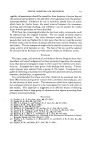
CORRESPONDENCE Louis Schwartz, M.D. 915 Nineteenth Street, N. W., Washinl•ton 6, D.C. November 5, 1954 Mr. M. G. deNavarre, Chairman Publications Committee JOVRH^L or THE SOCIETY OF COSMETIC CHEMISTS 404 Lothtop Road Grosse Pointe Farms 36, Michigan Dear Mr. aleNavarre: I would like to comment on the article by Dr. Peck in Volume V, Num- ber 2, of T•E JOVRH^L. By far the largest part of the article from page 113 to 124 is a review of material previously published. Much of it, as Peck states, is in the book "CosMETICS AND DERMATITIS," by Schwartz and Peck. From page 124 on to page 126 he comments on the article "Paraphenylenediamine Hair Dyes," ./lrch. Dermatol. and Syphilol., 66, 233 (1952), by Schwartz and Barban. Only two paragraphs on page 126 are observations by himself. There Peck states that: "In every instance of true cases of allergic contact dermatitis due to hair dye which I have studied, they not only gave a positive reaction to the hair dye which they used, but to a 1 or 2 per cent para solution. In order to avoid the primary irritant effect of the ammonia used in the hair dye it has been my habit after applying the test solution to allow it to dry thoroughly on the skin for at least ten minutes before the patch is applied. An open patch test is always used at the same time." The test solution does not "thoroughly dry" on the skin in ten min- utes. He does not state how many "true cases of allergic contact derma- titis due to hair dye" he has studied, and he does not state whether the positive patch test reaction occurred under the covered patch or over the open patch. One would expect to get a positive reaction to a patch test in a case of "true allergy." That is the basis of the pre-use test re- quired by the Food and Drug Administration. He states that, "There are always one or two of the operators who suffer from contact dermatitis from hair dyes .... " He admits this is poor argument to indicate the possible hazard of hair dyes for home use. He gives no data which proves that the beauty parlor operator's contact dermatitis is due to hair dyes. Beauty parlor operators handle many substances which are much more likely to cause dermatitis than are the hair dyes. For instance, shampoos, hair tonics containing alcohol and resorcin, nail lacquers, etc. In addition to this, when the operators handle the hair dyes they wear rubber gloves to prevent the paraphenylenediamine hair dyes from staining their hands, a stain very difficult to remove. This 316
Purchased for the exclusive use of nofirst nolast (unknown)
From: SCC Media Library & Resource Center (library.scconline.org)