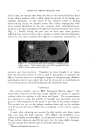
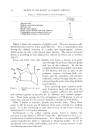
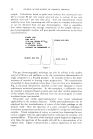
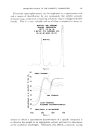
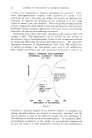
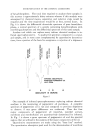
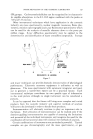
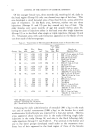
340 JOURNAL OF THE SOCIETY OF COSMETIC CHEMISTS gently in contact with water (2-4). The alcohol, as it diffuses from the oil into the water, carries with it some oil (forming a three-component phase in the immediate vicinity of the interface). As the alcohol diffuses further into the water, the associated oil is thrown out of solution it becomes "stranded" in the water in the form. of fine emulsion drops. An emulsion of water in oil may also be formed on the oil side of the interface, since the alcohol in the oil may initially permit some water to dissolve. As the alcohol passes into the aqueous phase, this water becomes "stranded" in the oil. (iii) NECATIVE INTERFACIAL TENSION If the interfacial tension 7 is locally negative, the area of the interface tends to increase spontaneouly. This occurs when an adsorbed film is present under conditions such that the surface pressure •r (where •r = 3'0 - 3') of m. aterial adsorbed in the interface exceeds the tension 3'0 of the clean interface, i.e. •r 3'0 a zero interfacial tension will also be un- stable, since chance vibrations and thermal fluctuations (i.e. entropy effects) will tend to break up the interface. As the area of the interface increases, the interfacial tension will become less negative, the surface pressure of the adsorbed film decreasing till finally •r is a little less than 3'o, i.e. the over-all interfacial tension is low and positive. This appears to be the mechanism operative in forming spontaneous emulsion when oleic acid dissolved in oil is placed on aqueous alkali (5). To choose between these three possible explanations is not easy, and sometimes more than one of the processes may be occurring. However, it is possible to devise tests (6, 7) to apply to any given experimental system to determine which mechanism is operative. EXAMPLES OF MECHANISM (i) No example of this is definitely established, though it is perhaps the most widely accepted mechanism (2). The obvious system to test for this mechanism {s that of methyl or ethyl alcohol in toluene in contact with water (8). This shows strong spontaneous emulsification (Fig. 1), and it also shows marked interfacial turbulence (9). Surprisingly, however, the emulsification in these systems is accounted for by the second mechanism, since when the interfacial turbulence is completely suppressed by adding a little detergent to the water, by dissolving salt in the water, or by spread- ing a protein film at the interface (6), the spontaneous emulsion {s still produced (Fig. 2). The only effect of the elimination of the interfacial turbulence is that the emulsion is no longer thrown violently away from the interface, but instead streams off quietly. The turbulence is thus no,' responsible (as many had previously thought) fo,' the ernt•lqification in this system.

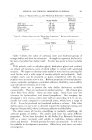
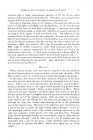
THE SEVENTH SPECIAL AWARD 341 EXAMPLES OF MECHANISM (ii) \Ve have eliminated the first mechanism for emulsions formed spon- taneously from solutions of methanol or ethanol in toluene, placed gently in contact with water prevention of the turbulence has but little effect on the emulsification. Further, the interfacial tension is always positive, of the order 10 dynes cm., leaving mechanism (ii) by default. This can be confirmed bv presaturating the toluene-alcohol mixture with water the diffusing alcohol leaves much water stranded in the oil, as well as oil stranded in the water. This mechanism is likely whenever the third component increases considerably the mutual solubility of the oil and the water: thus mixtures of an oil with sulfonated castor oil and sodium oleate, placed in contact with water, emulsify by the diffusing sodium oleate carrying oil with it into the water (10). The same explanation (6, 7) also fits the spontaneous emulsification seen when a solution in petrol-ether of commercial sodium dodecyl benzene Figure 1.--Drop of toluene containing 10% ethanol, formed in pure water. The drop is oscillating vigorously, and the emulsion is thrown off in turbulent eddies. Flash photograph (6).
Purchased for the exclusive use of nofirst nolast (unknown)
From: SCC Media Library & Resource Center (library.scconline.org)