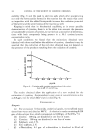
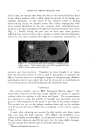
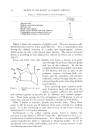
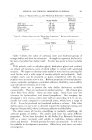
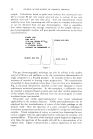
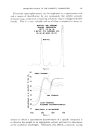
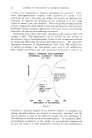
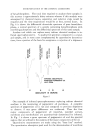
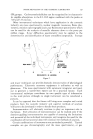
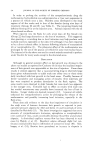
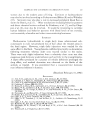
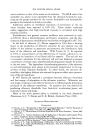
344 JOURNAL OF THE SOCIETY OF COSMETIC CHFMISTS Figure 3.--Xylene does not form a drop in an aqueous solution of dodecylamine hydro- chloride, as the interfadal tension is too low. Picture taken at 80 frames per second with a cin•-camera operating through a microscope (17). Steel tip as in Fig. 4 diameter of cylinder of oil •0.0! cm. Figure 4.--A drop of xylene is now being formed against the density gradient. Single frame from sequence at 80 frames per second, showing how the emulsion streams away from the freshly formed interface. The movements on the surface of the drop are quite in-- sufficient to explain the formation of the spontaneous emulsion (17). External diameter of end of tip is about 0.05 cm.

THE SEVENTH SPECIAL AWARD 345 olation). It appears that the spontaneous emulsion forms slightly when the tension of the interface is a few tenths of a dyne cm. -• below zero, and becomes pronounced when .• = -1 dyne cm. -•, i.e. when the pressure of the intel facial monolayer, adsorbed form both the oil and the water phases, exceeds by 1 dyne cm -t the tension of the clean interface. In general, ionic and nonionic surface-active agents adsorb almost in- dependently of each other, thus pointing to a general method of obtaining very small or negative interfacial tensions. Local lowerings of the interfacial tension to values below zero are also responsible for the spontaneous emulsification of an oil (e.g., xylene) in aqueous dodecylamine hydrochloride solutions of concentration in excess of M/10. This phenomenon involves only the passage of the oil into the aqueous phase, where it is ultimately solubilized: (16) there is no diffusional reason why excess of oil should appear on the aqueous side of the interface. The explanation (7, 17) is that the dodecylamine ions are strongly adsorbed [possibly with other surface-active impurities (18)] and momentarily reduce the interfacial tension to a negative value: the interface then in- creases in area by spontaneous emulsification (Figs. 3 and 4). Next, the passage of oil into the aqueous phase (as emulsion drops and as solubilized oil) reduces the concentration of free dodecylamine ions near the interface to a level from which adsorption is no longer sufficient to make the inter- facial tension negative. However, stray convection currents or density differences occasionally sweep fresh, undepleted solution of the dodecyl- amine into the interface through the enveloping emulsion, thus momentarily lowering the interfacial tension locally to below zero (17). This fluctuation of the interfacial tension causes both the kicking and the spontaneous emulsification. SUMMARY If the interfacial tension is negative, this is a sufficient explanation, provided the monolayer is not too highly viscous, and provided also that there is not complete miscibility at the interface. Emulsification by th's mechanism occurs at sharp concentration limits. If, however, the interfacial tension is appreciably positive and there is no interfacial turbulence, then the "diffusion and stranding" mechanisms must be operative. If the interfacial tension is positive and there is interfacial turbulence, t•rther investigation (e.g., by inhibiting the turbulence with a monolayer of adsorbed protein) is necessary. REFERENCES (1) Gad, J.,/itch./inat. u. Physiol., Leipzig, 181 (1878). Briicke,/inz./ikad. Wiss. lfien., 79, 267 (1879). Quincke, lfiedman's/Inn., 35, 593 (!888).
Purchased for the exclusive use of nofirst nolast (unknown)
From: SCC Media Library & Resource Center (library.scconline.org)