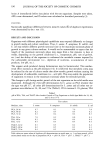
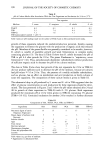
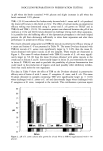
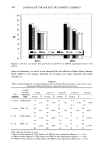
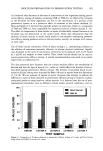
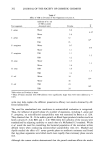
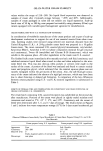
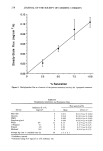
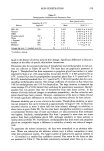
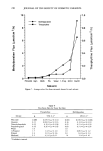
SKIN PENETRATION 241 imum of 14-fold for methanol. The degree of flux enhancement decreased with ethanol and further still with 1-propanol. Neat alcohols applied to human cadaver skin exhib- ited this same pattern (11). Methanol altered skin permeability about 3.5 times more than ethanol, while 1-propanol had little effect. Octanol greatly increased theophylline flux through hairless mouse skin in an irreversible manner (10). Propylene glycol treatment resulted in a moderate decrease in flux relative to aqueous systems. The more polar solvents PEG 400 and glycerin had a negative effect on flux. Dimethylisosorbide, a glucitol derivative, previously described as a non-damaging sol- vent (12), produced flux ratios between those of propylene glycol and the other polyols. Flux from PEG 400 was slightly less than one tenth that from water (Table V). Zatz and Dalvi (13), employing hairless mouse skin, also found a tenfold difference in ben- zocaine flux between aqueous and PEG 400 suspensions. Flux ratios for PEG 400, dimethylisosorbide, and ethanol do not differ significantly between permeants (Table V). The flux ratios for glycerin, propylene glycol, and methanol were greater with methylparaben, while theophylline exhibited a higher flux ratio for 1-propanol treat- ment. Thus, there are some quantitative differences when comparing permeants, but there is qualitative agreement in flux ratio for each solute studied. If skin were a simple, homogeneous membrane, we might expect the flux ratios shown in Table V to apply across the board to any solute. Consequently, it would be possible to anticipate the flux of any compound in a given solvent by knowing the flux ratio for the solvent and the results of a single penetration experiment from a reference solvent. However, this scenario is complicated by the fact that skin is a composite membrane resulting in multiple permeation pathways. The rather wide range of flux ratios suggests that all of the solvents included in this study must be thought of as interactive none are inert. As to the nature of the various interactions, we can only speculate without additional data. Among the possibilities are alteration of stratum corneum hydration, increase in the normal fluidity of the intercel- lular lipid layer, and extraction of lipid and/or other components. Methanol, of the alcohols studied, has the greatest effect on skin properties. All of the solvents, with the exception of water itself, would be expected to pull water out of the stratum corneum. Dehydration may explain the rather low flux levels from PEG 400, glycerin, and dimethylisosorbide. There is evidence that normal alcohols can extract lipid material from the stratum corneum (14,15). As with previous studies (13), there is no evidence that penetration from propylene glycol is greater than from water. Progressive hydroxylation of propane (from 1-pro- panol to propylene glycol to glycerin) results in a stepwise decrease in permeability. ACKNOWLEDGMENTS The authors are grateful for the support of an educational grant from the Society of Cosmetic Chemists and a project grant from the Upjohn Company. REFERENCES (1) Facts and Comparisons 0. B. Lippincott Co., St. Louis, MO, 1988). (2) B. J. Poulsen, in Design of Topical Products: Biopharmaceutics, Drug Design, E. J. Ariens, Ed (Academic Press, New York, 1973), Vol. 4, pp 149-192.

242 JOURNAL OF THE SOCIETY OF COSMETIC CHEMISTS (9) (10) (11) (15) (3) B. Idson, Percutaneous absorption, J. Pharm. Sci., 64, 901-924, 1975. (4) J. N. Twist and J. L. Zatz, Influence of solvents on paraben permeation through idealized skin model membranes, J, Soc. Cosmet. Chem., 37, 429-444, 1986. (5) J. N. Twist and J. L. Zatz, Membrane-solvent-solute interaction in a model permeation system, J. Pharm. Sci., 77, 536-540, 1988. (6) J. N. Twist and J. L. Zatz, A model for alcohol-enhanced permeation through polydimethylsiloxane membranes, J. Pharm. Sci., in press. (7) S. DelTerzo, C. R. Behl, R. A. Nash, N.H. Bellantone, and A. W. Malik, Evaluation of the nude rat as a model: Effect of short term freezing and alkyl chain length on permeability of n-alkanols and water, J. Soc, Cosmet. Chem., 37, 297-307, 1986. (8) E. Vander Merwe, C. Ackerman, and C. J. Van Wyk, Factors affecting the permeability of urea and water through nude mouse skin in-vitro. I. Temperature and time of hydration, lnt. J. Pharm., 44, 71-74, 1988. J. R. Bond and B. W. Barry, Limitations of hairless mouse skin as a model for in-vitro permeation studies through human skin: Hydration damage, J. Invest. Dermatol., 90, 486-489, 1988. K. B. Sloan, S. A. Koch, K. G. Siver, F. P. Flowers, Use of solubility parameters of drug and vehicle to predict flux through skin,J. Invest. Dermatol., 87, 244-252, 1986. R. J. Scheuplein and I. H. Blank, Mechanism of percutaneous absorption. IV. Penetration of non- electrolytes (alcohols) from aqueous solutions and from pure liquids, J. Invest, Dermatol., 60, 286-296, 1973. (12) B. W. Barry, D. Southwell, and R. Woodford, Optimization of bioavailability of topical steroids: Penetration enhancers under occlusion, J. Invest. Dermatol., 82, 49-54, 1984. (13) J. L. Zatz and U. G. Dalvi, Evaluation of solvent-skin interaction in percutaneous absorption, J. Soc. Cosmet. Chem., 34, 327-334, 1983. (14) K. Knutson, R. O. Potts, D. B. Guzek, G. M. Golden, J. E. McKie, W. J. Lambert, and W. I. Higuchi, Macro- and molecular physical-chemical considerations in understanding drug transport in the stratum comeurn. J. Control. Rel., 2, 67-87, 1985. T. Kai, V. Mak, R. O. Potts, and R. H. Guy, Mechanism of skin penetration enhancement: Effect of n-alkanols on the permeability barrier. Presented at the 15th International Symposium on Controlled Release of Bioactive Materials, Abstract 124, Basel, Switzerland, 1988.
Purchased for the exclusive use of nofirst nolast (unknown)
From: SCC Media Library & Resource Center (library.scconline.org)