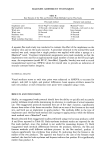
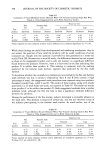
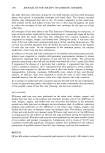
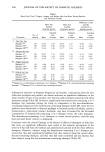
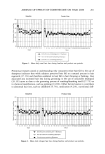
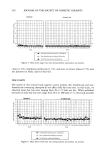
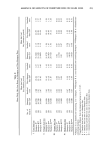
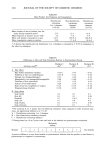
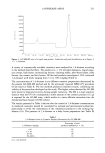
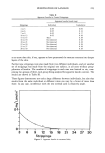
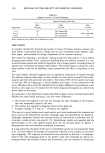
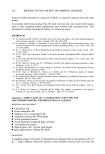
1,4-DIOXANE ASSAY 211 1 18.• 19.• 2•.• 21 .•) 22.•) 23.•) 24.0 25.•) 2•.•) 7 lrne (m•n.) Figure 2. GC-SIM-MS trace of a liquid soap product. Conditions and peak identification as in Figure 1 1 = 1,4-dioxane. A variety of commercially available cosmetics were analyzed for 1,4-dioxane according to the method described here. The products (n = 25) included shampoos, liquid soaps, sun creams, bath foams, moisturizing lotions, cleansing milks, after-shave balms, baby lotions, day creams, and hair lotions. Of the total products investigated, 56% contained 1,4-dioxane with levels ranging from 3.4 to 108.4 mg/kg (Table I). The concentrations of 1,4-dioxane in six different cosmetic preparations determined by the present GC-SIM-MS method and by the previously reported HPLC-UV procedure (9) are listed in Table II. The two methods produced consistent results, confirming the validity of the procedure developed in this study. The higher values obtained by GC-MS were traced to improved recovery during sample extraction. The MS is a more sensitive detector than the UV (9) consequently a lower amount of the cosmetic product (0.2 g) is required for the GC-MS assay, which results in a more efficient extraction into the dichloromethane-hexane (20:80) solvent. The results presented in Table I indicate that the control of 1,4-dioxane contaminations in marketed cosmetics should be considered by national and international authorities, particularly to verify the conformance of the commercial products to the existing leg- islation (16). The presence of 1,4-dioxane in a baby lotion preparation (see Table II) Table I 1,4-Dioxane Levels in Cosmetic Products Determined by GC-SIM-MS 1,4-Dioxane (mg/kg) Percentage of total products examined (n -- 25) n.d. 44 3.4-10 16 10-50 28 50-108.4 12 n.d., not detected.

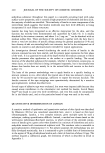
212 JOURNAL OF THE SOCIETY OF COSMETIC CHEMISTS Table II Comparison of 1,4-Dioxane Concentrations in Cosmetics Determined by GC-SIM-MS and HPLC-UV (9) Concentration* (mg/kg) Sample GC-SIM-MS HPLC-UV Day cream n.d. n.d. Baby lotion 10.9 9.1 Shampoo 33.4 24.6 Hair lotion 108.4 92.8 Moisturizing lotion 3.7 n.d. Bath foam 41.4 35.7 * Mean value of three determinations. n.d., not detected. gives reason for particular concern. It should also be stressed that even when the 1,4-dioxane content is low, under appropriate conditions of cosmetic use, long-term application to skin is common. CONCLUSIONS A capillary GC method using selected-ion monitoring MS detection has been developed for the rapid (taking less than 40 min to perform) and specific determination of 1,4- dioxane in commercial cosmetics. The procedure is less laborious than others reported in the literature, as time-consuming steps including solvent partitions (6), heating (6,8), or extensive calibrations (7,8) are not required. Moreover, the use of multisample apparatus designed for solid-phase extraction cartridges enables eight isolation proce- dures to be performed simultaneously. In addition, the computer-controlled GC-mass selective detection system provides SIM-MS specificity at a fraction of the cost of larger MS apparatus and requires less operator training and experience. Because of the minimal sample preparation, ease of operation, accuracy, and precision, the proposed method is suitable for routine quality control analyses of finished cosmetic products. REFERENCES (1) G. Barker, "Surfactants for Cosmetic Macroemulsions: Properties and Applications," in Surfactants in Cosmetics, M. M. Rieger, Ed. (Marcel Dekker, New York, 1985), pp. 18-21. (2) P. Thau, "Surfactants for Skin Cleansers," in Surfactants in Cosmetics, M. M. Rieger, Ed. (Marcel Dekker, New York, 1985), pp. 354-355. (3) D. J. Worsfold and A.M. Eastham, Cationic polymerization of ethylene oxide, J. Am. Chem. Soc., 79, 897-899 (1957). (4) B. A. Waldman, Analysis of 1,4-dioxane in ethoxylated compounds by gas chromatography/mass spectrometry using selected ion monitoring, J. Soc. Cosmet. Chem., 33, 19-25 (1982). (5) S. Scalia, Reversed-phase high-performance liquid chromatographic method for the assay of 1,4- dioxane in sulphated polyoxyethylene alcohol surfactants, J. Pharm. Biomed. Anal., 8, 867-870 (1990). (6) D. B. Black, R. C. Lawrence, E. G. Lovering, and J. R. Watson, Gas-liquid chromatographic method for determining 1,4-dioxane in cosmetics, J. Assoc. Off. Anal. Chem., 66, 180-183 (1983). (7) H. Beernaert, M. Herpol-Borremans, and F. De Cock, Determination of 1,4-dioxane in cosmetic products by headspace gas chromatography, Belg. J. Food Chem. Biotechnol., 42, 131-135 (1987).
Purchased for the exclusive use of nofirst nolast (unknown)
From: SCC Media Library & Resource Center (library.scconline.org)