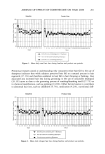
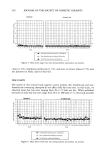
J. Soc. Cosmet. them., 43, 219-227 (July/August 1992) Short-term penetration of lanolin into human stratum corneum E. W. CLARK, Westbrook Lanolin Company, Laisterdyke, Bradford, West Yorkshire, England, BD4 8A U. Received January 23, 1992. Synopsis Lanolin is readily absorbed by the human skin, and since it contains both free and esterified cholesterol and fatty acid esters, it has at least in part some similarities to the intercellular lipids in stratum corneum. It is widely used as an effective emollient. As the first stage of a wider investigation into the mode of action of lanolin on the skin, the present study examines the extent of penetration of lanolin into the stratum corneum without attempting to find, at this stage, whether the substance is located intercellularly, in hair follicles, in sweat ducts, or elsewhere. It is already known not to lie merely in surface irregularities. Anhydrous lanolin was applied at a loading of 2 mg cm- 2 to an area of 2 x 1 cm of the flexor aspect of the inner forearm (in vivo). The treated area of stratum corneum was then removed in layers by 30 successive tape strippings, and lanolin contents of the strippings were determined quantitatively by a spectrophotometric method based on the Liebermann-Burchardt reaction for steroids, developed to give a limit of determination in the region of 50 }xg of lanolin and a sensitivity of 1.25 mg lanolin per unit absorbance on the linear portion of the calibration graph. The method is described in detail. Total recovery of lanolin was between 98.8 and 103.1% of that applied, the major portion being found in the first 12 strippings but traces still being detectable in the deepest layers adjacent to the stratum lucidum. The profile of lanolin content in the stratum corneum, when graphed, gave a curve very similar to another one previously obtained in a pilot study, and also similar to a curve published by other workers which related corneocyte removal by tape stripping to a depth within the stratum corneum. There appeared to be no significant transport of lanolin through the stratum corneum into underlying layers. Interference in the spectrophotometric method by the adhesive tape and other materials used was taken into account. The extent of interference by natural steroids in the stratum corneum was quantified by separate experiments and was found to be variable but very small. INTRODUCTION Intercellular lipids have been shown to influence the moisture-retaining capacity of human stratum corneum (1,2), and a bilayer arrangement of polar compounds such as cholesterol, glycerides, fatty acids, ceramides, and phospholipids has been demon- strated. A review was given by Ward and du Reau (3). Lanolin (the term implies the 219

220 JOURNAL OF THE SOCIETY OF COSMETIC CHEMISTS anhydrous substance throughout this paper) is a naturally occurring lipid with polar surface-active properties, and it contains a high proportion of cholesterol and fatty acids, the majority of which are esterified. This similarity of lanolin to some components of the intercellular lipids suggests that lanolin molecules may have little difficulty in being incorporated in such bilayer structures. Lanolin has long been recognized as an effective moisturizer for the skin, and this function has recently been demonstrated and quantified by Clark (4). It is readily absorbed by the stratum corneum, and about 2 to 3 mg cm-2 can be absorbed with no residual surface film. These attributes of the substance, together with the facts that it shows a very low incidence of specific allergy among the general population (5-9) and has a history of safe use extending back over centuries, has led to the widespread use of lanolin in cosmetics and pharmaceuticals intended for topical applications. An investigation directed toward elucidating the mode of action of lanolin in the stratum corneum has now been started, and the present paper represents the first phase of the work. It is a quantitative study of the depth within the stratum corneum to which lanolin penetrates after application to the surface at a specific loading. The actual location of the absorbed substance (for example, whether it lies between corneocytes, in sweat ducts, or in hair follicles) is being investigated separately, but it has already been shown that lanolin does not merely lie in the natural folds and crevices in the skin's surface (1). The basis of the present methodology was to apply lanolin at a specific loading to stratum corneum in vivo, after which the treated area of skin was removed a layer at a time by 30 successive tape strippings, sufficient to expose the stratum lucidum. The lanolin contents of the tape strippings were quantitatively determined by a sensitive spectrophometric method described later. Several types of adhesive tape were evaluated, but most were impracticable because they caused severe interference in the colorimetric test method for lanolin. Scotch Magic Tape © was found to cause very little interference, and even this could be compensated for in the blanks used, and so this particular brand of tape was used in the work. QUANTITATIVE DETERMINATION OF LAiNOLIN A sensitive method of qualitative and quantitative analysis of skin lipids was described by Okamoto (10) but was considered unsuitable here, since it is based on thin layer chromatography. Lanolin, a very complex mixture, gives multiple spots by such a technique, making quantification difficult. Instead, a method was chosen based on the well-known Liebermann-Burchardt reaction, in which certain of the steroidal compo- nents of lanolin give a green color when dissolved in a mixture of chloroform and acetic anhydride treated with concentrated sulphuric acid. The resultant color is amenable to spectrophotometric determination (11). For present purposes the methodology was not fully developed statistically, but it is estimated to give a reliable limit of determination in the region of 50 Ixg of anhydrous lanolin and a limit of detection of about 10 Ixg. The method requires a calibration graph, the derivation of which is described in detail in Appendix 1.
Purchased for the exclusive use of nofirst nolast (unknown)
From: SCC Media Library & Resource Center (library.scconline.org)