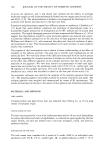
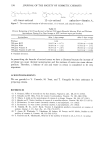
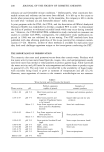
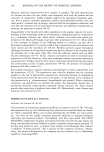
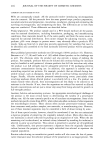
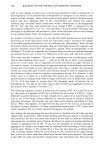
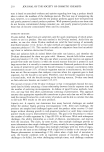
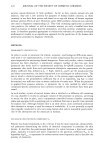
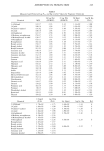
200 JOURNAL OF THE SOCIETY OF COSMETIC CHEMISTS ordinary use and foreseeable misuse conditions." Unfortunately, what constitutes fore- seeable misuse and ordinary use has never been defined. It is left up to the courts to decide when prosecuting specific cases. In the meantime, the company is left to decide for itself what "ordinary use and foreseeable misuse" really means. A joint program with the FDA, the CTFA, and the Association of Official Analytical Chemists (AOAC) was established to develop a standard PET in order "to demonstrate the ability of products to withstand microbial insult which may occur during intended use." However, the CTFA/AOAC/FDA collaborative study conducted no consumer use studies to correlate with PETs consequently, the collaborative study (publication ex- pected in 1996) was not validated by in-use testing. Two PET methods have been published with data allowing prediction of the in-use potential for consumer contam- ination (17-20). However, neither of these methods is available for replication since they both used challenge organisms unique to the investigators conducting the PET. THE IMPORTANCE OF PRESERVATION The cosmetics that most need preservatives are those that contain water. Products with low water activity (non-water based lipsticks, rouges, talcs, and antiperspirants) usually need little more than methyl or ethyl parabens to protect against fungi. Table I provides the water activity and pH limits for microorganisms and relates these to product types in general (21,22). The only limit to microbial life is the availability of liquid water, with microbes being found to grow at extremes of temperatures and pH (23,24). However, most organisms of concern to the cosmetic microbiologist are not extremo- Table I Water Activity and the Potential for Growth Problem organisms Examples of Water activity pH capable of growth cosmetic products 0.98-1.00 pH 5-9 Most Gram positives and negatives 0.95-0.97 pH 5-9 Most Gram positives and Liquid make-ups and eye area negatives (Pseudomonas begins products Below 5.5 0.92-0.95 Above 5.5 o. 90-0.92 Below 5.5 pH 5-9 0.80-0.90 pH 5-9 0.70-0.80 pH 5-9 0.65-0.70 pH 5-9 0.60-0.70 pH 5-9 Below 0.60 pH 5-9 to be limited) Some Gram negatives and most Gram positives (Pseudomonas limited) Few Gram negatives and most } Gram positives Most Gram positives Gram positive Lactobacilli and Staph. Staph., molds, yeasts Molds, yeasts Osmotolerant yeasts } Osmotolerant and xerophilic molds None Shampoos and emulsion products Some hair conditioners Some pressed powders Some rouges (non-water based) Lipsticks (non-water based) Some talcs Some antiperspirants

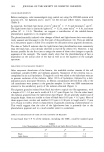
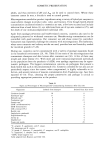
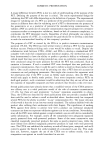
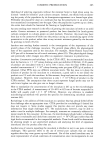
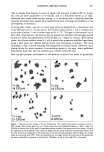
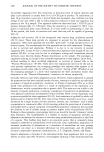
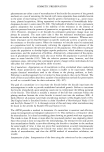
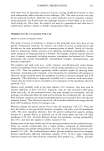
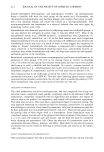
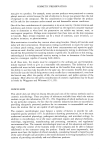
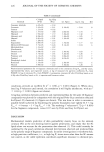
COSMETIC PRESERVATION 201 philes, and thus extremes of pH and A w can be used to control them. Where these extremes cannot be met, a biocide is used to control growth. Microorganisms metabolize product ingredients using a variety of hydrolytic enzymes to cause adverse changes in product odor, color, and viscosity. Even though health-related contamination incidences related to cosmetics are rare, a few have occurred and include infection from a hand lotion (3), eye infections from use of eye area cosmetics (25), and the death of one immunocompromised individual (26). Aside from spoilage prevention and health-related concerns, cosmetics also need to be adequately preserved to withstand consumer use. Manufacturing contamination can be controlled with good sanitation. But consumer use and abuse cannot be controlled. Consumers may repeatedly challenge the cosmetic with microorganisms. The bathroom, where most cosmetics and toiletry articles are used, provides heat and humidity needed for microbial growth (27,28). During use, cosmetics can be contaminated with a variety of spoilage organisms found in the household environment (29, 30). Table II lists some of the microorganisms that contaminate shampoos and skin lotions after consumer use (30). A few of these may invade and create disease (31). With more and more immunocompromised individuals in the population from the pandemic of AIDS, even spoilage organisms may be oppor- tunistic pathogens. The biggest contamination concerns are pathogens that present a frank health risk such as the pseudomonads (32). Cosmetics intended for eye area use are particularly suspect since the cornea, when compromised, is highly vulnerable to in- fection, and several instances of mascara contamination from Pseudomonas spp. have been reported (6-10). Thus, choosing the proper preservative and package is critical to providing appropriate protection to the product. Table II Types and Percentages of Microorganisms Contaminating Cosmetics After Use (30) Organisms Isolated from shampoo Isolated from skin lotion C itrobacter freundii 18 0 Enterobacter spp a 37 9 Klebsiella spp. b 9 9 Pseudomonas spp. c 9 21 Serratia spp. d 18 4 GNR e (nonfermentative) 0 4 GNR (fermentative) 9 0 CDC serotype IVC2 0 4 Bacillus spp. 0 4 S taphylococcus epidermidis 0 4 Propionibacterium sp. 0 4 Sarcina sp. 0 4 Diphtheroid 0 4 Yeasts and molds 0 29 • E. aerogenes, E. agglomerans, and E. cloacae. b K. pneumoniae and K. oxytoca. c p. putida, P. fluorescens, P. paucimobilis, P. aeruginosa, and P. maltophilia. • S. liquefaciens, S. odorifera, and S. rubidaea. e GNR, Gram-negative rod. Table adapted from Brannan and Dille (30).
Purchased for the exclusive use of nofirst nolast (unknown)
From: SCC Media Library & Resource Center (library.scconline.org)