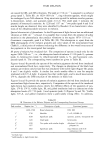
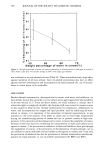
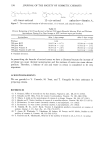
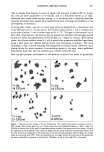
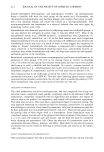
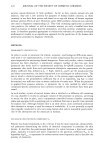
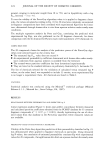
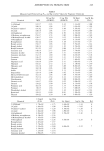
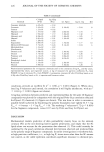
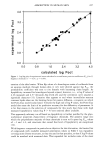
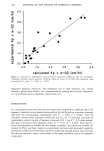
198 JOURNAL OF THE SOCIETY OF COSMETIC CHEMISTS H, OH L.• all- trans-retinol 13- cis-retinol anhydro-vitamin A. Figure 7. The structural formulas of all-tram-retinol, 13-cis-retinol, and anhydrovitamin A. Table II Percent Remaining of All-Trans-Retinol in Retinol (500 ppm)-Ethanolic Solution With and Without Antioxidants During Five Days Storage at 50øC (without argon gas blanket) Antioxidants After 3 days storage After 5 days storage Without 500 ppm BHT 500 ppm BHA 500 ppm Vitamin E 500 ppm Vitamin C (pH 7.0) 1.6% 94.4% (or = 0.71) 99.9% (or = 1.32) 96.4% (or = 2.67) 97.6% (or = 0.02) 92.0% (or = 0.46) 97.4% (or = 1.73) 89.6% (or = 0.30) 93.1% (or = 0.24) Standard deviation. In prescribing the formula of retinol-cream we have a dilemma because the increase of oil phase can cause thermal isomerization and the increase of water can cause decom- position. Therefore, a balance of oils and water in cream is considered to be very important. ACKNOWLEDGEMENTS We are grateful to Y. Yamada, H. Terai, and T. Yanagida for their assistance in preparing creams. REFERENCES (1) Y. Koizumi, Effect of retinoids on the skin diseases, FragranceJ. Jpn., 20, 26-31 (1992). (2) C. Kwasaki and M. Hida, Tests for vitamin A antioxidants, Vitamins, 15, 383-386 (1958). (3) T. Tabata, A study on the isomerization of vitamin A in drugs, Vitamins, 18, 164-167 (1961). (4) S. Hayashi and Y. Nishii, Stability of vitamin A in micellar solution, Vitamins, 28, 269-273 (1971). (5) L. Zechmeister, Cis-trans isomeric carotenoids vitamins A and arylpolyenes, 131 (1962). (6) L. Zechmeister, Cis-trans isomeric carotenoids vitamins A and arylpolyenes, 251 (1962). (7) K. Tsukida, M. Ito, and F. Ikeda, Vitamin A degradation products encountered on vitamin A analysis. Internat. J. Vit. Nutr. Res., 41, 158-170 (1971). (8) T. Anmo, M. Washitake, Y. Takashima, M. Isohata, M. Furuya, and K. Koike, Studies on the stability of vitamin A, Vitamins, 46, 193-203 (1972). (9) T. Tsunoda and K. Takabayashi, Behavior of the stability of retinol in oil, J.A.O.C.S. (in press).

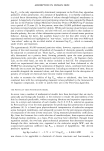
j. Soc. Cosmet. Chem., 46, 199-220 (July/August 1995) Cosmetic preservation DANIEL K. BRANNAN, Department of Biology, Abilene Christian University, Abilene, TX 79699. Received February I995. Synopsis The proper use of preservatives to prevent microbial contamination of cosmetics is often viewed as an art rather than a science. This view is a result of the multifactorial thinking that has to go into preservative selection. In this general article, an historical and critical review of preservative efficacy tests (PETs) is provided to understand the assumptions inherent in designing PETs. A conceptual framework of micro- organisms existing as communities in association with each other is also promoted, which provides a different understanding of how microorganisms contaminate cosmetics and why PETs are often misinter- preted. In addition, the mode of action of preservatives is discussed and contrasted with the mode of action of antibiotics. Finally, the role of the microbiologist is better defined in light of the fact that he or she must have expertise in far more than microbiology alone. INTRODUCTION Microbial contamination of cosmetics did not become an issue until about 50 years ago (1). The first microbial contamination observed was probably mold spoilage. Parabens provided adequate protection. During the 1960s, contamination of consumer products by Escherichia, Klebsiella, Enterobacter, Serratia, and Pseudomonas spp. occurred (2-5), demanding more effective and responsible preservation practices. By the mid-1970s, several cases of blindness due to Pseudomonas-contaminated mascaras caused eye cosmetics to be closely scrutinized (6-8). Most products reached the consumer in good microbi- ological condition, but they could not withstand contamination during use (9-14). The main issue addressed over the next few years was to develop preservative efficacy tests (PETs) that predicted the risk of consumer contamination. In 1975 and in 1985 the Food and Drug Administration (FDA) gave contracts to develop such PETs. The FDA never published the data from these studies, and no FDA •nethods were developed. In 1990, the Cosmetics, Toiletries and Fragrance Association (CTFA) published the results of a survey to determine if companies had already correlated their PET data with consumer use data (15). Nearly all the companies claimed they already had correlation programs in place, thus validating the ability of their company's PET to predict con- sumer contamination potential (16). Inherent in this validation process is the question, "What level of consumer abuse must a manufacturer anticipate for his product?" This question is usually answered with a legal definition: "To a level that is safe under 199
Purchased for the exclusive use of nofirst nolast (unknown)
From: SCC Media Library & Resource Center (library.scconline.org)