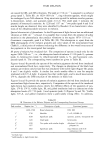
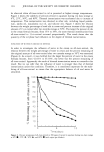
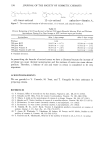
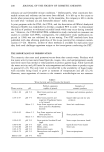
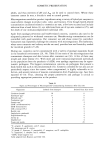
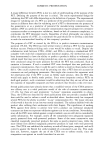
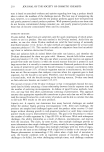
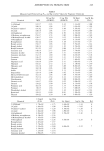
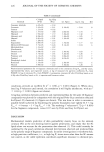
226 JOURNAL OF THE SOCIETY OF COSMETIC CHEMISTS Table I (continued) C Kp(d) log CKp Chemical (P-G) (P-G) Lit. Kp(e) log lit. Kp Ref. Cinnamic aidehyde 6.65e-03 - 2.18 Coumarin 2.45e-03 - 2.61 9.10e-03 - 2.04 8 Cumene 1.2 le-01 - 0.92 Heptanoic acid 1.57 e-02 - 1.80 2.00e-02 - 1.70 7 Heptanol 1.92e-02 - 1.72 3.20e-02 - 1.49 7 Hexanoic acid 8.06e-03 - 2.09 1.40e-02 - 1.85 7 Hexanol 9.8 le-03 - 2.01 1.30e-02 - 1.89 9 Indole 1.20e-02 - 1.92 Isoquinoline 6.09e-03 - 2.22 1.70e-02 - 1.77 10 Methyl-4-OH benzoate 5.72e-03 - 2.24 9.12e-03 - 2.04 6 Methylsalicylate 1.2 le-02 - 1.92 Nitrobenzene 7• 3 le-03 - 2.14 Octanoic acid 3.68e-02 - 1.43 2.50e-02 - 1.60 7 Octanol 3.74e-02 - 1.43 5.20e-02 - 1.28 7 Pentanoic acid 4.13e-03 - 2.38 2.00e-03 - 2.70 7 Pentanol 5.02e-03 - 2.30 6.02e-03 - 2.22 9 Phenylethyl alcohol 3.16e-03 - 2.50 Resorcinol 1.53e-03 - 2.82 2.40e-04 - 3.62 6 Thymol 5.99e-02 - 1.22 5.30e-02 - 1.28 6 Physicochemical parameters for 33 fragrance chemicals used in the correlation of log Poet and Kp values, experimental Kp values, and respective sources. a) log of measured o/w partition coefficients Poet from PCMCP b) log of calculated Po•t from PCMCP c) permeation constants kP after Potts/Guy based on a) d) Kp after Potts/Guy based on b) e) experimental literature values. conditions, provides an excellent fit (r 2 = 0.86, p 0.001) (Figure 2). When calcu- lated log P values are used instead, the correlation is still highly satisfactory, with an r 2 = 0.83 (p 0.001) (figure not shown). A log/log correlation between predicted and experimental Kps for the same 20 fragrance compounds was plotted for comparison with the original Potts-Guy correlation obtained for Flynn's 93 chemicals (1) (figure not shown). This was done in order to ascertain a possible benefit achieved by bracketing the polarity boundaries more tightly (0.5 log Poet +4 versus -3 log Poet + 6). The resulting r 2 values are 0.72 (p 0.001) for the fragrance compounds, versus 0.67 seen by Potts and Guy for Flynn's set. DISCUSSION Mathematical models predictive of skin permeability mainly focus on the stratum corneum (SC) as the rate-limiting barrier against penetration, and imply that the SC lipids alone can account for the penetration data observed (1). This could certainly be confirmed by the good correlations obtained here between observed and predicted Kps in the polarity range of fragrance compounds. In earlier investigations it was shown that, at high partition coefficients, i.e., at high log P, tissue strata other than the SC assume rate control, as the viable epidermis contributes significant resistance to chemical pen-

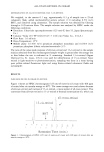
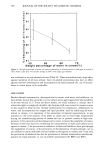
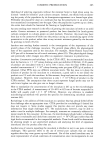
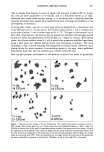
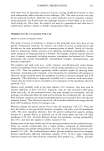
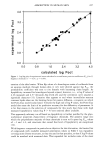
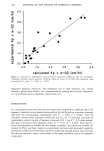
ABSORPTION IN HUMAN SKIN 227 4.0 3.2 - 2,4 - 1,6 - 0.8 - 0.0 I I I I I I I I 0.0 0.8 1.6 2.4 3.2 4.0 calculated log Poct Figure 1. Log/log plot of experimental versus calculated n-octanol/water partition coefficients (Poct) for 33 fragrance chemicals (r 2 = 0.97, p 0.00l). etration of the skin barrier. When Kp values of a homologous series of n-alkanols from an aqueous medium through human skin in vitro were plotted against log Poct, the permeability coefficient was seen to rise linearly with increasing chain length. As lipophilicity increased for homologues beyond octanol, however, i.e., at log P values of 4.26 (nonanol) and 4.57 (decanol), Kp levels off, and the correlation curve assumes a sigmoidal character (11). Linearity thus appears to end where intercellular stratum corneum lipids alone are the limiting factor for passive diffusion, a requisite on which the Potts-Guy model is also based. Towards the high end of log P values, the Potts-Guy model also nears the limit of its predictive accuracy for the diffusivity of permeants. It is for that reason in the selection of compounds for this study that those with high measured lipophilicity values (log P 4) were omitted albeit available. This apparently arbitrary cut-off based on lipophilicity is further justified by the phys- icochemical properties characteristic of fragrance chemicals. The polarity range into which the preponderant majority of these chemicals is seen to fit spans log Poct values of -1 and + 4, and structures that exceed that level of lipophilicity are exceptional (12). With fragrance compounds in particular as objective for this discussion, the limited list of compounds with available measured penetration values in Table I was expanded, covering more diverse structures, as they are used in that specialty, so that C log P values could be matched with measured data. That expanded list includes some of the most
Purchased for the exclusive use of nofirst nolast (unknown)
From: SCC Media Library & Resource Center (library.scconline.org)