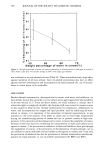
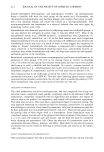
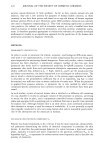
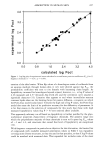
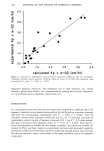
228 JOURNAL OF THE SOCIETY OF COSMETIC CHEMISTS X 6,0 - 4,8 - 3.6- 2.4- 1.2- 0.0 -- 0.0 1.2 2.4 3.6 4.8 6.0 calculated Kp x e-02 (cm/hr} Figure 2. Correlation of experimental versus predicted permeation coefficients, Kp, for 20 fragrance compounds through human epidermis. Predicted values are based on the Potts-Guy algorithm using measured log Poet data (r 2 = 0.86, p 0.001). important fragrance chemicals, used frequently and in large amounts, e.g., benzyl benzoate, phenylethyl alcohol, and cinnamaldehyde, making the list more representa- tive of materials used in fragrance compositions (12). CONCLUSIONS It is demonstrated that the values for the steady-state permeability coefficient Kp of 20 fragrance chemicals across human skin predicted by the Potts-Guy algorithm correlate well with the corresponding experimental data (r 2 = 0.86, p 0.001). Also the calculated octanol-water partition coefficients log Pact for 33 chemical structures of intermediate polarity typical of fragrance chemicals (0.8 log P 4.0) show remark- ably good correlation with measured values (r 2 = 0.97, p 0.001). Since log Pact values demonstrated as reliable are also readily accessible, the prediction method de- veloped by Potts and Guy, based on octanol/water partition and molecular weight for permeation coefficients of otherwise untested compounds through human skin, becomes the obvious method of choice, particularly in the range of polarity typical for fragrance compounds.

ABSORPTION IN HUMAN SKIN 229 ACKNOWLEDGMENTS Thanks go to William G. Reifenrath, PhD (RCR) and Philip S. Magee, PhD (BIOSAR) for their assistance in statistics and for discussion of the manuscript. Supported in part by the National Institutes of Health (ES-06825), the U.S. Air Force Office of Scientific Research, and the U.S. Environmental Protection Agency. REFERENCES (1) R. O. Potts and R. H. Guy, Predicting skin permeability, Pharm. Res., 9, 663-669 (1992). (2) R. Kaiser, "Trapping, Investigation and Reconstitution of Flower Scents," in Perfumes.' Art, Science, Technology, P. M. Muller and D. Lamparsky, Eds. (Elsevier Applied Science, London, New York, 1991), pp. 213-250. (2a) C. L. Gummer, R. S. Hinz, and H. I. Maibach, The skin penetration cell: a design update, Int. J. of Pharmaceutics, 40, 101-104 (1987). (3) Pomona College Medicinal Chemistry Project, Pomona College, Claremont, California. (4) United States Environmental Protection Agency, Derreal Exposure Assessment.' Principles and Applications, EPA/600/8-91/01 lB (1992). (5) S. Arctander, Perfume and Flavor Materials of Natural Origin. (S. Arctander, Montclair, NJ, 1960). (6) M. S. Roberts, R. A. Anderson, D. E. Moore, and J. Swarbrick, The distribution of nonelectrolytes between human stratum corneum and water, Austral. J. Pharm. Sci., 6, 77-82 (1977). (7) R. J. Scheuplein and I. H. Blank, Permeability of the skin, Physiol. Rev., 51(4), 702-747 (1971). (8) W. A. Ritschel, A. Sabouni, and A. S. Hussain, Percutaneous absorption of coumarin, griseofulvin and propranolol across human scalp and abdominal skin, Meth. Find. Exp. Clin. Pharmacol., 11(10), 643-646 (1989). (9) R. J. Scheuplein and I. H. Blank, Mechanism of percutaneous absorption. IV. Penetration of non- electrolytes (alcohol) from aqueous solutions and from pure liquids,J. Invest. Dermatol., 60, 286-326 (1973). (10) J. Hadgraft and G. Ridout, Development of model membranes for percutaneous absorption measure- ments: I. Isopropyl myristate, Int. J. Pharm., 39, 149-156 (1987). (11) R. J. Scheuplein, Percutaneous absorption after twenty-five years: or "old wine in new wineskins,"J. Invest. Dermatol., 67, 31-38 (1976). (12) K. Bauer, D. Garbe, and H. Surburg, Common Fragrance and Flavor Materials., 2nd ed. (VCH Verlagsgesellschaft mbH, Weinheim, 1990).
Purchased for the exclusive use of nofirst nolast (unknown)
From: SCC Media Library & Resource Center (library.scconline.org)