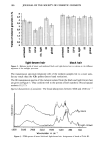
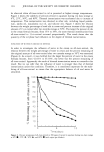
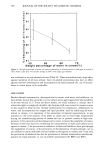
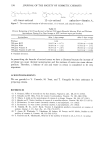
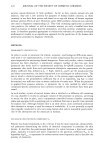
188 JOURNAL OF THE SOCIETY OF COSMETIC CHEMISTS a,b gtobnt IR[ighf vis. f. 1900 1630 13/.0 1080 820 550 1900 1630 13/.0 1080 820 550 Wovenumber in cm -q Wovenumber in cm -1 Figure 4. FTIR spectra of melanin from black hair after 6 weeks of irradiation with simulated sunlight (global), U¾-B, UB-A, visible light, and IR irradiation in relation to nonirradiated hair. Assignment of bands of Table III. a: Irradiation with U¾-A or U¾-B. b: Irradiation with visible light, IR or global light. a,b unfreaf. 1960 17•+0 1520 1300 1080 860 UV- B UV- A g untreaf. 1960 17Z,0 1520 1300 1080 860 gtobct[ v•s. Light Wovenumber in cm -• Wovenumber in cm -1 Figure 5. FTIR spectra of melanin from light-brown hair after 6 weeks of irradiation with simulated sunlight (global), U¾-B, UB-A, visible light, and IR irradiation in relation to nonirradiated hair. As- signment of bands of Table III. a: Irradiation with UV-A or UV-B. b: Irradiation with visible light, IR, or global light.

HAIR MELANIN 189 visible light, IR, and global irradiation (Figure 5b) bring about a decrease of DHI- assigned bands (peaks 4 and 5). A gradual elimination of the absorption assigned to the sulfur moiety (peak 6) is evident upon exposure to UV-B and UV-A radiation (Figure 5a). SUMMARY This investigation provides qualitative and quantitative evidence regarding the different response to sunlight exposure of melanin from black and light-brown hair. The photochemical degradation by visible light of eumelanin, the predominant pigment of black and light-brown hair, is, under the conditions of these experiments, relatively small and can be shown quantitatively (gravimetry) and qualitatively (color measure- ments, IR-spectroscopy). On the other hand, a mixture of pheo- and eumelanins, the pigment of light-brown hair, appears to be affected by all segments of sunlight, particularly by UV-A and visible light. The irradiation brings about drastic degradation of the granules (gravimetry) and substantial changes in the melanin polymer (IR-spectroscopy, see below). IR investigation of the melanin of irradiated light-brown hair suggests extensive de- struction of the quinone system, which according to Crippa (3) is essential for the photoprotective effect of the melanin. In the case of eumelanin the dihydroxyindole moleties are prone to irradiation. The higher photostability of the eumelanin, particularly the limited degradation of the quinone structure, suggests that eumelanin has a better photoprotective effect on hair than pheomelanin. REFERENCES (1) j. P. Cesarini, "Melanin and Color of Hair" (in German), in Haar undHaarkrankheiten, C. E. Orfanos, Ed., pp. 137-166 (1979). (2) S. Ito and K. Fujita, Microanalysis ofeumelanin and pheomelanin in hair and melanomas by chemical degradation and liquid chromatography, Anal Bzochem., 144, 527-536 (1985). (3) R. Crippa, V. Horak, G. Prota, P. Svoronos, and L. Wolfram, "Chemistry of Melanins," in The Alkaloids, Vol. 36, A. Brossi, Ed. (Academic Press, 1989). (4) V. Boudier, Etude du comportement photochimique d'eumelanines et du complexe melanine-keratine du cheveu par spectroscopies raman et infrarouge, Thesis, UBP Clermont-Ferrand II (1989). (5) T. Sarna and R. C. Sealy, Photoinduced oxygen consumption in melanin systems. Action spectra and quantum yields for eumelanin and synthetic melanin, Photothem. Photobiol., 39 (1), 69-74 (1984). (6) T. Sarna, B. Pilas, E. J. Land, and T. G. Truscott, Interaction of radicals from water radiolysis with melanin, Biochim. Biophys. Acta, 883 (1), 162-168 (1986). (7) W. Korytowski and T. Sarna, Bleaching of melanin pigments, J. Biol. Chem., 265 (21), 12410- 12416 (1990). (8) N. S. Ranadive and I. A. Menon, Role of reactive oxygen species and free radicals from melanins in photoinduced cutaneous inflammations. Pathol. Immunopathol. Res., 5 (2), 118-139 (1986). (9) M. Tatsuda, M. Uemura, K. Torii, and M. Matsuoka, Studies on hair damage and demelanization by ultra violet light, J. Soc. Cosmet. Chem. Japan., 21, 43-49 (1987). (10) K. Jimbow, Y. Miyake, K. Homma, K. Yasuda, Y. Izumi, A. Tsutsumi, and S. Ito, Characterization of melanogenesis and morphogenesis of melanosomes by physicochemical properties of melanin and melanosomes in malignant melanoma, Cancer Res., 44 (3), 1128-1134 (1984).
Purchased for the exclusive use of nofirst nolast (unknown)
From: SCC Media Library & Resource Center (library.scconline.org)