EVALUATION OF UV HAIR DAMAGE BY AFM 273 IRRADIATION OF HAIR Hair tresses weighing 2.0 g were exposed to simulated solar radiation in the Atlas Weather-Ometer, model 65 XW-WR1. It utilized a 6500W xenon lamp. The specific exposure condition of hair fibers to UV/visible radiation was 160 hours. The program- ming used was 102 minutes of insolation at relative humidity (RH) levels of 50 + 5% and 18 minutes of insolation with rain simulation with 100% RH. The mean tempera- ture in a cycle of two hours was 60øC. The energy density at the 340-nm wavelength was maintained at 0.35 W/m 2. In the wavelength range of 250-800 nm, the energy densities were 397 W/m 2, resulting in a total energy density of 41.27 mW/cm 2. TESTING Two different techniques were employed to assess hair photodamage: (1) the scanning electronic microscopy (SEM) technique was used to identify morphological changes on the hair surface and (2) the atomic force microscopy (AFM) technique was used to analyze hair morphology as the environmental conditions changed, allowing the direct study of roughness and cuticle thickness. SCANNING ELECTRON MICROSCOPY (SEM) SEM has been widely used over many years for claim substantiation of various toiletry treatments on the architecture of the hair's surface. It has been used to evaluate the effectiveness of hair shampoos in the removal of sebum and detritus, to investigate the effects of permanent waving systems, and to observe the deposition of polymeric mate- rials from hair products. Although SEM analyses provide valuable information about the hair surface, which helps to understand some of the existing hair products and aids in the development of new ones, it should not be seen as a key technique to understand all product systems. Its use is limited by many factors because pictures produced by SEM usually cause a high visual impact, but the technique is poor in terms of quantitative analysis. Longitudinal segments of untreated and UV-exposed fibers were mounted on an alu- minum substrate and coated with an approximately 90 • thickness of gold. The hair fiber topography was examined in a ZEISS 940-A spectrometer digital scanning electron microscope coupled to EDS and PGT, Digital Prism model. The objective was to analyze the morphological alterations in hair exposed to UV radiation. ATOMIC FORCE MICROSCOPY (AFM) The atomic force microscopy (AFM) technique has received a great deal of attention in recent years due to its enormous potential for the study of the surface of materials. AFM can be used for imaging non-conductive surfaces. The equipment consists of a probe, a laser beam, and a photodiode used to detect the movement of the probe. The probe, in the form of a sharp tip attached to a cantilever, scans the surface by using force in the order of 10 to 20 nN in the contact mode, and 0.1 nN in the tapping mode. The tapping mode is used to measure the surface characteristics of soft materials such as some

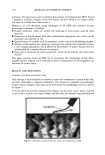
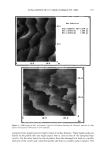
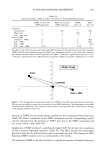
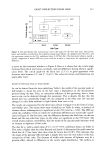
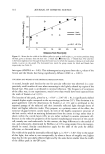
274 JOURNAL OF COSMETIC SCIENCE polymers. The equipment used was Digital Instruments model Nanoscope IIIa ©. Figure 1 presents a schematic diagram of the hair surface and how AFM, in its contact mode, was used to evaluate hair characteristics. Mattoso et aL (10) described several advantages of the AFM over common electron microscopy techniques, including: ß Greater resolution, which can achieve the molecular or even atomic scale for some materials. ß Generation of digital images from three-dimensional topographic data, which can be quantitatively analyzed in 3D. ß Quantification of variables such as roughness, surface area, and morphology heights. ß Absence of the need for any conductive coating on the sample to be analyzed, but just a little sample preparation, which allows the discernment of surface features that are undetectable by scanning electron microscopy. ß Depiction of variations of surface properties, which can be directly and statistically studied. This paper presents results of AFM use to investigate the morphology of hair fibers exposed and not exposed to UV radiation as well as measurement of the roughness and thickness of cuticle layers. RESULTS AND DISCUSSION SCANNING ELECTRON MICROSCOPY (SEM) Hair damage is the breakdown or removal of structural components or parts of hair that are more vulnerable to chemical breakdown. The exposure to sunlight over prolonged periods induces changes in hair that can be detected at the morphological level, as shown in Figure 2. It can be observed that the unexposed hair (Figure 2a) has more cuticle layers, that the cuticles have a uniform and regular shape, and that they are oriented longitudinally and Cantilever... •Tip : Hair st•rface Figure 1. Schematic diagram of the hair surface and evaluation by AFM.
Purchased for the exclusive use of nofirst nolast (unknown)
From: SCC Media Library & Resource Center (library.scconline.org)