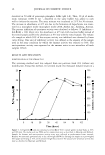
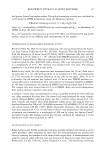
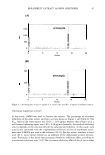
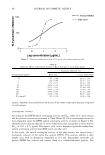
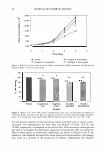
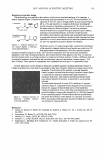
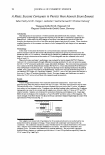
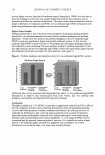
10 JOURNAL OF COSMETIC SCIENCE creams with increasing storage temperature may be due to the increase in the rate of water evaporation. With increasing storage temperature, the evaporation of water in creases, resulting in a viscosity increase. In a similar study, Korhonen et al. (3) found that the consistency of a cream containing a non-ionic surfactant, PG 25 soya sterol and sorbitan trioleate, increased with increasing storage temperature. At longer storage periods a clear effect of the storage temperature on the viscosity of the salt-free sample can be seen, where a significant increase in the apparent viscosity is observed (see Figure 7). The salt-free sample stored for two months at 45 ° C showed the highest viscosity beyond the viscosity range that can be measured by the viscometer. The effect of increasing the storage temperature on the viscosity of the salt-free sample was more pronounced than that observed for the salted sample. However, the salt-free samples showed a higher rate of increase in apparent viscosity with storage time than that observed for the salted samples. CONDUCTIVITY MEASUREMENTS The conductivity test is a rapid method for determining the stability of creams based on the change in the physical characteristics of the cream (11). Conductivity measurements of cream samples were performed at room temperature and over various storage periods up to four months. Conductivity values of the creams increased as the amount of added DS salt was in creased. This may reflect the higher level of free ions within the cream samples as the 40 35 u, 30 - ·en 25 u, · 20 a. 15 10 Storage time = 2 months Shear rate = 7.387 (1/second) * EB 0.00 ..... -·····•··.,, __ _ _ _ _ ___ __ :_:_� ■ II room temperature __ .. ----------m ... ...... .... ·rn.. __________________ 0.04 0.08 0.12 Salt concentration (w/w%) room temperature 45 ° c 0.16 Figure 7. The effect of DS salt concentration on the apparent viscosity of cream samples stored for two months at different temperatures.

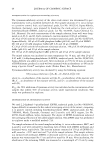
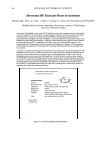
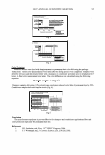
DEAD SEA SALTS IN COSMETIC EMULSION 11 amount of added DS salt was increased (12). This behavior can be observed in Figure 8. A sudden change in conductivity curves can be seen at salt concentrations of 0.07 and 0.15 wt%, corresponding to the observed maximum viscosities. This result suggests that the added ions to the system at these concentrations have a more pronounced effect on the emulsion structure, leading to an increase in viscosity, than does the free water, which leads to an increase in conductivity. A decrease in the conductivity values of body cream samples with storage time up to four months can be also seen in Figure 8. This is an expected result of water evaporation during the storage period. As shown in Figure 9, the conductivity of the salt-free cream stored for four months decreases with the storage temperature. The conductivity values of the body cream samples decreased during the four months of storage over the entire range of storage temperatures. A decrease in the conductivity values with increasing storage temperature at constant storage time can be clearly observed. A low conductivity value reveals that there is more lamellar water and less free water in the cream, which can be seen as an increase in the viscosity of the cream (13 ). The largest change in conductivity during storage was observed for the sample stored at 45 ° C. This cream previously had a maximum viscosity related to the increase in water evaporation at this condition. Figure 10 shows that the conductivity of a body cream sample containing 0.07% DS salt content decreases with both storage time and storage temperature. The largest and the sharpest changes in conductivity during storage were observed for the sample stored at 45 ° C, which exhibited a maximum viscosity, as shown previously. � ' u ::J ""C C 0 (.) 200 150 100 50 0 0.00 0.05 Storage conditions: room temperature Storage period: -D-- One week -+- Two months -----A- Four months 0.10 0.15 Salt concentartion (w/w % ) 0.20 0.25 Figure 8. The effect of DS salt concentration on the conductivity of body creams stored for different periods at room temperature.
Purchased for the exclusive use of nofirst nolast (unknown)
From: SCC Media Library & Resource Center (library.scconline.org)