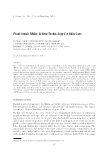
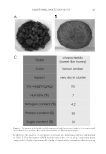
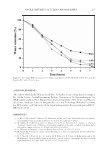
JOURNAL OF COSMETIC SCIENCE 138 leads to the disintegration of microbial cells. Toxic action of terpene compounds against microbes consists in coagulation of the cytoplasm and increased cell membrane permea- bility, resulting in excessive loss of hydrogen and potassium ions, which in turn causes reduction in membrane potential, which disturbs the functioning of proton pumps and, thus, reduces the amount of synthesized adenosine triphosphate (1–4). An example may be tea tree oil, which contains about 100 compounds (monoterpenes, sesquiterpenes, and their alcohol derivatives). The main components of tea tree oil are terpinene-4-ol, α-terpinene, and γ-terpinene (70%). In this oil, the following are also present: p-cymene, terpinolene, α-terpineol, and α-pinene (15%). Research on tea tree oil showed (3,5,6) that most of the ingredients in this oil inhibit the development of Candida albicans yeast—a commensal organism—that can become pathogenic in immunocompromised people. In addition, these studies showed that the antifungal activity of this oil can be infl uenced by all of its ingredients, even those that occur in small quantities or are con- sidered as inactive. Limonene is a terpene compound that is very valuable and of natural origin and can be obtained from waste orange peels (renewable waste from the food industry, biomass). By simple isomerization of this compound (over an appropriate catalyst, e.g., Ti-SBA-15, and without any solvent), it is possible to obtain from limonene other valuable compounds, such as α-terpinene, γ-terpinene, terpinolene, and p-cymene (Figure 1). These com- pounds, the same as limonene, have a lot of applications in medicine and also in cosmetic and food industries. Of particular interest are the cosmetic and medical applications of these compounds (7–9). α-Terpinene is a fragrant compound of natural origin that is present in various foods, such as oranges, coriander, and oregano. It can also be obtained as the product of isomerization of limonene. Thanks to its characteristic refreshing scent, it is widely used as a fragrance in cosmetic, household, and food products. α-Terpinene is a com- ponent of tea tree oil and is considered to be a component responsible for the anti- oxidant properties of this oil. The properties of tea tree oil allow the use of this oil in the treatment of skin problems, such as acne or mycosis. Studies on α-terpinene showed the effi ciency of this compound in the treatment of parasitic infections with auger in horses (10–14). γ-Terpinene is anot her product that can be obtained during the isomerization of limonene. In nature, this compound can be synthesized by a plant like rice (γ-terpinene destroys the cell membrane of the bacteria that causes plague among this plant). Generally, this com- pound exhibits antibacterial properties. Moreover, γ-terpinene in combination with routine Figure 1. Structure of limonene and the products of limonene isomerization and dehydroaromatization.

ANTIMICROBIAL PROPERTIES OF NATURAL LIMONENE 139 antioxidants is used in the treatment of atherosclerosis because of its ability to pre- vent low-density lipoprotein (LDL) oxidation (14–17). Terpinolene is used as an additive to fruits, baked products, ice creams, nonalcoholic bev- erages, and candies. This compound has a calming effect. Terpinolene inhalations affect the functioning of the autonomic nervous system and the human psyche. As a conse- quence, terpinolene reduces tension and increases the feeling of relaxation. Therefore, this compound can be used in the treatment of mental disorders such as depression. In addition, terpinolene has the potential to treat atherosclerosis. This compound, in combination with β-carotene and α-tocopherol, effectively prevents oxidation of LDL, which plays a key role in the formation of artelectrosclerosis (18–21). p-Cymene is a product of dehydroaromatization of limonene isomers. This compound is a component of numerous essential oils and is becoming more and more popular among scientists. For example, it is a ligand of many catalysts applied in olefi n metathesis—one of the most frequently used reactions in modern organic synthesis. p-Cymene can also be used as a solvent because it is less harmful to the environment than commonly used organic solvents (22–25). Considering the presented antimicrobial properties of limonene, α-terpinene, γ-terpinene, terpinolene, and p-cymene, we decided to investigate whether a mixture of the mentioned compounds (the mixture obtained after the isomerization of limonene) exhibited an anti- microbial activity. Such use of the postreaction mixture of terpenes would lower the cost of preparing therapeutic formulations (e.g., creams), as it will not require a step of isolation of individual components from the postreaction mixture, e.g., by distillation methods. Such a mixture could be treated as an “artifi cial essential oil” with a very narrow composi- tion. The following microorganisms were selected for microbiological tests: Escherichia coli K12 (ACCT 25922) and Staphylococcus epidermidis (ACCT 49461), yeast fungi C. albicans, and fungi Trichophyton rubrum, Aspergillus niger, Penicillium commune, Trichoderma viride, and Cladosporium cladosporioides. With the compound having the highest antimicrobial activ- ity (terpinolene), therapeutic creams containing 0.5 and 2 wt% of this compound were prepared. The creams used in the research were as simple as possible, so that the com- pounds included in their composition did not infl uence the results of the microbiological tests. Therefore, we did not use emulsifi ers as ingredients of the investigated creams. These creams can be used as potential therapeutic and protective creams for relief of skin lesions and in the treatment of acne or atopic dermatitis. MATERIALS AND METHODS SEPAR ATION OF NATURAL LIMON ENE Natural orange oil containing up to 98% of limonene can be obtained from waste orange peels by the steam distillation method. This method does not require the application of organic solvents, which makes it environmentally friendly, and the water used for the process can be reused in subsequent processes. The method of obtaining essential orange oil from orange peels by the steam distillation method is based on passing water vapor through fresh orange peels shredded with the use of a food processor. A kilogram of orange peels prepared in this way was placed in a glass reactor and 2.5 L of distilled water was poured into the reactor. The steam passed through the plant material and volatile components
Purchased for the exclusive use of nofirst nolast (unknown)
From: SCC Media Library & Resource Center (library.scconline.org)