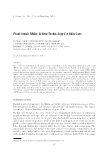
JOURNAL OF COSMETIC SCIENCE 154 XPS scans (see supplementary mater ial) of ilmenite and TPs show the characteristic Ti2p peak appearing at 459.3 eV. However, peak fi tting confi rms the presence of two peaks for natural ilmenite, indicating two different oxidation states for the titanium atoms. The asymmetrically broad Ti2p3/2 photoelectron peak suggests the presence of both +3 and +4 oxidation states for titanium. The two peaks observed for the Ti2p3/2 appear at 458.1 and 459.3 eV. The Ti2p and Fe2p XPS data suggest that natural weathered ilmenite used in this work contain Ti and Fe atoms in their two common oxidations states, Fe2+/Ti4+ and Fe3+/Ti3+. The appearance of an intense P2p peak at 134.3 eV and the absence of Fe2p peak in the iron region for the XPS scan of TOP clearly suggest that ilmenite has converted into TOP during acid digestion with low iron content. FTIR spectra of TPs show the chara cteristic overlapped bands in the 960–1200 cm-1 range because of antisymmetric P–O stretching vibration. The relevant bending vibra- tions appear at lower frequencies less than 670 cm-1. Based on the previously published data, it can be suggested that the phosphate ions form the ideal tetrahedral structures for the TPs (see supplementary material) (28,29). The white powder obtained with a low ir on content from digestion of ilmenite in H3PO4 is Ti(HPO4)2·H2O and calcination has led to the production of TiP2O7. Re- sults clearly confi rm the chemical identity and the morphology of synthesized Ti(HPO4)2·H2O and TiP2O7. Furthermore, XRF analysis (see supplementary mate- rial) of TOP and TP indicate the high purity of synthesized materials with trace amounts of other metals. Figure 3. T E M images and EDX analysis: (A), (B) for TOP and (C), (D) for TP.

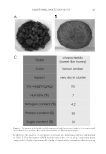
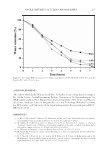
FACILE SYNTHESIS OF TITANIUM PHOSPHATES 155 COSMETIC PROPERTIES OF SYNTHESIZED TPS UV -Vis DRS (Figure 4) were obtained t o assess the optical property of synthesized sam- ples of TPs and to compare with PG-TiO2 and Degussa P25. The degree of diffuse refl ec- tance is dependent on parameters such as the refractive index, band gap, shape, and particle size of the material. A higher refractive index of 2.6 for TiO2 (30) favors higher light scattering properties than TPs, which has a lower refractive index below 1.8 (31). Therefore, Degussa P25 (Figure 4C) and PG-TiO2 (Figure 4D) show comparatively higher diffuse refl ectance than TPs (Figure 4A and B). PG-TiO2 having particle diameter 50 nm exhibit lower diffuse refl ectance than Degussa P25. The pigment materials used in cosmetic pr oducts having a lower photoactivity is an added advantage to minimize a certain degree of sebum breakdown on the skin (6,7). Titanium dioxide, the white pigment used in cosmetics is a powerful photoactive mate- rial capable of degrading wide variety of organic substances via rapid photochemical reac- tions in hydrated environments (32–34). Therefore, photoactivity of the synthesized TOP and TP were tested and compared with both PG-TiO2 and Degussa P25. Photo- induced abstraction of hydrogen atoms from hydrocarbons by DPPH can be assisted by the presence of semiconductor materials such as TiO2 (35,36). Photo-induced fading of DPPH from purple to pale yellow was followed by a rapid decrease in the absorption at 520 nm (see Figure 5B). The photoactivities of TP, TOP, PG-TiO2, and Degussa 25 were compared by measuring the decrease in absorption intensity at 520 nm for a period of 30 min of the analyte containing DPPH mixture and a test material. Gradual decrease in the Figure 4. UV - Vis DRS of (A) TOP, (B) TP, (C) P25, and (D) PG-TiO2.
Purchased for the exclusive use of nofirst nolast (unknown)
From: SCC Media Library & Resource Center (library.scconline.org)