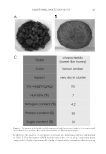
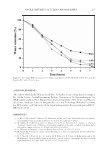
JOURNAL OF COSMETIC SCIENCE 156 peak intensity at 520 nm recorded as a function of time is shown in Figure 5A. Samples show a 50% drop of the intensity at 28, 13, 11, and 4 min, respectively, for TP, TOP, PG-TiO2, and Degussa P25. Results clearly indicate that synthesized TP and TOP are fairly photoinactive when compared with TiO2. WR ability is another signifi cant paramet er in cosmetic products and urea is commonly used as an additive to maintain the moisture level on the skin and for the smoothness (37). Therefore, WR capacities of both TOP and TP samples with 5% w/w urea were tested after moisturizing at 57% RH (Figure 6A and B) (18). PG-TiO2 and Degussa P25 TiO2 were used as controls (Figure 6C and D). For TOP, PG-TiO2, and Degussa P25 TiO2, WR capacities rapidly declined to a 15–20% level because of the evaporation of loosely bound water from the surface in the fi rst 5 h. Subsequently, it remained relatively constant for the next tested time period. Interestingly, TP indicates a drop of WR to ~35% at 5 h and thereafter shows a slow water release rate. After 7 h, it shows about ~30% WR capacity, a higher value than TOP and control TiO2 samples. This indi- cates a good WR ability for the synthesized TP, which is better than the commercially available TiO2. CONCLUSIONS Two potential replacements fo r PG-TiO2 in cosmetic products, TOP and TP, were syn- thesized using ilmenite obtained from mineral sand as the starting material through H3PO4 digestion. The synthesized TOP and TP white pigments demonstrate signifi - cantly less photoactivity than PG-TiO2, implying a reduced risk of sebum breakdown on human skin. The WR capacities of moisturized pastes prepared with powdered materials, TOP, TP, and TiO2 with 5% urea, were measured. The synthesized TP shows a better WR capacity than TOP and PG-TiO2. As a potential next step in this research, safety data would be needed to generate to be used as a permitted colorant in the cosmetics industry. Figure 5. (A) Effect of UV irradiation on DPPH absorption at 520 nm with (i) no catalyst, (ii) TP, (iii) TOP, (iv) PG-TiO2, and (v) Degussa P25 dispersions. (B) UV-Vis absorption spectra of the DPPH• radical (i) and (ii-iii) the reduced form of the DPPH2.

FACILE SYNTHESIS OF TITANIUM PHOSPHATES 157 ACKNOWLEDGMENTS The authors thank Lanka M ineral Sands Ltd ., Sri Lanka, for providing ilmenite samples Dr. Asitha Cooray, Central Instrument Facility, University of Sri Jayewardenepura, for XRD sample analysis Prof. Masaru Shimomura, Department of Electronics and Materi- als Science, Graduate School of Integrated Science and Technology, Shizuoka University for XPS studies and University of Sri Jayewardenepura for the research grant ASP/01/ RE/SCI/2018/14. REFERENCES (1) A. Weir, P. Westerhoff, L . Fabricius , K. Hristovski, and N. von Goetz, Titanium dioxide nanoparticles in food and personal care products, Environ. Sci. Technol., 46, 2242–2250 (2012). (2) M. Auffan, M. Pedeutour, J. Rose, A. Masion, F. Ziarelli, D. Borschneck, C. Chaneac, C. Botta, P. Chaurand, J. Labille, and J.-Y. Bottero, Structural degradation at the surface of a TiO2-based nanomate- rial used in cosmetics, Environ. Sci. Technol., 44, 2689–2694 (2010). (3) G. P. Dransfi eld, Inorganic sunscreen s, Radiat. Protect. Dosim., 91, 271–273 (2000). (4) M. Picardo, M. Ottaviani, E. Camera, and A. Mastrofrancesco, Sebaceous gland lipids, Dermato-endocrinology, 1, 68–71 (2009). (5) H. J. Choi, K.-C. Park, H. Lee, T. C r ouzier, M. F. Rubner, R. E. Cohen, G. Barbastathis, and G. H. McKinleyand, Superoleophilic titania nanoparticle coatings with fast fi ngerprint decomposition and high transparency, ACS Appl. Mater. Interfaces, 9, 8354–8360 (2017). Figure 6. Perce n tage WR capacities at 57% relative humidity for (A) TP, (B) TOP, (C) PG-TiO2, and (D) Degussa P25 with 5% (w/w) urea.
Purchased for the exclusive use of nofirst nolast (unknown)
From: SCC Media Library & Resource Center (library.scconline.org)