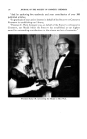
168 JOURNAL OF THE SOCIETY OF COSMETIC CHEMISTS reading--and I saw an angle to it which must have appealed to her inner nature. The article emphasized what cosmetics can do for a woman even beyond making her prettier or more glamorous or correcting her surface faults. They can contribute to her personality and react on her mind and character. If she knows she looks well, this makes her feel more cheerful and contented, giving her self-assurance. That is the sort of thing which interests Florence. There is an extreme sensitiveness there--almost hypersensitiveness-- but she tries to conceal it. She rarely discusses her own troubles yet she is a well of discretion when others wish to discuss their troubles with her. Yes, Florence Wall can think and work like a man. I have heard her say that she was the only woman on those early chemical jobs that she had. But a womanly sympathy and understanding--call it sentiment, if you like--is behind so much that she does. She seems to like to conceal this from business associates. That is why I wanted the privilege of bringing it out in the open for I think it transcends even her great accom- plishments as a professional person. It is just because she is that sort of person that I feel confident I am speaking for a host of others when I hope that this happy occasion will bring her enough good cheer to last for a long, long time to come. THE MEDALIST'S ADDRESS Mr. President, Mr. Toastmaster, Fellow Members and Guests: AFTER THIS triple exposure of my life and work, I feel appropriately overwhelmed, but I am also sincerely and humbly grateful that the Medal Award Committee was willing to choose one of my peculiar assortment of accomplishments for this highest honor. As you may have gathered, much of my work, although it has been related to cosmetics, has taken me far from the chemistry of cosmetics, to which our SOCIETY is nominally dedicated. Only those of you who were also working in it in those early days can appreciate the changes that have evolved during my half-a-lifetime of labor in one corner or another of our vast industry. Nor can you imagine how diflScult it is to try to inject a new branch of study into established educational centers. All of this has made a career which has always been interesting but never easy. Again, my thanks for this token of your esteem. I shall always treasure this beautiful medal, and it should serve me as an inspiration to do more, and even better, in the future.

COSMETICS AND COSMETOLOGY IN GENERAL EDUCATION By FLORENCE E. •/VALL, M.A. Consultant, New York WHEN COMPARED with cosmetics, of which the history has been un- broken for about six thousand years, the branch of study called cos- metology, which can boast of only sixty years, is so relatively new that it is still difficult to view it objectively and evaluate it. For all in the industry the specific meaning and connotations of cosmetics as products have been more than adequately defined by law. The scope and implications of cosmetology are not so generally understood, and many in the industry seem to believe that it is quite outside of their particular interests. As it is a vast field through which cosmetic products and accessories reach millions of users, everyone should be at least curious about what goes on and how possibly mutual interests might be served. Cosmetology has been defined variously, from merely "A treatise on dress and bodily cleanliness" (1) to "The art or practice of cosmetic treat- ment of the skin, hair, and nails and professional application of cosmetics" (2). Most broadly, then, the term could cover all use of cosmetic products and treatments by consumers in their personal grooming, but--at least in the United States--cosmetology has come to mean the use of cosmetic products and treatments in beauty salons, and the educational preparation of those that work in them. The terms cosmetology for the work, and cosmetologist as the analogous term for the practitioner, were adopted a few years after the National Hairdressers Association was founded (1921), on the recommendation of C. W. Godefroy of St. Louis, then a vice president of the Association and chairman of its committee on technical terms. They satisfied the long time demand by women shop owners whose training and services not only included but also far exceeded the implications of the old generic term hairdresser (3). The word cosmetology has occasionally been questioned by those in the so-called learned professions, and even by legislators. There it was in the respected dictionaries, however, showing appropriate etymology and venerable ancestry, so it has maintained its legitimacy. It has been 169
Purchased for the exclusive use of nofirst nolast (unknown)
From: SCC Media Library & Resource Center (library.scconline.org)