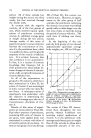
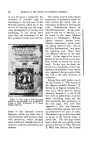
184 JOURNAL OF THE SOCIETY OF COSMETIC CHEMISTS basic invention of an Englishman, Peter Sartory (U.S. Patent No. 1,565,509). The process involved the first use of an exothermic chemi- cal reaction for the generation of the heat sufficient to permanent wave hair. However, as with many original ideas, Sartory was influenced by the predominant factor in the art, which was the electrical machine, and Sartory's utilization of his idea of using chemical heat instead of elec- trical heat resulted in a mechanical set-up which in appearance as well as in operation was very much like the electrical machine. Actually the chandelier contrap- tion was a necessity in the Sattory concept, because by selecting the hydration of lime as his exothermic chemical reaction, and in applying his concept of how it should be used, that is, as a functional dt/plicate of the electrical machines, Sartory generated temperatures similar in range and duration to those of the electrical heaters, and this required a very large amount of lime to wave each strand of hair. These lime heaters also required some means of support, and in order to have a steam-retaining unit, a rigid casing was used around the porous lime container. In order to introduce the water, a bulb-syringe was inserted into an inlet on this ex- ternal casing. The water, starting at the outer side of the layer of lime, generated heat according to the reaction CaO + H•O -,- Ca(OH)• + A This raised the excess water to steam which reacted with the next layer of CaO to generate further heat and thus steam at a higher tem- perature until the steam coming from the internal (next to the hair) section of the calcium oxide was in. many instances around 500øF. and sufficient to char paper--typical of the electrical units. It is little wonder that this crude invention did not receive a ready acceptance in competition with the highly developed electrical units and that the organization offering it in America soon went into bankruptcy. However, this unit may be looked upon as the forerunner of the active chemical phase in the American permanent wave art. Dr. R. L. Evans (who purchased the bankrupt organization) and co- workers investigated this process thoroughly but soon came to the conclusion that it could not com- pete with the highly developed electrical heating systems. But as so often happens, where logic and science acknowledge a blind alley, a less scientific and more ingenious mind will find a way out. This was the case here. Not a chemist or an electrical engineer, but a very ingenious hairdresser named Fred Winkel from the Penn- sylvania mountains, without knowl- edge of chemistry and without knowledge that commercially ex- othermic chemical heat lind bowed to electrical heat, was able to re- awaken the interest in exothermic chemical heat and actually produce and successfully operate the first

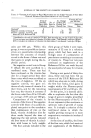
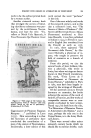
DEVELOPMENT OF MACHINELESS PERMANENT WAVING 185 means and method which today are known as "machineless" pads used and the "machineless method" of permanent waving of hair. The term "machineless" aptly describes the system because for the first time women were emancipated from wires and overhanging sup- ports. As with many basic inventions, in retrospection and upon casual examination it appears to be simple and obvious. Primarily Winkel's invention (U.S. Patent No. 2,051,063) in- volved the use of a single moisture- absorbent element to accomplish the following functions: (1) to supply the water to initiate and continue the exothermic chemical reaction (2) to serve as a wet shield to prevent the hair from being damaged by being heated to a high dry heat (3) to serve as a fast heat conductant to the wound hair strand since the element lay be- tween the hair and the envelope containing the exothermic heat. The second element of Winkel's invention involved the use of a flex- ible impervious envelope, one face of which was perforated. Thus the water was pressed through the per- foration to the chemical. The heat generated was quickly transferred by the wet element to the hair, thus raising its temperature almost as fast as the temperature within the pad. The impervious envelope by permitting the steam to issue in only one direction allowed for only little heat to escape by radiation except in the direction of the hair. What heat was not used, as with a small swatch of hair, escaped as steam, but the wet absorbent, serv- ing as the water giving means and the system depending upon water for exothermic reaction, became an automatic control to assure that no overheating to a dry state occurred. The very high efficiency of this unit allowed for a marked decrease in the amount of heat required-- the Winkel pad requiring only 12 gm. of lime, while the Sartory sys- tem required about three times this amount (actually 35 gm.). The Winkel pad was not a perfect pad even though it was used com- mercially, but Evans and his co- workers immediately saw with their background of experience with the Sartory set-up that here was the opening to the blind alley. Sales AfFiliates, Evans' company, bought the Winkel invention, and Evans started an intensive research pro- gram to improve the product. The first of the improvements was the overcoming of one of the major limitations of the Winkel pad. This was the lack of an assured and standard control over the generation of the heat by the exothermic chemi- cal reaction. Evans was the first to recognize that this could be done chemically and Patents 1,892,426, 1,894,032, and 1,919,690 were issued to him. In the very first stages of work on the Winkel machineless pad, it was recognized by Evans and McDon- ough that other exothermic chemi- cal reactions would better serve to generate the heat than the hydra-
Purchased for the exclusive use of nofirst nolast (unknown)
From: SCC Media Library & Resource Center (library.scconline.org)