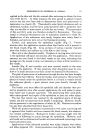
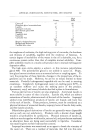
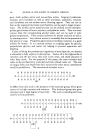
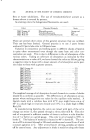
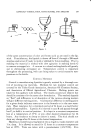
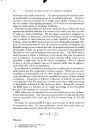
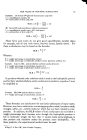
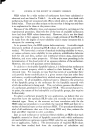
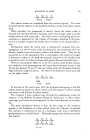
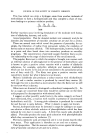
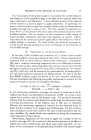
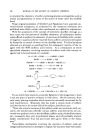
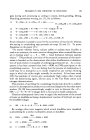
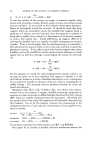
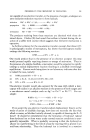
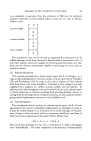
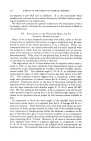
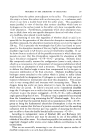
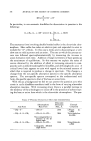
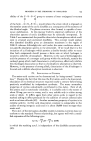
RANCIDITY IN SOAPS 279 11 10 i 9 8 --CH2--CH--CH--CH2-- Nonoic i Azelaic The carbon atoms are numbered from the carboxyl group. The acids derived from the rupture at the double bond thus contain nine carbon atoms each. When rancidity has progressed in methyl oleate the iodine value is lowered and the false inference has been drawn that oxygen adds on at the double bond to form a peroxide. The iodine value is misleading and if saturation is measured by the volume of hydrogen absorbed in the pres- ence of a suitable catalyst the double bond is shown to be substantially in- tact. Furthermore when the rancid ester is disruptively oxidised with per- manganate not two but four acids are produced, two monobasic and two dibasic, namely octoic and nonoic, suberic and azelaic acids. They can be accounted for on the assumption that in autoxidation the attack by oxygen is directed to either of the methylene groups adjacent to the double bond at atoms 8 and 1 ] and that hydroperoxide groups become attached there. With the autoxidation effective at the 11th carbon atom further disrup- tive oxidation with permanganate will cause fission between atoms 9 and 10 and also between 10 and 11 and one carbon atom will disappear from the high molecular weight products. On the left we shall have octoic acid and on the right, azelaic. 11 10i 9 8 --CH--CH--CH--CH2-- I : OOH Octoic Azelaic In the part of the rancid ester with the hydroperoxide group at the 8th carbon atom the products will be nonoic acid (monobasic 9 carbon atoms) and suberic acid (dibasic 8 carbon atoms). The evidence I have outlined was provided by publications under the auspices of the Rubber Producers Research Association in 1942, twelve years ago, and forms the starting point for the newer theories of rancidity (1). The most satisfactory theory is that the first stage of the oxidation process is the formation of a free radical under the influence of residual free radicals or radiation, by loss of a hydrogen atom from a methylene group adjacent to a double bond. Molecular oxygen then forms a l•eroxidic free radical. 11 10 9 8 --CH•CH--CH--CH•-- Ill 10 9 8 --CH--CH•-CH--CH•-- • ß .

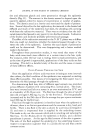
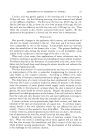
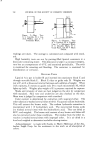
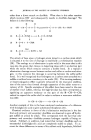
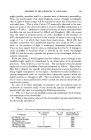
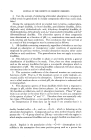
280 JOURNAL OF THE SOCIETY OF COSMETIC CHEMISTS This free radical can strip a hydrogen atom from another molecule of methyloleate to form a hydroperoxide and thus complete a chain of reac- tions leading to a primary oxidation product. 11 10 9 8 --CH--CH=CH--CH2-- I OOH Further reactions occur involving breakdown of the molecule with forma- tion of aldehydes, ketones, and acids. Second proposition: That the chemical methods now commonly used for the detection and measurement of rancidity constitute an art and not a science. There are several tests which reveal the presence of peroxides, for ex- ample, the liberation of iodine from potassium iodide, the oxidation of ferrous salts or stannous chloride. The hydroperoxides, however, build up to a point and then break down into secondary products as rancidity progresses. The concentration of peroxide oxygen therefore bears no pre- cise relationship to the stage of deterioration of the rancid material. The popular Kreis test in which the sample is brought into contact with an ethereal solution of phloroglucinol in the presence of hydrochloric acid is known to give a positive colour reaction with a number of aldehydic substances, for example, epihydrin aldehyde and malonic dialdehyde which are not known to be and are not considered to be autoxidation prod- ucts of fatty acids (2). The Kreis test gives a positive reaction with rancid fatty matter but what it detects is not known. Malonic dialdehyde also produces a colour reaction with thiobarbituric acid (3) and a similar reaction is produced by rancid fatty matter (4). Although this test is described as more sensitive than the Kreis test we still do not know what it denotes. Other tests are directed to distinguish a-dicarbonyl compounds (5). So tar as soaps are concerned these tests would be carried out on the fatty acids prepared by decomposition with mineral acids. I suggest as other possibly useful tests in the same category as those I have mentioned, first, a reaction with vanillin in presence of concentrated hydrochloric acid (6). A strong pink coloration is produced by a rancid fat and the test is quite delicate. What it detects is again not known. Second, hydroperoxides may be detected in soaps by adding to an aque- ous solution a dilute alcoholic solution of phenolphthalein which has been reduced by zinc dust in caustic soda. A little free caustic soda should be added. Peroxides produce the usual pink coloration with phenolphthalein which they reconstitute by oxidation (7). The tests commonly used are empirical and it is not known exactly what they mean. Their application is therefore an art and not a science. Third proposition: That the measures adopted to ensure against the develop- ment of rancidity constitute an art and not a science,
Purchased for the exclusive use of nofirst nolast (unknown)
From: SCC Media Library & Resource Center (library.scconline.org)