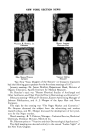
NEW YORK SECTION NEWS WARREN B. DENNIS, JR. Chairman HARRY ISACOFF Chairman-Elect MRs. MARIA WIENER VINCENT DEFEO Secretary Treasurer THE NEW YORK Chapter of the SOCIETY OF COSMETIC CHEMISTS had the following guest speakers for the first three meetings of 1957: January meeting--Dr. James Dutcher, Department Head, Division of Organic Chemistry, Squibb Institute for Medical Research. Dr. Dutcher's topic was "Recent Chemical Studies of Antifungal and Other Antibiotics and Their Potential Use in Dermatology and Cosmetics." February meeting--William P. Grayson, Eastern Advertising Manager of Johnson Publications, and A. J. Morgan of the Apex Hair and News Company. The topic for the evening was "The Negro Market and Cosmetics." Mr. Grayson discussed the subject from the advertising and market research phase, and Mr. Morgan discussed the development of hair prod- ucts for the Negro market. March meeting--B. T. Palermo, Manager--Technical Service, Medicinal Chemicals, Chemical Division, Merck & Co. Mr. Palermo spoke on "Vitamins and their Dermatological Applications." The April meeting was devoted entirely to the annual "Ladies Night" of the New York Chapter. 178

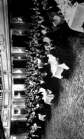
THE BRITISH SOCIETY OF COSMETIC CHEMISTS TI• A•u^L DI•R D^•c• was held on January 18th at the Caf• Royal, Regent Street, London. Sir Eric Rideal, M.B.E., F.R.S., Chairman of the Advisory Council on Scientific Research and Technical Development to the Minister of Supply and President of the forthcoming Second International Congress of Surface Activity, was guest of Honor. Other guests included T. G. Hendy, chair- man of the Toilet Preparations Federation, Trat Mikkelsen, founder member of the Danish Society of Cosmetic Chemists and the five candidates for the Society's Diploma which allowed them to enter the Society as Associate Members. The third winter meeting was addressed by Dr. J. H. Schulman, O.B.E., Reader in Surface Chemistry at the University of Cambridge, on the sub- ject of "The Behavior of Proteins at Interfaces." The study presented the phenomena observed when dilute solutions of proteins are injected below monolayers formed by lipids, such as detergents on a water surface in a modified Langmuir trough. The lecture provided information of great import to the cosmetic chemists. Dr. H. W. Hibbott, A.R.I.C., gave the fourth lecture on the subject of "Particle Size in Powders." The powdered materials supplied to the cosmetic industry were shown to have their characteristic ranges of particle size, and grinding before use was designed to break up agglomerates of fine particles in other words, to mix rather than to grind. The im- portant effects of aggregation were demonstrated by experiments in which a suspension of fine chalk in water separated much more rapidly than a suspension in alcohol and conversely a suspension of titanium dioxide in alcohol separated in a few minutes as compared with several days for a suspension in water. The application of Stokes Law to these cases would lead to conflicting testimony. In case of conflict the lowest value offered is accepted as the most probable. In the light of such experiments the methods of measurement of particle size and of separation were very criti- cally examined by Dr. Hibbott. At the fifth meeting held at the Royal Society of Arts, I. Greenfield, B.Sc., A.R.I.C., gave a well-illustrated lecture on "Polyvinylpyrrolidone, Its Manufacture, Properties and Use in Cosmetics." The organic chemist had presented us with an exceptional achievement in converting the un- promising raw materials limestone, coke, water and air into a substance 179
Purchased for the exclusive use of nofirst nolast (unknown)
From: SCC Media Library & Resource Center (library.scconline.org)