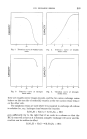
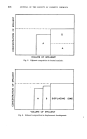
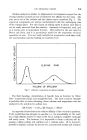
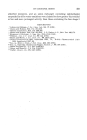
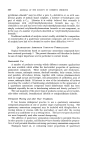
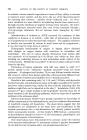
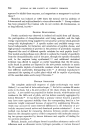
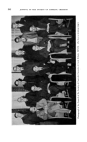
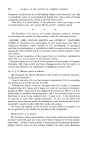
in the sodium form which takes up the streptomycin and allows everything else to pass, through. The streptomycin is •then eluted: from. the column with dilute HC1 or dilute sulphuric acid to give streptomycin hydrochloride or sulphate respectively. The separation of ions is carried out by taking advantage of the different affinities of the various ions for the resin. This technique is used a great deal in chemical analysis, mainly in the analysis of inorganic substances since these are more frequently ionised than organic substances. However, organic acids and bases can be separated by using the appropriate resin. This is the principle of ion exchange chromatography. Perhaps the single field in which the most work has b•een carried out is that of amino acids. Some extremely elegant separations of amino acid mixtures containing as many as 50. amino acids have been carried out by Moore and Stein 9 in the U.S.A. and by Partridge •ø in this country. Generally a resin is used of finer particle size than that for ordinary simple ion exchange procedures where 16-50 mesh particles are. normal, and although sometimes 100-200 mesh material is used, most commonly it is less than 200 mesh. This is essential because only by the use of such fine particles combined with low flow rates can the near-equilibrium conditions be attained that are so essential to the production of sharp boundaries. Any of the techniques of frontal analysis, displacement development or elution can be used, just as in conventional chromatography on, say, alumina. In frontal analysis the solution containing the ions to be separated is flowed continuously through the column of resin, the ions of higher affinity displacing those of lower after an initial period in which all the ions are taken up--see Fig. 5. Only the. ion of lowest affinity A + is .obtair•ed pure, and in consequence the method is only used when one component (and that having the lowest affinity) is required 'pure. An example of its use is in the separa- tion of a weak and a strong acid, e.g., • acetic and hydrochloric, on a weakly basic resin. In displacement development the mixture of ions to be separated is absorbed'as a band at the top of the column. A displacing solution is then flowed through the column, this solution containing an exchanging ion that has a higher affinity for the resin than any component of the original rpixture. The ions ultimately move down and out of the column in the order of their increasing affinities, that •with the least affinity appearing firstwsee Fig. 6. This is the method used by Partridge. Its advantages are that the separated ions can be obtained in high concentration, and loadings as high as 50 per cent of the total capacity of the column can be used (i.e. the band extends half-way down the column). It can, accordingly, be used as • preparative method.

218 JOURNAL OF THE SOCIETY OF COSMETIC CHEMISTS z A VOLUME OF EFFLUENT Fig. 5. Efliuent composition in frontal analysis. 1.1_ 1.1_ w VOLUME OF EFFLUENT Fig. 6. E•uent composition in displacement development. DISPLACING IONS
Purchased for the exclusive use of nofirst nolast (unknown)
From: SCC Media Library & Resource Center (library.scconline.org)