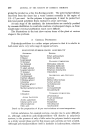
•o• •XCI•A•G• R•S•S 215 resin merely swells when the dry substance is placed in water. If the degree of cross linking is too low a further change in volume will occur during the exchange of one ion for another if the cross linking is too high the exchange of ions becomes undesirably slow. In practice sufficient cross linking is used to strike a balance between these two opposing effects. Ion exchange in resins is not merely a surface phenomenon and the whole of the•particles is available for exchange, the exchanging ions being able to travel to the centres of the particles in a comparatively short time. The ions reach the centre by moving along the water-filled pores of the resin and these pores are of molecular dimensions, generally between about 5 and 15 •k diameter according to the resin. Ions larger than this cannot pass down the pores and a limited exchange capacity is observed with such ions. In fact, this can be exploited to separate small ions from large ones. The position of equilibrium is determined by the "affinities" for the resin of each of the two ions taking part in the exchange. For instance, in the exchange between H + on a strongly acidic resin with Na + in solution the equilibrium lies rather more than half-way to tb.e right, indicating that the sodium /on has a slightly higher affinity for the resin than the hydrogen ion. By measuring the position of equilibrium reached with a resin in some standard ionic form--the hydrogen form, for example--and solutions con- taining a series of salts with other cations, a table of affinities can be con- structed. Similarly, by taking an anion exchange resin in, say, the chloride form, an• allowing it to come to equilibrium with a series of salts containing ott•er anions, a table of affinities for anion exchange can be obtained. The order of affinities of some cations from 0-1N chloride solution for a phenol sulphonate resin* is: Hg ++ Li + H + Na + K+= NH4 + Cd ++ Ag+(NOa) Mn++ Mg++: Zn ++ Cu++ _• Ni++ Co ++ Ca ++ • Sr ++ Pb++(NO•) Ba ++ A1 +++ Th++++(NO•). The order of affinities of some anions for a quaternary ammonium anion exchange resin• is: Fluoride = hydroxide acetate formate bicarbonate chloride nitrite bisulphite cyanide bromide nitrate bisulphate iodide salicylate. As already mentioned, a weakly basic anion exchange resin in the free base form will not take up anions appreciably from neutral salts but only from free acids. The affinities under these circumstances will be largely determined by the strength of the acid (as measured by its, dissociation constant) and its basicity, and the order of affinities of a few acids for a resin of this type is HC1 = HNO• H•SO• H•P04, and benzoic oxalic formic acetic: citric salicylic. If the resin is converted to an

216 JOURNAL OF THE SOCIETY OF COSMETIC CHEMISTS ionic from other than the free base form, say the chloride form, the order of affinities is different',: fluoride chloride bromide •- iodide---- .acetate phosphate nitrate tartrate citrate chromate ,, sulphate hydroxide .... • APPLICATIONS The applications of the materials can be broadly listed under three headings: (1) Complete removal of ions from a solution: ,(a) 'undesirab!e ions from a valuable solution , (b) valuable' iohs from an otherwise valueless • Solution. I• I Separation and concentr•hon of electrolytes. Substitution of specific ions it/solution by other ions: Removal of undesirable •ions, from a valuable solution can be achieved comparatively simply if the valuable substance is not itself to, ken up by the exchanger, as will be the case if it is non-ionic or it is present.as a com- plex or if it is ionised but is too large to pass down the resin pores. • For the complete. removal of electrolytes from •a solution the demi•neralisation technique, using first a hydrogen exchanger and then an union exchanger to remove the acids so .formed, would be used. Alternatively,, the,mixed bed technique can be used, in which the cation and union exchangers are, mixed together and the solution to be demineralised.is .flowed through• a single column _of the mixture. Examples are the removal of electrolytes ,from sugar solutions, from glycerine solutions and from solutions of other non- ionised organic substances. Mercuri c .chloride is largely unionised in solution and impurities can be remove, d by passing the solution through a hydrogen exchanger• which .scarcely affects the mercury salt. The mixed bed technique is also useful for removing all the/suits pres•ent in tap water, and water conforming to the B.P. standard for distilled water can be obtained in this way. Indeed, in the latest edition of the Pharma- copoeia the previous item "distilled water" has now been' amended to "purified water," and this includes water produced from a mixed bed of ion exchange resinss., The removal of valuable' ions from an otherwise valueless solution can be carried out by using the appropriate resin which is chosen such that the valuable ions are taken up by the resin and the impurities pass through. On regenerating or eluting the resin' the cation resin with acid and the anionresinwith alkali--the valuable ions appear in the reienerant effluents in concentrated form and can be recovered, for example, by, a suitable chemical method. An example of this,is,the recovery of streptomycin on a carboxylic resia. The mould that produces st•reptomycin is grown in a nutrient. salt solution in the presence of air, and ,when it has finished its work it,is filtered off from the solution, which now contains th e streptomycin along with the inorganic nutrient salts. ,.This solution is passed. through a car•boxylic resin
Purchased for the exclusive use of nofirst nolast (unknown)
From: SCC Media Library & Resource Center (library.scconline.org)