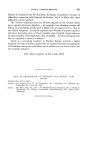
THE DEVELOPMENT OF GAS CHROMATOGRAPHY 271 both at home and in the laboratory. He went to school in London, and thence to the University of Cambridge for both his baccalaureate and Ph.D. degrees. Somewhere during this period his natural bent for mathematics and physical chemistry developed. He majored in biochemistry, and he is also an expert and imaginative theoriser. In fact, one of the remarkable things about Martin is that he is so gifted in thinking in theoretical terms and at the same time he is so skilful in the shop and the laboratory. In summarising the research which has led to the award to-day, and in turning to the career of A. T. James, I need to take you back briefly before the year 1949, when the collaboration of James and Martin began, and speak of the campus of the University of Cambridge in the late 1930's. At that time two graduate students on the campus happened to pool their resources to solve a common problem. A. J. P. Martin and R. L. M. Synge joined efforts on a project concerned with the separation of acetyl-amino acids by liquid-liquid extraction. After graduation, they both went together to take their first jobs with the British Wool Industries Research Laboratory in Leeds, and continued their collaboration 'there. In the course of several very fruitful years they hit upon the idea of carrying out liquid-liquid extraction using a gel to support one of the phases. They thus introduced chromato- graphic columns in which fractionation could be achieved by virtue of the different distribution coefficients of solutes between a mobile phase and a stationary liquid or gel-lik'e phase. When the support for the stationary phase was cellulose in the form of sheets of paper, the ingenious method of paper chromatography was born, and I think that you all know that within a few years the method of paper chromatography described by Consden, Gordon and Martin became the most widely used separation technique in biochemistry. Adsorption chromatography had been widely used before for the separation of pigments and sterois, but Martin and Synge's concept of liquid-liquid chromatography rendered the chromato- graphic technique available for the separation of a host of water-soluble amino-acids, sugars, lower fatty acids, antibiotics, and other compounds of partidular interest in biochemistry and medicine. Within remarkably few years the technique received the recognition which it well deserved when Martin and Synge were awarded the Nobel Prize in 1952. But there was more to come. In Martin and Synge's initial papers in about 1940 they suggested that, in addition to using two liquid phases, a chromatogram could be operated with a gas phase and a liquid phase, and that this arrangement would have ad•vantages for the separation of volatile compounds. In the meantime, there were changes in jobs and interests, and this aspect of the subject did not receive attention immediately. Martin moved from Leeds to a position with the Boots Pure Drug Co., and Synge to the i.ister Institute in London. Martin then moved to the Lister at about the

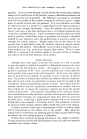
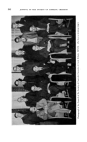
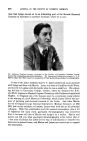
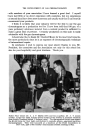
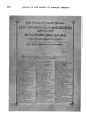
272 JOURNAL OF THE SOCIETY OF COSMETIC CHEMISTS time that Synge moved on to an interesting post at the Rowett Research Institute in Aberdeen in northern Scotland, where he is now. Dr. Anthony Trafford James--recipient of the Society of Cosmetic Chemists Specia Award for outstanding scientific literature. Dr. James and Nobel prize winner A. J. P. Martin share the 1 •57 Award in recognition of their publications on gas chromatography. It was at the Lister Institute that A. T. James started out as an associate with Synge and then with Martin. James was born in Cardiff in South Wales, and moved to London with his family when he was a small boy. His school- ing led him to University College, London, where he obtained the B.Sc. and Ph.D. degrees in Physical Organic Chemistry with Professors Ingold and Hughes. In England one of the honours open to a promising young scholar is the winning of a Beit Memorial Fellowship, which James did for the pur- pose of pursuing post-doctoral research at the Lister. And when Martin moved to England's large National Institute for Medical Research at Mill Hill, just on the outskirts of London, James went with him as his principal colleague. With this combination and this research atmosphere, plus a lot of ingenious but hard work, gas-liquid chromatography was converted from a ten-year-old idea of Martin and Synge's to a reality. Martin and James can tell you what gas-liquid chromatography is far better than I --but your Chairman has asked me by way of introduction to describe the discovery in general terms, and Martin and James can correct me or expand the description.
Purchased for the exclusive use of nofirst nolast (unknown)
From: SCC Media Library & Resource Center (library.scconline.org)