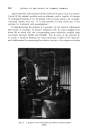
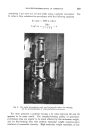
THE DEVELOPMENT OF GAS CHROMATOGRAPHY 273 We are all familiar with the extraction of organic compounds from aqueous solution by ether. Gas-liquid chromatography operates on the principle of repeated extractions in which the two phases are a gas and a liquid instead of two liquids. A tube is packed with particles of an absorbent solid which holds a high boiling liquid as the stationary phase. For example, a sample of hydrocarbons to be separated is introduced at one end in vaporised form in a stream of nitrogen. The individual hydrocarbons are extracted from the gas phase in differing proportions depending upon their individual distribution coefficients between the two phases. The rates of travel of the constituents of the mixture down the tube are a function of these distribution coefficients. A spatial separation of the components is thus achieved as in other forms of chromatography, and the individual compounds are detected by measuring devices placed across the stream of nitrogen emerging from the delivery end of the tube. A key part of the equipment is the measuring device, and Martin and James have invented a gas-density balance that is more sensitive than any of the hot-wire analysers which, however, serve many commercial purposes. The speed of the method is remarkable. Many analyses of complex mixtures are complete in 30 minutes. In this manner volatile compounds can be separated far more effectively than by simple fractional distillation, and gas-liquid chromatography is rendering obsolete, for many analytical purposes, the method of fractional distillation which we learned in school. If you pick up a current copy of almost any journal of analytical chemis- try you will find advertisements of machines for gas chromatography by the method of Martin and James. One of the largest markets is, of course, in the petroleum industry, where the method has revolutionised the analysis of gasoline and other hydrocarbon fuels. Martin and James worked the procedure out first for amines and for the esters of fatty acids, which are examples of only two of the many types of organic compounds that can be handled. Many of these are of biochemical importance, and it is in part the interest in the determination of organic acids in and on the skin that has attracted the interest of your Society in this method, together with the application to the analysis and preparation of perfumes. Dr. James, as a member of the staff of the National Institute for Medical Research in London, is currently visiting the Rockefeller Institute here in New York. He came over at the special invitation of Dr. E. H. Ahrens, Jr., to set up the method for the study of fatty acids in human metabolism. He brought over equipment which Martin himself had made in London, and James has us watching in admiration as the automatic recorder runs off beautiful analyses in a matter of minutes. Martin flew over yesterday for this occasion at your invitation. He is now a free-lance consultant who has a laboratory and shop set up as a part of his house near London. At the age of eight he was making things in his

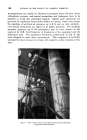
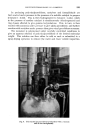
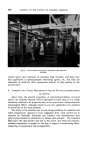
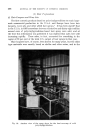
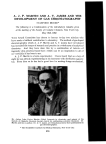
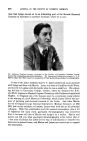
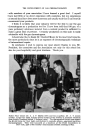
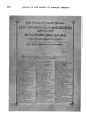
274 JOURNAL OF THE SOCIETY OF COSMETIC CHEMISTS basement--in his forties he is still making things in his basement, but with a remarkable career of accomplishment behind him, with a host of friends among his contemporaries, and he is still full of new ideas. This, then, is a brief history of the men who I am very happy to see you honouring to-day--Dr. Archer Martin and Dr. Anthony James. The President of the Society of Cosmetic Chemists, Subbat J. Strianse, in presenting the awards (see illustration), made the following citation: , "ARCHER JOHN PORTER MARTIN and ANTHONY TRAFFORD JAMES, i• recognition and appreciation of your pione•ering in the field of analytical chemistry, which resulted in the development of gas-liquid partition chromatography, a contribution which has opened new avenues of approach to the problems which are common to the cosmetic research worker and analyst . . . "and in special recognition of the papers that you both have publi hed to make this new tool available to all chemical workers... "I hereby present you, on behalf of the members of the Society of Cosmetic Chemists, with these scrolls and these cheques awarded by the Society to reward and stimulate the publication of significant research work." Dr. A. J.P. Martin replied as follows: Mr. President, Dr. Moore, Members of the Society of Cosmetic Chemists, Ladies and Gentlemen: I hope I can convey to you the pleasure and gratitude I feel in accepting the Special Award of the Society for 1957. Nothing was further from our thoughts than the Society of Cosmetic Chemists when Dr. James and I began.our work on Gas-Liquid,Chromato- graphy in 1950. Synge and I had suggested the method in 1941 in our first publication on partition chromatography, and I was surprised that no one had taken it up as I was confident that it would work. I had myself had no occasion to work with volatile substances. In fact, it took James and myself no more than six weeks to establish the basic conditions and obtain practically valuable results with fatty acids and amines. We know the method is now of value to many fields of chemistry but we are grateful to the Society for this first public recognition. Reply by Dr. A. T. James: Mr. President, ladies and gentlemen, I am deeply conscious of the honour you have conferred upon me to-day and I wish to thank you for this munifi- cent award. At first, I must confess, I was puzzled at the uses gas chromato- graphy could be put to in the cosmetic industry but after some discussion
Purchased for the exclusive use of nofirst nolast (unknown)
From: SCC Media Library & Resource Center (library.scconline.org)