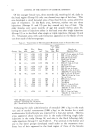
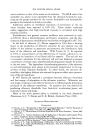
ALOPECIA AND CUTANEOUS ULCERATION IN RATS 333 given the male sex hormone (Group 18) and one had a similar effect from treatment on the side (Group 19). Two others in this group had thinning of fur about the injection sites. These results indicate that such short treatment with sex hormones do not appreciably alter the usual results with methoxamine hydrochloride although they suggest that the male hormone may possibly increase the activity of the drug in females. TABLE 2.--INJECTIONS OF METHOXAMINE HYDROCHLORIDE INTO RATS RECEIVING ESTRADIOL OR METHYL TESTOSTERONE -- Days lnjec- of tions Results at Age, Wt., Dose, Injec- per Injection Group Sex mos. gm. ml. Site tion Day Sites 16 M 8 350 0.25 Hd 4 1 HA* 2 cm. in 5 rats Sc.•- on 2 rats 17 M 8 350 0.25 F1 4 3 HA 1-3 cm. in 5 rats Sc. on 1 rat 18 F 41/4 200 0.1 Hd 4 1 Thin F{ 1 X 1 cm. in 3 rats 19 F 41/4 200 0.1 F1 4 3 HA 1 X 2 cm. in 1 rat Thin F in 2 rats * HA Hairless areas, cm. across. •- Sc.--Small scabs at sites of injections. :[ Thin F--Thinning fur, cm. across. TABLE 3.--INJECTIONS OF MF•THOXAMINE HYDROCHI,ORIDE SUSPENDED IN PEANUT OIL Days Injec- of tions Results at Age, Wt., Dose, Injec- per Injection Group Sex mos. gm. ml. Site tion Day Sites 20 M 61/2 350 0.25 Hd 9 1 HA* 0.5-1 cm. in 5 rats (Oil depots re- mained for weeks) 21 F 101/,2 230 0.25 Hd 9 1 HA 1-1.5 cm. in 4 rats Thin Ft 1 X 1.5 cm. in 1 rat (Oil depots remained for weeks) 22 F 101/.2 230 0.25 FI 7 1 Ulcerations 2-3 cm. on 5 rats * HA--Hairless areas, cm. across. • Thin F--Thinning fur, cm. across.

334 JOURNAL OF THE SOCIETY OF COSMETIC CHEMISTS In order to prolong the activity of the sympathomimetic drug the methoxamine hydrochloride was administered as a 1 per cent suspension in a peanut oil vehicle once a day. Hairless areas developed in the head regions of all five males and in four of the females during nine days of treatment (Groups 20 and 21) (see Table 3). The remaining female had definite thinning of fur at the injection area. Animals injected with the oil alone showed no effects. When injected into the flank for only seven days all five female rats (Group 22) had large ulcerations at the sites of treatment. This suggested that gnawing or scratching due to local irritation may help produce such marked reactions especially on the sides (11) although it has been reported to be a direct ischemic effect in humans following infusion of metaraminol (6) or norepinephrine (3). The pilomotor effect of the methoxamine was prolonged by the use of the peanut oil vehicle for some twenty-four hours. The injected oil in the above rats and in control animals remained in pockets under the skin for many weeks except in the ulcerated areas. Discussion Although no general systemic effect on hair growth was obvious in the above rat studies as reported by Cockrein (4) in mice the localized impair- ment of hair growth was appreciable at the site of injection. From these results it seemed apparent that a vasoconstricting drug in relatively large doses given subcutaneously to adult male rats either once or three times daily interfered with hair growth in the head areas. Possibly because of better vascularity and massaging action of muscles three injections per day were required to produce denudation in the flank regions. The same results were observed in older females but were much less apparent in the younger ones. Estradiol had no effect on results with male rats but methyl testosterone may possibly have increased the loss of hair in females. Longer studies are deemed necessary (12). A peanut oil vehicle enhanced the sympathomimetic action by prolonging the release of the methoxamine and possibly increasing local irritation, especially in the flank areas. These data add evidence to the idea that impairment of circulation in the scalp areas of humans decreases hair growth as reported in post- operative pressure alopecia by Abel and Lewis (1) and by periods of stress described by Reinhold (13). The latter investigation suggested that extra amounts of sympathomimetic hormones, epinephrine or norepinephrine, over a period of time, could conceivably decrease blood flow and produce alopecia. A diminished capillary venous flow has been observed in such cases by Haddy, eta/. (9). Resultant edema although slight but con- tinuous could possibly lead to infiltration of connective tissue (10). Sulz- berger, eta/. (14), likewise have postulated an increase in alopecia in
Purchased for the exclusive use of nofirst nolast (unknown)
From: SCC Media Library & Resource Center (library.scconline.org)