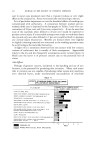
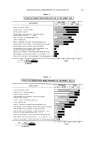
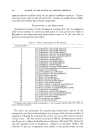
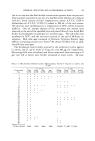
438 JOURNAL OF THE SOCIETY OF COSMETIC CHEMISTS factorial design (4) was used to screen the following factors at the indicated levels: Levels Order of addition o --• w w --• o Emulsifier location w o Emulsifier concentration, % 1 2.5 Proportion of water, % 90 50 30 Temperature, øC. 25 70 Agitation Propeller Homo-Mixer* * Trademark of Eppenbach, Inc. Each preparation factor was studied at two values or procedural conditions except the proportion of water, which was investigated at three levels. Although for each emulsifier-oil pair there are 96 combinations, only twelve separate experiments in this design are required to screen the importance of the six factors. The twelve methods are indicated in Table 1. TABLE 1--ExPERIMENTAL DESIGN OF EMULSION PREPARATIVE VARIABLES STUDY Method Order of Emulsifier Emulsifier Water, Temp., Agitation Number Addition Location Conc., % % øC. Method 1 o-w w 1 90 25 Propeller 2 w-o w 2.5 90 70 Propeller 3 o-w o 1 30 70 Propeller 4 w-o o 2.5 30 25 Propeller 5 o-w o 1 50 70 Propeller 6 w-o w 1 30 25 Homo-Mixer 7 o-w w 2.5 30 70 Homo-Mixer 8 w-o o 2.5 50 25 Propeller 9 o-w w 2.5 50 70 Homo-Mixer 10 w-o w 1 50 25 Homo-Mixer 11 w-o o 1 90 70 Homo-Mixer 12 o-w o 2.5 90 25 Homo-Mixer In the experimental design, as shown in Table 1, the experiments may be divided into three groups of four methods each according to the proportion of water used. Thus methods 1, 2, 11 and 12 utilize 90 per cent water, methods 5, 8, 9 and 10 utilize 50 per cent water and methods 3, 4, 6 and 7 employ 30 per cent water. Comparisons for each of the variables are made with two of these groups of four experiments at a time. For convenience, these combinations of groups are designated in this article by the quantity of water in the groups under comparison as 90-30 or 90-50. The nature of the present experimental design is such that valid comparisons may be made within the 90-30 groups and within the 90-50 groups. It was expected that the preparative variables studied might have differ- ent degrees of importance for different oils and surfactants. The chemical and physical nature of the nonaqueous liquids and the emulsifiers used in this investigation constitute additional, nonstatistical variation. The

STATISTICAL APPROACH TO COMMON VARIABLES 439 experimental design was applied to each combination of the following four nonaqueous liquids and thirteen surface-active agents. • Oils Surfactants Paraffinic mineral oil (Marcol GX) Cottonseed oil (Wesson oil) Oleic acid (Emery 233LL) Methylphenyl silicone (Dow Corning 710 Fluid) Cetylethylmorpholinium ethosulfate (G-263) Isopropylammoniumdodecyl benzenesulfonate (IPADBS) Polyoxyethylene (100) stearate (G-2159) Polyoxyethylene (8) stearate (Myrj 45) Polyoxyethylene (23) lauryl alcohol (Brij 35) Polyoxyethylene (15) nonyl phenol (Renex 678) Polyoxyethylene (20) sorbitan monostearate (Tween 60) Polyoxyethylene (20) sorbitan monooleate (Tween 80) Polyoxyethylene (5) sorbitan monooleate (Tween 81) Sorbitan monolaurate (Span 20) Sorbitan monostearate (Span 60) Sorbitan monooleate (Span 80) Sorbitan trioleate (Span 85) A trademark or other designation is stated in parentheses following the name of each oil and surfactant. Thus, with 12 methods for each emulsifier-substrate combination, 624 emulsion preparations were made. Their emulsion type and stability are the data reported in this study. It must be emphasized that the object of this investigation was not to determine the optimum methods for emul- sifying each oil under consideration but, rather, to determine the impor- tance of the preparative variables studied in influencing emulsion type and stability. EXPERIMENTAL In addition to the variables specified in the elements of the experimental design, the following general procedure was followed in the preparation of the emulsions. Distilled water and oils were measured by volume and emulsifier by weight. Relatively less vigorous agitation was obtained with a propeller, while more vigorous agitation was obtained with an Eppenbach Homo-Mixer which is an enclosed turbine type of stirrer. Glass apparatus was used throughout, except for the propeller shaft and blade and the Homo-Mixer. All of one phase was added to the other at one time, with agitation. Agitation, whether by propeller or by means of the Homo-Mixer, was continued for five minutes after addition was completed. In maki.ng emulsions at 70øC., both the water and the oil were previously brought to this temperature. Emulsion type was determined by the dilution tech- nique. Emulsion stability was observed in an Atlab viewer (6). Stability was evaluated initially approximately ten minutes after emulsion prepara- tion, after one day and after one week. RESULTS The stability of the emulsions formed was exlSressed on a numerical scale of 9 to 0, excellent stability being represented by 9. This qualitative
Purchased for the exclusive use of nofirst nolast (unknown)
From: SCC Media Library & Resource Center (library.scconline.org)